{"title":"A review of fuel cell cathode catalysts based on hollow porous materials for improving oxygen reduction performance†","authors":"Zexu Jia , Xiaoqiu Lin , Congju Li","doi":"10.1039/d4cy00830h","DOIUrl":null,"url":null,"abstract":"<div><div>Fuel cells are highly efficient green power generation devices that convert chemical energy into electricity. They have great potential for use in transportation, households, and power stations. The oxygen reduction reaction (ORR) represents a key electrochemical process in fuel cells, significantly impacting energy conversion efficiency. The limitations to further commercialization of fuel cells stem from several fundamental and technical issues, including the slow oxygen reduction reaction (ORR) at the cathode and the use of a large number of precious metal catalysts. This paper critically evaluates recent reports on material selection and structural optimization of catalysts, highlighting the successful strategies employed in these studies. Hollow porous catalysts are a highly cost-effective alternative to precious metal catalysts, owing to their significantly lower manufacturing costs and potential structural benefits. The potential for hollow porous materials to replace precious metal catalysts is indicated by their low cost, high specific surface area, potential structural advantages, and abundant surface defects. This text provides a comprehensive understanding of efficient catalyst design and fabrication by reviewing research results on hollow porous materials and structures applied to ORR electrocatalysis. The potential for the continued development of hollow porous catalysts in fuel cells is envisaged.</div></div>","PeriodicalId":66,"journal":{"name":"Catalysis Science & Technology","volume":"14 19","pages":"Pages 5505-5524"},"PeriodicalIF":4.2000,"publicationDate":"2024-09-30","publicationTypes":"Journal Article","fieldsOfStudy":null,"isOpenAccess":false,"openAccessPdf":"","citationCount":"0","resultStr":null,"platform":"Semanticscholar","paperid":null,"PeriodicalName":"Catalysis Science & Technology","FirstCategoryId":"92","ListUrlMain":"https://www.sciencedirect.com/org/science/article/pii/S2044475324004672","RegionNum":3,"RegionCategory":"化学","ArticlePicture":[],"TitleCN":null,"AbstractTextCN":null,"PMCID":null,"EPubDate":"2024/8/4 0:00:00","PubModel":"Epub","JCR":"Q2","JCRName":"CHEMISTRY, PHYSICAL","Score":null,"Total":0}
引用次数: 0
Abstract
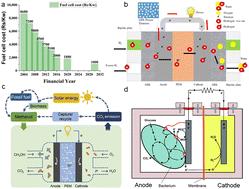
Fuel cells are highly efficient green power generation devices that convert chemical energy into electricity. They have great potential for use in transportation, households, and power stations. The oxygen reduction reaction (ORR) represents a key electrochemical process in fuel cells, significantly impacting energy conversion efficiency. The limitations to further commercialization of fuel cells stem from several fundamental and technical issues, including the slow oxygen reduction reaction (ORR) at the cathode and the use of a large number of precious metal catalysts. This paper critically evaluates recent reports on material selection and structural optimization of catalysts, highlighting the successful strategies employed in these studies. Hollow porous catalysts are a highly cost-effective alternative to precious metal catalysts, owing to their significantly lower manufacturing costs and potential structural benefits. The potential for hollow porous materials to replace precious metal catalysts is indicated by their low cost, high specific surface area, potential structural advantages, and abundant surface defects. This text provides a comprehensive understanding of efficient catalyst design and fabrication by reviewing research results on hollow porous materials and structures applied to ORR electrocatalysis. The potential for the continued development of hollow porous catalysts in fuel cells is envisaged.
期刊介绍:
A multidisciplinary journal focusing on cutting edge research across all fundamental science and technological aspects of catalysis.
Editor-in-chief: Bert Weckhuysen
Impact factor: 5.0
Time to first decision (peer reviewed only): 31 days



 京公网安备 11010802042870号
京ICP备2023020795号-1
京公网安备 11010802042870号
京ICP备2023020795号-1

 分享
分享
 求助内容:
求助内容: 应助结果提醒方式:
 扫码关注我们
