{"title":"Optimizing therapeutic efficacy of antifungal peptides via strategic terminal amino acid modification","authors":"Jing Song, Shanshan Zhang, Junya Xing, Licong Zhang, Jiajun Wang, Anshan Shan","doi":"10.1016/j.jare.2024.09.017","DOIUrl":null,"url":null,"abstract":"<div><h3>Introduction</h3><div>Antifungal peptides (AFPs) have the potential to treat antifungal-resistant infections; however, their structure–function relationship remains unknown, hindering their rapid development. Therefore, it is imperative to investigate and clarify the structure–function relationships of AFPs.</div></div><div><h3>Objectives</h3><div>This study aimed to investigate the impact of end-tagging single hydrophobic amino acids and capping the N-terminus with glycine (Gly) on the antifungal activity of peptide W4.</div></div><div><h3>Methods</h3><div>The antifungal efficacy of the engineered peptides was initially assessed by determining the minimum inhibitory concentration (MIC) /minimal fungicidal concentration (MFC), killing kinetics, and drug resistance induction, in addition to evaluating the biocompatibility and stability. Subsequently, the antifungal mechanism was investigated using fluorescence labeling, electron microscopy, reactive oxygen species (ROS) detection, and measurement of mitochondrial membrane potential and apoptosis. The impact of the engineered peptides on <em>Candida albicans</em> (<em>C. albicans</em>) biofilm and their potential application in the scratch keratomycosis model were investigated.</div></div><div><h3>Results</h3><div>The antifungal activity of W4 was significantly enhanced by capping Gly at the N-terminus, resulting in a decrease in average activity from 11.86 μM to 6.25 μM (GW4) and an increase in TI values by 1.9-fold (TI<sub>GW4</sub> = 40.99). Mechanistically, GW4 exerted its antifungal effect by disrupting the cellular membrane structure in <em>C. albicans</em>, forming pores and subsequent leakage of intracellular contents. Concurrently, it facilitated intracellular ROS accumulation while decreasing the mitochondrial membrane potential. Additionally, GW4 demonstrated an excellent ability to inhibit and eliminate biofilms of <em>C. albicans</em>. Notably, GW4 demonstrated significant therapeutic potential in a <em>C. albicans</em>-associated keratitis model.</div></div><div><h3>Conclusion</h3><div>Capping Gly at the N-terminus increased residue length while significantly enhancing the helical propensity of W4, thereby augmenting its antifungal activity. Our exploratory study demonstrated the potential strategies and avenues for optimizing the structure–function relationships of AFPs and developing highly effective antifungal drugs.</div></div>","PeriodicalId":14952,"journal":{"name":"Journal of Advanced Research","volume":"74 ","pages":"Pages 555-570"},"PeriodicalIF":13.0000,"publicationDate":"2024-09-23","publicationTypes":"Journal Article","fieldsOfStudy":null,"isOpenAccess":false,"openAccessPdf":"","citationCount":"0","resultStr":null,"platform":"Semanticscholar","paperid":null,"PeriodicalName":"Journal of Advanced Research","FirstCategoryId":"103","ListUrlMain":"https://www.sciencedirect.com/science/article/pii/S2090123224004168","RegionNum":1,"RegionCategory":"综合性期刊","ArticlePicture":[],"TitleCN":null,"AbstractTextCN":null,"PMCID":null,"EPubDate":"","PubModel":"","JCR":"Q1","JCRName":"MULTIDISCIPLINARY SCIENCES","Score":null,"Total":0}
引用次数: 0
Abstract
Introduction
Antifungal peptides (AFPs) have the potential to treat antifungal-resistant infections; however, their structure–function relationship remains unknown, hindering their rapid development. Therefore, it is imperative to investigate and clarify the structure–function relationships of AFPs.
Objectives
This study aimed to investigate the impact of end-tagging single hydrophobic amino acids and capping the N-terminus with glycine (Gly) on the antifungal activity of peptide W4.
Methods
The antifungal efficacy of the engineered peptides was initially assessed by determining the minimum inhibitory concentration (MIC) /minimal fungicidal concentration (MFC), killing kinetics, and drug resistance induction, in addition to evaluating the biocompatibility and stability. Subsequently, the antifungal mechanism was investigated using fluorescence labeling, electron microscopy, reactive oxygen species (ROS) detection, and measurement of mitochondrial membrane potential and apoptosis. The impact of the engineered peptides on Candida albicans (C. albicans) biofilm and their potential application in the scratch keratomycosis model were investigated.
Results
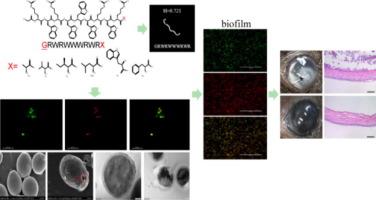
The antifungal activity of W4 was significantly enhanced by capping Gly at the N-terminus, resulting in a decrease in average activity from 11.86 μM to 6.25 μM (GW4) and an increase in TI values by 1.9-fold (TIGW4 = 40.99). Mechanistically, GW4 exerted its antifungal effect by disrupting the cellular membrane structure in C. albicans, forming pores and subsequent leakage of intracellular contents. Concurrently, it facilitated intracellular ROS accumulation while decreasing the mitochondrial membrane potential. Additionally, GW4 demonstrated an excellent ability to inhibit and eliminate biofilms of C. albicans. Notably, GW4 demonstrated significant therapeutic potential in a C. albicans-associated keratitis model.
Conclusion
Capping Gly at the N-terminus increased residue length while significantly enhancing the helical propensity of W4, thereby augmenting its antifungal activity. Our exploratory study demonstrated the potential strategies and avenues for optimizing the structure–function relationships of AFPs and developing highly effective antifungal drugs.
期刊介绍:
Journal of Advanced Research (J. Adv. Res.) is an applied/natural sciences, peer-reviewed journal that focuses on interdisciplinary research. The journal aims to contribute to applied research and knowledge worldwide through the publication of original and high-quality research articles in the fields of Medicine, Pharmaceutical Sciences, Dentistry, Physical Therapy, Veterinary Medicine, and Basic and Biological Sciences.
The following abstracting and indexing services cover the Journal of Advanced Research: PubMed/Medline, Essential Science Indicators, Web of Science, Scopus, PubMed Central, PubMed, Science Citation Index Expanded, Directory of Open Access Journals (DOAJ), and INSPEC.



 京公网安备 11010802042870号
京ICP备2023020795号-1
京公网安备 11010802042870号
京ICP备2023020795号-1

 分享
分享
 求助内容:
求助内容: 应助结果提醒方式:
 扫码关注我们
