{"title":"Selective and Orally Bioavailable c-Met PROTACs for the Treatment of c-Met-Addicted Cancer","authors":"Shilong Ying, Hongli Chi, Xiaoqiu Wu, Pingping Zeng, Jinling Chen, Ting Fu, Weitao Fu, Penghui Zhang, Weihong Tan","doi":"10.1021/acs.jmedchem.3c02417","DOIUrl":null,"url":null,"abstract":"c-Met is an attractive therapeutic target in multiple tumors. Previous studies have discovered some effective proteolysis-targeting chimeras (PROTACs) able to degrade c-Met; however, the structure–activity relationship (SAR), degradation selectivity, and pharmacokinetic profiles of c-Met PROTACs have, to date, remained largely unknown. Herein, through extensive SAR studies on various warheads, linkers, and E3 ligase ligands, a novel potent c-Met PROTAC <b>Met-DD4</b> was identified. Our results suggested that <b>Met-DD4</b> could induce robust c-Met degradation with excellent selectivity (DC<sub>50</sub> = 6.21 nM), substantially killing the c-Met-addicted cancer cells (IC<sub>50</sub> = 4.37 nM). Furthermore, in vivo studies showed that <b>Met-DD4</b> could achieve excellent oral bioavailability and c-Met degradation, strongly retarding tumor growth with minute organ toxicity. Overall, this study reveals that targeted degradation of c-Met is a promising strategy for the treatment of c-Met-addicted cancers and provides novel lead compounds for the clinical translation of c-Met PROTACs.","PeriodicalId":46,"journal":{"name":"Journal of Medicinal Chemistry","volume":"44 1","pages":""},"PeriodicalIF":6.8000,"publicationDate":"2024-09-30","publicationTypes":"Journal Article","fieldsOfStudy":null,"isOpenAccess":false,"openAccessPdf":"","citationCount":"0","resultStr":null,"platform":"Semanticscholar","paperid":null,"PeriodicalName":"Journal of Medicinal Chemistry","FirstCategoryId":"3","ListUrlMain":"https://doi.org/10.1021/acs.jmedchem.3c02417","RegionNum":1,"RegionCategory":"医学","ArticlePicture":[],"TitleCN":null,"AbstractTextCN":null,"PMCID":null,"EPubDate":"","PubModel":"","JCR":"Q1","JCRName":"CHEMISTRY, MEDICINAL","Score":null,"Total":0}
引用次数: 0
Abstract
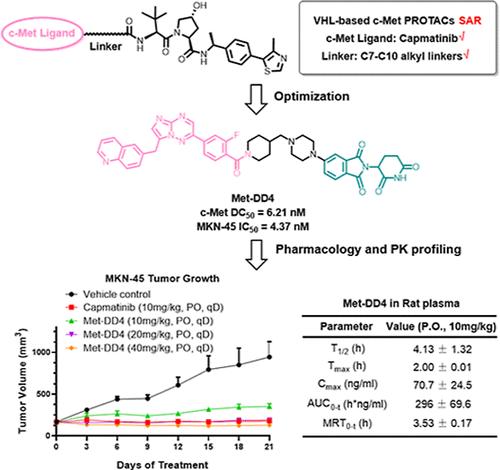
c-Met is an attractive therapeutic target in multiple tumors. Previous studies have discovered some effective proteolysis-targeting chimeras (PROTACs) able to degrade c-Met; however, the structure–activity relationship (SAR), degradation selectivity, and pharmacokinetic profiles of c-Met PROTACs have, to date, remained largely unknown. Herein, through extensive SAR studies on various warheads, linkers, and E3 ligase ligands, a novel potent c-Met PROTAC Met-DD4 was identified. Our results suggested that Met-DD4 could induce robust c-Met degradation with excellent selectivity (DC50 = 6.21 nM), substantially killing the c-Met-addicted cancer cells (IC50 = 4.37 nM). Furthermore, in vivo studies showed that Met-DD4 could achieve excellent oral bioavailability and c-Met degradation, strongly retarding tumor growth with minute organ toxicity. Overall, this study reveals that targeted degradation of c-Met is a promising strategy for the treatment of c-Met-addicted cancers and provides novel lead compounds for the clinical translation of c-Met PROTACs.
期刊介绍:
The Journal of Medicinal Chemistry is a prestigious biweekly peer-reviewed publication that focuses on the multifaceted field of medicinal chemistry. Since its inception in 1959 as the Journal of Medicinal and Pharmaceutical Chemistry, it has evolved to become a cornerstone in the dissemination of research findings related to the design, synthesis, and development of therapeutic agents.
The Journal of Medicinal Chemistry is recognized for its significant impact in the scientific community, as evidenced by its 2022 impact factor of 7.3. This metric reflects the journal's influence and the importance of its content in shaping the future of drug discovery and development. The journal serves as a vital resource for chemists, pharmacologists, and other researchers interested in the molecular mechanisms of drug action and the optimization of therapeutic compounds.



 京公网安备 11010802042870号
京ICP备2023020795号-1
京公网安备 11010802042870号
京ICP备2023020795号-1

 分享
分享
 求助内容:
求助内容: 应助结果提醒方式:
 扫码关注我们
