Sougata Mallick, Yanis Sassi, Nicholas Figueiredo Prestes, Sachin Krishnia, Fernando Gallego, Luis M. Vicente Arche, Thibaud Denneulin, Sophie Collin, Karim Bouzehouane, André Thiaville, Rafal E. Dunin-Borkowski, Vincent Jeudy, Albert Fert, Nicolas Reyren, Vincent Cros
{"title":"Driving skyrmions in flow regime in synthetic ferrimagnets","authors":"Sougata Mallick, Yanis Sassi, Nicholas Figueiredo Prestes, Sachin Krishnia, Fernando Gallego, Luis M. Vicente Arche, Thibaud Denneulin, Sophie Collin, Karim Bouzehouane, André Thiaville, Rafal E. Dunin-Borkowski, Vincent Jeudy, Albert Fert, Nicolas Reyren, Vincent Cros","doi":"10.1038/s41467-024-52210-y","DOIUrl":null,"url":null,"abstract":"<p>The last decade has seen significant improvements in our understanding of skyrmions current induced dynamics, along with their room temperature stabilization, however, the impact of local material inhomogeneities still remains an issue that impedes reaching the regime of steady state motion of these spin textures. Here, we study the spin-torque driven motion of skyrmions in synthetic ferrimagnetic multilayers with the aim of achieving high mobility and reduced skyrmion Hall effect. We consider Pt|Co|Tb multilayers of various thicknesses with antiferromagnetic coupling between the Co and Tb magnetization. The increase of Tb thickness in the multilayers reduces the total magnetic moment and increases the spin-orbit torques allowing to reach velocities up to 400 ms<sup>−1</sup> for skyrmions with diameters of about 160 nm. We demonstrate that due to reduced skyrmion Hall effect combined with the edge repulsion of the magnetic track, the skyrmions move along the track without any transverse deflection. Further, by comparing the field-induced domain wall motion and current-induced skyrmion motion, we demonstrate that the skyrmions at the largest current densities present all the characteristics of a dynamical flow regime.</p>","PeriodicalId":19066,"journal":{"name":"Nature Communications","volume":"40 1","pages":""},"PeriodicalIF":15.7000,"publicationDate":"2024-10-01","publicationTypes":"Journal Article","fieldsOfStudy":null,"isOpenAccess":false,"openAccessPdf":"","citationCount":"0","resultStr":null,"platform":"Semanticscholar","paperid":null,"PeriodicalName":"Nature Communications","FirstCategoryId":"103","ListUrlMain":"https://doi.org/10.1038/s41467-024-52210-y","RegionNum":1,"RegionCategory":"综合性期刊","ArticlePicture":[],"TitleCN":null,"AbstractTextCN":null,"PMCID":null,"EPubDate":"","PubModel":"","JCR":"Q1","JCRName":"MULTIDISCIPLINARY SCIENCES","Score":null,"Total":0}
引用次数: 0
Abstract
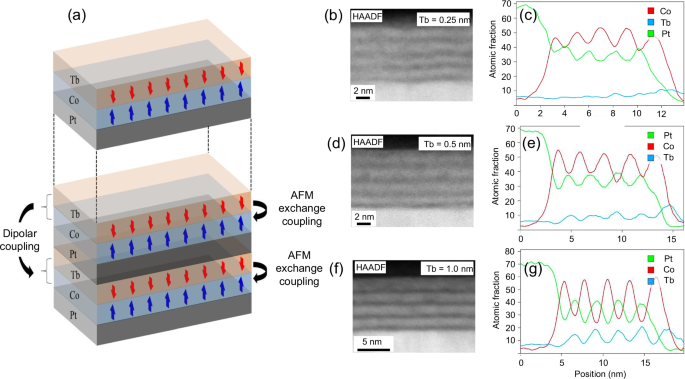
The last decade has seen significant improvements in our understanding of skyrmions current induced dynamics, along with their room temperature stabilization, however, the impact of local material inhomogeneities still remains an issue that impedes reaching the regime of steady state motion of these spin textures. Here, we study the spin-torque driven motion of skyrmions in synthetic ferrimagnetic multilayers with the aim of achieving high mobility and reduced skyrmion Hall effect. We consider Pt|Co|Tb multilayers of various thicknesses with antiferromagnetic coupling between the Co and Tb magnetization. The increase of Tb thickness in the multilayers reduces the total magnetic moment and increases the spin-orbit torques allowing to reach velocities up to 400 ms−1 for skyrmions with diameters of about 160 nm. We demonstrate that due to reduced skyrmion Hall effect combined with the edge repulsion of the magnetic track, the skyrmions move along the track without any transverse deflection. Further, by comparing the field-induced domain wall motion and current-induced skyrmion motion, we demonstrate that the skyrmions at the largest current densities present all the characteristics of a dynamical flow regime.
期刊介绍:
Nature Communications, an open-access journal, publishes high-quality research spanning all areas of the natural sciences. Papers featured in the journal showcase significant advances relevant to specialists in each respective field. With a 2-year impact factor of 16.6 (2022) and a median time of 8 days from submission to the first editorial decision, Nature Communications is committed to rapid dissemination of research findings. As a multidisciplinary journal, it welcomes contributions from biological, health, physical, chemical, Earth, social, mathematical, applied, and engineering sciences, aiming to highlight important breakthroughs within each domain.



 京公网安备 11010802042870号
京ICP备2023020795号-1
京公网安备 11010802042870号
京ICP备2023020795号-1

 分享
分享
 求助内容:
求助内容: 应助结果提醒方式:
 扫码关注我们
