{"title":"Identification of the visual landmark pathway in the mammalian brain","authors":"Paul A. Dudchenko","doi":"10.1113/JP287506","DOIUrl":null,"url":null,"abstract":"<p>A central question in neuroscience is how the mammalian brain processes information from the outside world. In primates, visual information is conveyed to the cortex primarily via the lateral geniculate nucleus (LGN) of the thalamus, and secondarily through the superior colliculus. In rodents the converse is true: only a minority of retinal outputs project to the LGN, while 90% project to the superior colliculus (e.g. Ellis et al., <span>2016</span>). Thus, it has been unclear how visual information from the outside world, for example visual landmarks that rodents use for orientation and navigation, is processed in the rodent brain. The study by Street and Jeffery in this issue of <i>The Journal of Physiology</i>, however, now provides a compelling answer: visual landmark information travels via the LGN, even in rodents.</p><p>Street and Jeffery (<span>2024</span>) tested how visual landmark information is processed in the brain by using the head direction cell system. This system is composed of head direction cells, neurons which fire when the animal faces a specific direction within its environment. Different head direction cells encode different directions, such that the entire 360° surround of the animal is represented. Head direction cells are found in an interconnected set of brain structures stretching from the brainstem to the cortex.</p><p>A basic property of head direction cells (as well as other spatially tuned neurons, for example place cells in the hippocampus and grid cells in the entorhinal cortex) is that their spatial tuning is ‘anchored’ to salient visual landmarks in the environment (Taube et al., <span>1990</span>). This stimulus control is often demonstrated by recording these cells as a rodent explores a circular enclosure with a single, polarising, visual landmark affixed to the wall of the enclosure. When this landmark is shifted to a new position, the individual firing directions of head direction cells also shift by a corresponding amount (Fig. 1).</p><p>Street and Jeffery exploited this property of head direction cells to test the hypothesis that visual landmark information travels via the LGN–visual cortex pathway as opposed to the phylogenetically older, superior collicular pathway. They lesioned the LGN and subsequently recorded from head direction cells in the postsubiculum while the animal explored a circular enclosure. The enclosure was equipped with two visual landmarks – so called ‘cue cards’ – affixed to opposite sides of the enclosure walls. To test whether the head direction cells in animals with LGN lesions could ‘see’ these cards, the authors shifted the cue cards by varying amounts (± 45°, 90°, 135° or 180°). They also varied the discriminability of the two landmarks by having either identical landmarks (all white or all black), quite different landmarks (one white and one black), or landmarks that were weakly contrasting (one with a horizontal black stripe <i>vs</i>. one with a vertical black stripe).</p><p>The results were striking. For sham-lesioned, control animals, all landmarks exerted strong stimulus control over the directional firing of head direction cells. That is, the firing directions of these cells shifted by an amount that corresponded to the shift in the position of the visual landmarks. For LGN-lesioned animals, this stimulus control was not observed. Head direction cells in these animals showed weak anchoring to the high-contrast landmarks, and no anchoring to the more weakly contrasting landmarks. These results indicate that visual landmark information reaches the head direction cell system (in the postsubiculum) via the LGN, and not via the superior colliculus.</p><p>Consistent with the above impairment, the directional tuning of head direction cells in LGN-lesioned animals tended to drift during recording sessions, yielding tuning curves that were broader than those observed in sham-lesioned animals. The drift in firing directions observed in the LGN-lesioned animals occurred in the presence of salient visual landmarks, suggesting again that head direction cells in these animals had impaired access to visual landmark information.</p><p>These findings are intrinsically important, firstly as they provide a vital clue as to the pathway by which visual landmarks reach the head direction cell system. Secondly, they suggest that in both rodents and primates, visual landmarks are processed via the LGN as part of the retino-geniculo-striate pathway. Third, as in many important studies, these findings have broader implications: if visual landmark information reaches the head direction cell system via the LGN, it is likely that the same is true for visual landmark control over other spatial representations in the brain, such as place cells and grid cells. Finally, the task itself provides a simple and spontaneous way of probing the visual acuity of the animal, as head direction cells in control animals were sensitive to contrasting landmarks but could not distinguish between identical landmarks. The study of Street and Jeffery overall provides a key data point on how landmarks in the environment guide internal, spatial representations.</p>","PeriodicalId":50088,"journal":{"name":"Journal of Physiology-London","volume":"602 20","pages":"5133-5134"},"PeriodicalIF":4.4000,"publicationDate":"2024-09-25","publicationTypes":"Journal Article","fieldsOfStudy":null,"isOpenAccess":false,"openAccessPdf":"https://onlinelibrary.wiley.com/doi/epdf/10.1113/JP287506","citationCount":"0","resultStr":null,"platform":"Semanticscholar","paperid":null,"PeriodicalName":"Journal of Physiology-London","FirstCategoryId":"3","ListUrlMain":"https://physoc.onlinelibrary.wiley.com/doi/10.1113/JP287506","RegionNum":2,"RegionCategory":"医学","ArticlePicture":[],"TitleCN":null,"AbstractTextCN":null,"PMCID":null,"EPubDate":"","PubModel":"","JCR":"Q1","JCRName":"NEUROSCIENCES","Score":null,"Total":0}
引用次数: 0
Abstract
A central question in neuroscience is how the mammalian brain processes information from the outside world. In primates, visual information is conveyed to the cortex primarily via the lateral geniculate nucleus (LGN) of the thalamus, and secondarily through the superior colliculus. In rodents the converse is true: only a minority of retinal outputs project to the LGN, while 90% project to the superior colliculus (e.g. Ellis et al., 2016). Thus, it has been unclear how visual information from the outside world, for example visual landmarks that rodents use for orientation and navigation, is processed in the rodent brain. The study by Street and Jeffery in this issue of The Journal of Physiology, however, now provides a compelling answer: visual landmark information travels via the LGN, even in rodents.
Street and Jeffery (2024) tested how visual landmark information is processed in the brain by using the head direction cell system. This system is composed of head direction cells, neurons which fire when the animal faces a specific direction within its environment. Different head direction cells encode different directions, such that the entire 360° surround of the animal is represented. Head direction cells are found in an interconnected set of brain structures stretching from the brainstem to the cortex.
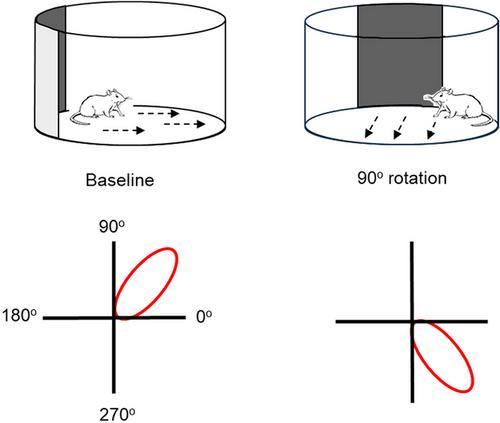
A basic property of head direction cells (as well as other spatially tuned neurons, for example place cells in the hippocampus and grid cells in the entorhinal cortex) is that their spatial tuning is ‘anchored’ to salient visual landmarks in the environment (Taube et al., 1990). This stimulus control is often demonstrated by recording these cells as a rodent explores a circular enclosure with a single, polarising, visual landmark affixed to the wall of the enclosure. When this landmark is shifted to a new position, the individual firing directions of head direction cells also shift by a corresponding amount (Fig. 1).
Street and Jeffery exploited this property of head direction cells to test the hypothesis that visual landmark information travels via the LGN–visual cortex pathway as opposed to the phylogenetically older, superior collicular pathway. They lesioned the LGN and subsequently recorded from head direction cells in the postsubiculum while the animal explored a circular enclosure. The enclosure was equipped with two visual landmarks – so called ‘cue cards’ – affixed to opposite sides of the enclosure walls. To test whether the head direction cells in animals with LGN lesions could ‘see’ these cards, the authors shifted the cue cards by varying amounts (± 45°, 90°, 135° or 180°). They also varied the discriminability of the two landmarks by having either identical landmarks (all white or all black), quite different landmarks (one white and one black), or landmarks that were weakly contrasting (one with a horizontal black stripe vs. one with a vertical black stripe).
The results were striking. For sham-lesioned, control animals, all landmarks exerted strong stimulus control over the directional firing of head direction cells. That is, the firing directions of these cells shifted by an amount that corresponded to the shift in the position of the visual landmarks. For LGN-lesioned animals, this stimulus control was not observed. Head direction cells in these animals showed weak anchoring to the high-contrast landmarks, and no anchoring to the more weakly contrasting landmarks. These results indicate that visual landmark information reaches the head direction cell system (in the postsubiculum) via the LGN, and not via the superior colliculus.
Consistent with the above impairment, the directional tuning of head direction cells in LGN-lesioned animals tended to drift during recording sessions, yielding tuning curves that were broader than those observed in sham-lesioned animals. The drift in firing directions observed in the LGN-lesioned animals occurred in the presence of salient visual landmarks, suggesting again that head direction cells in these animals had impaired access to visual landmark information.
These findings are intrinsically important, firstly as they provide a vital clue as to the pathway by which visual landmarks reach the head direction cell system. Secondly, they suggest that in both rodents and primates, visual landmarks are processed via the LGN as part of the retino-geniculo-striate pathway. Third, as in many important studies, these findings have broader implications: if visual landmark information reaches the head direction cell system via the LGN, it is likely that the same is true for visual landmark control over other spatial representations in the brain, such as place cells and grid cells. Finally, the task itself provides a simple and spontaneous way of probing the visual acuity of the animal, as head direction cells in control animals were sensitive to contrasting landmarks but could not distinguish between identical landmarks. The study of Street and Jeffery overall provides a key data point on how landmarks in the environment guide internal, spatial representations.
期刊介绍:
The Journal of Physiology publishes full-length original Research Papers and Techniques for Physiology, which are short papers aimed at disseminating new techniques for physiological research. Articles solicited by the Editorial Board include Perspectives, Symposium Reports and Topical Reviews, which highlight areas of special physiological interest. CrossTalk articles are short editorial-style invited articles framing a debate between experts in the field on controversial topics. Letters to the Editor and Journal Club articles are also published. All categories of papers are subjected to peer reivew.
The Journal of Physiology welcomes submitted research papers in all areas of physiology. Authors should present original work that illustrates new physiological principles or mechanisms. Papers on work at the molecular level, at the level of the cell membrane, single cells, tissues or organs and on systems physiology are all acceptable. Theoretical papers and papers that use computational models to further our understanding of physiological processes will be considered if based on experimentally derived data and if the hypothesis advanced is directly amenable to experimental testing. While emphasis is on human and mammalian physiology, work on lower vertebrate or invertebrate preparations may be suitable if it furthers the understanding of the functioning of other organisms including mammals.





 京公网安备 11010802042870号
京ICP备2023020795号-1
京公网安备 11010802042870号
京ICP备2023020795号-1

 分享
分享
 求助内容:
求助内容: 应助结果提醒方式:
 扫码关注我们
