{"title":"An Injection Molded SlipChip with Self-Sampling for Integrated Point-of-Care Testing of Human Papilloma Virus","authors":"Jiajie Zhang, Zhangli Dong, Lei Xu, Xu Han, Zheyi Sheng, Weiyu Chen, Jiayi Zheng, Dongmei Lai, Feng Shen","doi":"10.1002/advs.202406367","DOIUrl":null,"url":null,"abstract":"<p>High-risk human papillomavirus (HPV) screening is crucial for cervical cancer prevention. However, laboratory-based nucleic acid amplification tests (NAATs) require costly equipment, designated lab space, and skilled personnel. Additionally, cervical swabs collected by healthcare professionals can be inconvenient, uncomfortable, and reduce privacy, limiting broader application and patient compliance. A SlipChip-based Integrated Point-of-Care (SIPOC) system featuring an injection-molded SlipChip is presented with preloaded reagents for nucleic acid extraction and a portable four-channel real-time quantitative PCR instrument for detection. This system incorporates a self-sampling method that allows participants to collect their own vaginal swabs, with the β-Globin gene as a control. After testing 130 participants for HPV-16 and HPV-18, 97.7% of the self-collected samples are valid. Among valid samples, 25 tested positive for HPV-16 and 9 for HPV-18. Compared to Roche's standard HPV PCR test, the SIPOC system shows 100% positive predictive value (PPV) for both HPV-16 and HPV-18 and negative predictive values (NPVs) of 99.0% and 99.1%, respectively. This system is promising for HPV screening in resource-limited settings and adaptable for other point-of-care NAAT applications, including home testing.</p>","PeriodicalId":117,"journal":{"name":"Advanced Science","volume":"11 43","pages":""},"PeriodicalIF":14.1000,"publicationDate":"2024-09-25","publicationTypes":"Journal Article","fieldsOfStudy":null,"isOpenAccess":false,"openAccessPdf":"https://www.ncbi.nlm.nih.gov/pmc/articles/PMC11578293/pdf/","citationCount":"0","resultStr":null,"platform":"Semanticscholar","paperid":null,"PeriodicalName":"Advanced Science","FirstCategoryId":"88","ListUrlMain":"https://advanced.onlinelibrary.wiley.com/doi/10.1002/advs.202406367","RegionNum":1,"RegionCategory":"材料科学","ArticlePicture":[],"TitleCN":null,"AbstractTextCN":null,"PMCID":null,"EPubDate":"","PubModel":"","JCR":"Q1","JCRName":"CHEMISTRY, MULTIDISCIPLINARY","Score":null,"Total":0}
引用次数: 0
Abstract
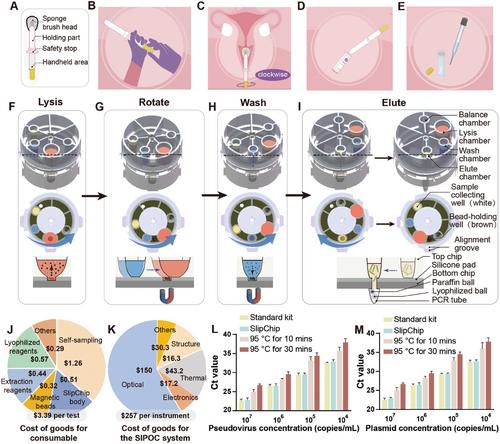
High-risk human papillomavirus (HPV) screening is crucial for cervical cancer prevention. However, laboratory-based nucleic acid amplification tests (NAATs) require costly equipment, designated lab space, and skilled personnel. Additionally, cervical swabs collected by healthcare professionals can be inconvenient, uncomfortable, and reduce privacy, limiting broader application and patient compliance. A SlipChip-based Integrated Point-of-Care (SIPOC) system featuring an injection-molded SlipChip is presented with preloaded reagents for nucleic acid extraction and a portable four-channel real-time quantitative PCR instrument for detection. This system incorporates a self-sampling method that allows participants to collect their own vaginal swabs, with the β-Globin gene as a control. After testing 130 participants for HPV-16 and HPV-18, 97.7% of the self-collected samples are valid. Among valid samples, 25 tested positive for HPV-16 and 9 for HPV-18. Compared to Roche's standard HPV PCR test, the SIPOC system shows 100% positive predictive value (PPV) for both HPV-16 and HPV-18 and negative predictive values (NPVs) of 99.0% and 99.1%, respectively. This system is promising for HPV screening in resource-limited settings and adaptable for other point-of-care NAAT applications, including home testing.
期刊介绍:
Advanced Science is a prestigious open access journal that focuses on interdisciplinary research in materials science, physics, chemistry, medical and life sciences, and engineering. The journal aims to promote cutting-edge research by employing a rigorous and impartial review process. It is committed to presenting research articles with the highest quality production standards, ensuring maximum accessibility of top scientific findings. With its vibrant and innovative publication platform, Advanced Science seeks to revolutionize the dissemination and organization of scientific knowledge.




 京公网安备 11010802042870号
京ICP备2023020795号-1
京公网安备 11010802042870号
京ICP备2023020795号-1

 分享
分享
 求助内容:
求助内容: 应助结果提醒方式:
 扫码关注我们
