{"title":"The spectrum of sickle cell disease","authors":"Barbara J. Bain","doi":"10.1002/ajh.27494","DOIUrl":null,"url":null,"abstract":"<p>The hemoglobin concentration (Hb) in sickle cell anemia is typically 60–100 g/L with the blood film (top left, all images May–Grünwald–Giemsa, ×100 objective) showing sickle cells boat-shaped cells, target cells, features of hyposplenism (Howell–Jolly bodies, Pappenheimer bodies, large platelets), nucleated red blood cells, polychromasia and sometimes irregularly contracted cells or linear fragments. Some compound heterozygous states, for example, SD (top center), have hematological features very similar to those of sickle cell anemia.<span><sup>1</sup></span> Others differ. Microcytosis and hypochromia are additional features in sickle cell/β thalassemia (top right). Sickle cell/hemoglobin C disease also differs. The Hb tends to be higher and the blood film may show distinctive SC poikilocytes when the crystallization of hemoglobin C and polymerization of hemoglobin S occur in the same cell<span><sup>2</sup></span>; hemoglobin C crystals may also be present (bottom left and center). A distinctive poikilocyte is also associated with hemoglobin S-Oman in heterozygotes (bottom right), homozygotes, and compound heterozygotes; these poikilocytes have been referred to as Napolean hat cells.</p><p>The different types of sickle cell disease differ in their clinicopathological characteristics and disease outcomes. It is, therefore, important that the heterogeneity is recognized and that articles in scientific journals and presentations at congresses make clear in what sense the term “sickle cell disease” is being used.<span><sup>3</sup></span></p><p>The author declares no conflict of interest.</p>","PeriodicalId":7724,"journal":{"name":"American Journal of Hematology","volume":"100 2","pages":"296-297"},"PeriodicalIF":9.9000,"publicationDate":"2024-10-01","publicationTypes":"Journal Article","fieldsOfStudy":null,"isOpenAccess":false,"openAccessPdf":"https://www.ncbi.nlm.nih.gov/pmc/articles/PMC11705198/pdf/","citationCount":"0","resultStr":null,"platform":"Semanticscholar","paperid":null,"PeriodicalName":"American Journal of Hematology","FirstCategoryId":"3","ListUrlMain":"https://onlinelibrary.wiley.com/doi/10.1002/ajh.27494","RegionNum":1,"RegionCategory":"医学","ArticlePicture":[],"TitleCN":null,"AbstractTextCN":null,"PMCID":null,"EPubDate":"","PubModel":"","JCR":"Q1","JCRName":"HEMATOLOGY","Score":null,"Total":0}
引用次数: 0
Abstract
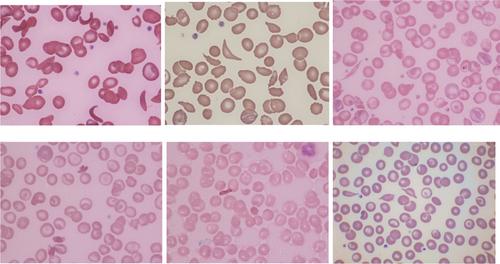
The hemoglobin concentration (Hb) in sickle cell anemia is typically 60–100 g/L with the blood film (top left, all images May–Grünwald–Giemsa, ×100 objective) showing sickle cells boat-shaped cells, target cells, features of hyposplenism (Howell–Jolly bodies, Pappenheimer bodies, large platelets), nucleated red blood cells, polychromasia and sometimes irregularly contracted cells or linear fragments. Some compound heterozygous states, for example, SD (top center), have hematological features very similar to those of sickle cell anemia.1 Others differ. Microcytosis and hypochromia are additional features in sickle cell/β thalassemia (top right). Sickle cell/hemoglobin C disease also differs. The Hb tends to be higher and the blood film may show distinctive SC poikilocytes when the crystallization of hemoglobin C and polymerization of hemoglobin S occur in the same cell2; hemoglobin C crystals may also be present (bottom left and center). A distinctive poikilocyte is also associated with hemoglobin S-Oman in heterozygotes (bottom right), homozygotes, and compound heterozygotes; these poikilocytes have been referred to as Napolean hat cells.
The different types of sickle cell disease differ in their clinicopathological characteristics and disease outcomes. It is, therefore, important that the heterogeneity is recognized and that articles in scientific journals and presentations at congresses make clear in what sense the term “sickle cell disease” is being used.3
期刊介绍:
The American Journal of Hematology offers extensive coverage of experimental and clinical aspects of blood diseases in humans and animal models. The journal publishes original contributions in both non-malignant and malignant hematological diseases, encompassing clinical and basic studies in areas such as hemostasis, thrombosis, immunology, blood banking, and stem cell biology. Clinical translational reports highlighting innovative therapeutic approaches for the diagnosis and treatment of hematological diseases are actively encouraged.The American Journal of Hematology features regular original laboratory and clinical research articles, brief research reports, critical reviews, images in hematology, as well as letters and correspondence.



 京公网安备 11010802042870号
京ICP备2023020795号-1
京公网安备 11010802042870号
京ICP备2023020795号-1

 分享
分享
 求助内容:
求助内容: 应助结果提醒方式:
 扫码关注我们
