{"title":"Impact of Frailty Risk on Functional Outcome after Aneurysmal Subarachnoid Hemorrhage: A Historical Cohort Study.","authors":"Yoshinori Yamamoto, Shinsuke Hori, Kenta Ushida, Yuka Shirai, Miho Shimizu, Yuki Kato, Ryo Momosaki","doi":"10.2176/jns-nmc.2023-0251","DOIUrl":null,"url":null,"abstract":"<p><p>We evaluated the utility of the Hospital Frailty Risk Score (HFRS) as a predictor of adverse events post-hospitalization in a retrospective analysis of patients undergoing neurosurgical procedures due to aneurysmal subarachnoid hemorrhage (SAH). This historical cohort study analyzed the data of patients hospitalized with aneurysmal SAH (n = 1,343) between April 2014 and August 2020 who were registered in the JMDC database. We used HFRS to classify the patients into the low-frailty risk group (HFRS < 5) and high-frailty risk group (HFRS ≥ 5). The primary outcome was a modified Rankin Scale (mRS) score of 0-2 points at discharge. Of 1,343 patients, 1,001 (74.5%) and 342 (25.5%) were in the low- and high-frailty risk groups, respectively. A high-frailty risk was negatively associated with a mRS score of 0-2 at discharge (high-frailty risk group: odds ratio 0.4; 95% confidence interval [CI]: 0.3-0.6) and home discharge (high-frailty risk group: odds ratio 0.5; 95% CI: 0.4-0.7). A high-frailty risk was negatively associated with Barthel Index gain (high-frailty risk group: coefficient -10.4, 95% CI: -14.7 to -6.2) and had a longer length of stay (high-frailty risk group: coefficient 8.4, 95% CI: 5.1-11.7). HFRS could predict adverse outcomes during hospitalization of aneurysmal SAH patients.</p>","PeriodicalId":19225,"journal":{"name":"Neurologia medico-chirurgica","volume":" ","pages":"409-417"},"PeriodicalIF":2.3000,"publicationDate":"2024-11-15","publicationTypes":"Journal Article","fieldsOfStudy":null,"isOpenAccess":false,"openAccessPdf":"https://www.ncbi.nlm.nih.gov/pmc/articles/PMC11617354/pdf/","citationCount":"0","resultStr":null,"platform":"Semanticscholar","paperid":null,"PeriodicalName":"Neurologia medico-chirurgica","FirstCategoryId":"3","ListUrlMain":"https://doi.org/10.2176/jns-nmc.2023-0251","RegionNum":4,"RegionCategory":"医学","ArticlePicture":[],"TitleCN":null,"AbstractTextCN":null,"PMCID":null,"EPubDate":"2024/9/26 0:00:00","PubModel":"Epub","JCR":"Q2","JCRName":"CLINICAL NEUROLOGY","Score":null,"Total":0}
引用次数: 0
Abstract
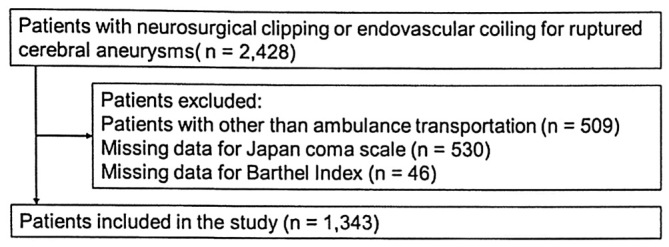
We evaluated the utility of the Hospital Frailty Risk Score (HFRS) as a predictor of adverse events post-hospitalization in a retrospective analysis of patients undergoing neurosurgical procedures due to aneurysmal subarachnoid hemorrhage (SAH). This historical cohort study analyzed the data of patients hospitalized with aneurysmal SAH (n = 1,343) between April 2014 and August 2020 who were registered in the JMDC database. We used HFRS to classify the patients into the low-frailty risk group (HFRS < 5) and high-frailty risk group (HFRS ≥ 5). The primary outcome was a modified Rankin Scale (mRS) score of 0-2 points at discharge. Of 1,343 patients, 1,001 (74.5%) and 342 (25.5%) were in the low- and high-frailty risk groups, respectively. A high-frailty risk was negatively associated with a mRS score of 0-2 at discharge (high-frailty risk group: odds ratio 0.4; 95% confidence interval [CI]: 0.3-0.6) and home discharge (high-frailty risk group: odds ratio 0.5; 95% CI: 0.4-0.7). A high-frailty risk was negatively associated with Barthel Index gain (high-frailty risk group: coefficient -10.4, 95% CI: -14.7 to -6.2) and had a longer length of stay (high-frailty risk group: coefficient 8.4, 95% CI: 5.1-11.7). HFRS could predict adverse outcomes during hospitalization of aneurysmal SAH patients.



 京公网安备 11010802042870号
京ICP备2023020795号-1
京公网安备 11010802042870号
京ICP备2023020795号-1

 分享
分享
 求助内容:
求助内容: 应助结果提醒方式:
 扫码关注我们
