Liesa Beier, Qendresa Thaqi, Ans Luyben, Nina Kimmich, Rahel Naef
{"title":"Predicting collaborative practice between midwives and obstetricians: A regression analysis.","authors":"Liesa Beier, Qendresa Thaqi, Ans Luyben, Nina Kimmich, Rahel Naef","doi":"10.18332/ejm/192696","DOIUrl":null,"url":null,"abstract":"<p><strong>Introduction: </strong>Effective collaborative practice between midwives and obstetricians improves patient safety and obstetrical outcomes, but its implementation remains challenging. Therefore, its determinants need to be better understood. This study examined factors impacting collaborative practice (CP) between these professional groups.</p><p><strong>Methods: </strong>This study was a cross-sectional survey that took place in Swiss hospital labor wards in 2021. Collaborative practice perceptions of 70 midwives (57.4% response rate) and 44 obstetricians (29.0% response rate) were assessed using the Interprofessional Collaboration Scale, with the score serving as the main outcome. A total of 13 individual, behavioral, and organizational predictors were analyzed by multiple linear regression.</p><p><strong>Results: </strong>Participants rated collaborative practice with a median score of 3.1 (IQR: 2.8-3.4) out of a maximum score of 4.0. Results showed that five predictors significantly influenced collaborative practice: type of profession (β= -0.180; 95% CI: -0.296 - -0.040, p=0.011), trust/respect (β=0.343; 95% CI: 0.085-0.040, p=0.000), shared visions/goals (β=0.218; 95% CI: 0.030-0.204, p=0.009), workplace (β=0.253; 95% CI: 0.089-0.445, p=0.004) and shared power (β=0.163; 95% CI: 0.042-0.222, p=0.015). The model explained 66% of the variance (adjusted R2) in collaborative practice in labor wards.</p><p><strong>Conclusions: </strong>This study has identified key factors influencing CP in Swiss labor wards: workplace characteristics that require tailored CP models, and a power-sharing culture that fosters trust, respectful interactions and shared goals, requiring active exchange between midwives and obstetricians.</p>","PeriodicalId":32920,"journal":{"name":"European Journal of Midwifery","volume":"8 ","pages":""},"PeriodicalIF":1.7000,"publicationDate":"2024-09-24","publicationTypes":"Journal Article","fieldsOfStudy":null,"isOpenAccess":false,"openAccessPdf":"https://www.ncbi.nlm.nih.gov/pmc/articles/PMC11440071/pdf/","citationCount":"0","resultStr":null,"platform":"Semanticscholar","paperid":null,"PeriodicalName":"European Journal of Midwifery","FirstCategoryId":"1085","ListUrlMain":"https://doi.org/10.18332/ejm/192696","RegionNum":0,"RegionCategory":null,"ArticlePicture":[],"TitleCN":null,"AbstractTextCN":null,"PMCID":null,"EPubDate":"2024/1/1 0:00:00","PubModel":"eCollection","JCR":"Q3","JCRName":"NURSING","Score":null,"Total":0}
引用次数: 0
Abstract
Introduction: Effective collaborative practice between midwives and obstetricians improves patient safety and obstetrical outcomes, but its implementation remains challenging. Therefore, its determinants need to be better understood. This study examined factors impacting collaborative practice (CP) between these professional groups.
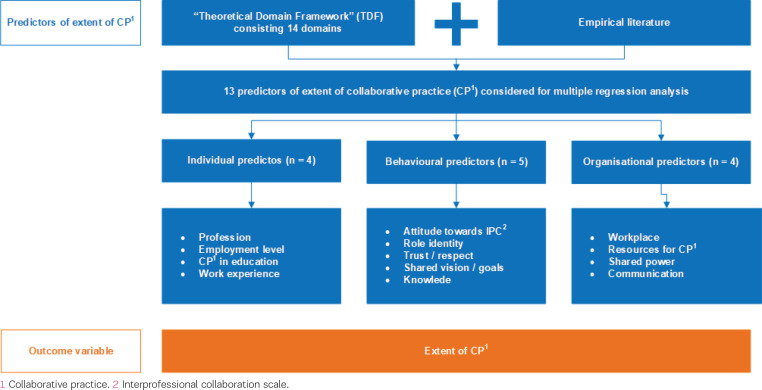
Methods: This study was a cross-sectional survey that took place in Swiss hospital labor wards in 2021. Collaborative practice perceptions of 70 midwives (57.4% response rate) and 44 obstetricians (29.0% response rate) were assessed using the Interprofessional Collaboration Scale, with the score serving as the main outcome. A total of 13 individual, behavioral, and organizational predictors were analyzed by multiple linear regression.
Results: Participants rated collaborative practice with a median score of 3.1 (IQR: 2.8-3.4) out of a maximum score of 4.0. Results showed that five predictors significantly influenced collaborative practice: type of profession (β= -0.180; 95% CI: -0.296 - -0.040, p=0.011), trust/respect (β=0.343; 95% CI: 0.085-0.040, p=0.000), shared visions/goals (β=0.218; 95% CI: 0.030-0.204, p=0.009), workplace (β=0.253; 95% CI: 0.089-0.445, p=0.004) and shared power (β=0.163; 95% CI: 0.042-0.222, p=0.015). The model explained 66% of the variance (adjusted R2) in collaborative practice in labor wards.
Conclusions: This study has identified key factors influencing CP in Swiss labor wards: workplace characteristics that require tailored CP models, and a power-sharing culture that fosters trust, respectful interactions and shared goals, requiring active exchange between midwives and obstetricians.




 京公网安备 11010802042870号
京ICP备2023020795号-1
京公网安备 11010802042870号
京ICP备2023020795号-1

 分享
分享
 求助内容:
求助内容: 应助结果提醒方式:
 扫码关注我们
