{"title":"Exceptional Tumor Regression in Diffuse Intrinsic Pontine Glioma Post-Radiotherapy: A Case Study.","authors":"Ashish Dilip Uke, Anurag Luharia, Shweta Dahake, Gaurav V Mishra, Chandrashekhar Mahakalkar","doi":"10.12659/AJCR.944869","DOIUrl":null,"url":null,"abstract":"<p><p>BACKGROUND Diffuse intrinsic pontine glioma represent approximately 10% to 20% of all pediatric central nervous system tumors. Classic brain stem symptoms are cranial nerve deficits, long tract signs, ataxia, alone or in combination. Focal radiotherapy has been the standard of care in patients with diffuse intrinsic pontine gliomas with minimum response. Here, we present an unusual case with excellent tumor regression with radiotherapy and good clinical outcome. CASE REPORT A 13-year-old girl presented with headache and imbalance during walking for the past 2-3 months, along with a deviation of the right eye in the last month. Brain magnetic resonance imaging (MRI) suggested a well-defined solid cystic altered-signal-intensity lesion involving the pons and medulla, causing its expansion up to the midbrain on the left side. The lesion was 4.6×3.7×3.6 cm. We applied the intensity-modulated radiotherapy technique (IMRT) using a 6-MV photon beam with the conventional dose fractionation of 54 Gy in 30 fractions (1.8 Gy/fraction). Three months later, MRI brain with spectroscopy and perfusion showed evidence of non-enhancing, altered-signal-intensity lesion in the pons and medulla, measuring 1.9×2.2×2.4 cm. CONCLUSIONS Early detection of symptoms of DIPG in a young patient along with effective radiological investigation with valid tumor board decision as definitive radiotherapy as a sole therapeutic treatment option and with robust radiotherapy planning resulted in an excellent response, with 80% reduction in gross tumor volume (GTV) as seen in pre-radiotherapy (RT) and post-RT MRI images.</p>","PeriodicalId":39064,"journal":{"name":"American Journal of Case Reports","volume":"25 ","pages":"e944869"},"PeriodicalIF":0.7000,"publicationDate":"2024-09-30","publicationTypes":"Journal Article","fieldsOfStudy":null,"isOpenAccess":false,"openAccessPdf":"https://www.ncbi.nlm.nih.gov/pmc/articles/PMC11452143/pdf/","citationCount":"0","resultStr":null,"platform":"Semanticscholar","paperid":null,"PeriodicalName":"American Journal of Case Reports","FirstCategoryId":"1085","ListUrlMain":"https://doi.org/10.12659/AJCR.944869","RegionNum":0,"RegionCategory":null,"ArticlePicture":[],"TitleCN":null,"AbstractTextCN":null,"PMCID":null,"EPubDate":"","PubModel":"","JCR":"Q3","JCRName":"MEDICINE, GENERAL & INTERNAL","Score":null,"Total":0}
引用次数: 0
Abstract
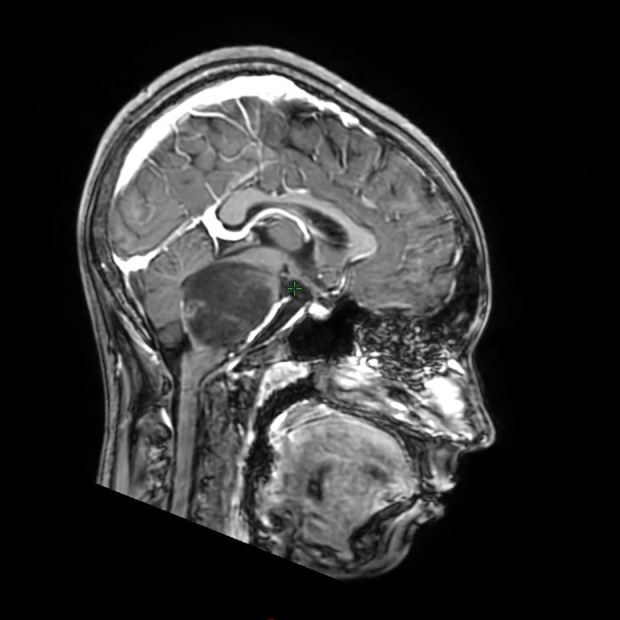
BACKGROUND Diffuse intrinsic pontine glioma represent approximately 10% to 20% of all pediatric central nervous system tumors. Classic brain stem symptoms are cranial nerve deficits, long tract signs, ataxia, alone or in combination. Focal radiotherapy has been the standard of care in patients with diffuse intrinsic pontine gliomas with minimum response. Here, we present an unusual case with excellent tumor regression with radiotherapy and good clinical outcome. CASE REPORT A 13-year-old girl presented with headache and imbalance during walking for the past 2-3 months, along with a deviation of the right eye in the last month. Brain magnetic resonance imaging (MRI) suggested a well-defined solid cystic altered-signal-intensity lesion involving the pons and medulla, causing its expansion up to the midbrain on the left side. The lesion was 4.6×3.7×3.6 cm. We applied the intensity-modulated radiotherapy technique (IMRT) using a 6-MV photon beam with the conventional dose fractionation of 54 Gy in 30 fractions (1.8 Gy/fraction). Three months later, MRI brain with spectroscopy and perfusion showed evidence of non-enhancing, altered-signal-intensity lesion in the pons and medulla, measuring 1.9×2.2×2.4 cm. CONCLUSIONS Early detection of symptoms of DIPG in a young patient along with effective radiological investigation with valid tumor board decision as definitive radiotherapy as a sole therapeutic treatment option and with robust radiotherapy planning resulted in an excellent response, with 80% reduction in gross tumor volume (GTV) as seen in pre-radiotherapy (RT) and post-RT MRI images.
期刊介绍:
American Journal of Case Reports is an international, peer-reviewed scientific journal that publishes single and series case reports in all medical fields. American Journal of Case Reports is issued on a continuous basis as a primary electronic journal. Print copies of a single article or a set of articles can be ordered on demand.






 京公网安备 11010802042870号
京ICP备2023020795号-1
京公网安备 11010802042870号
京ICP备2023020795号-1

 分享
分享
 求助内容:
求助内容: 应助结果提醒方式:
 扫码关注我们
