{"title":"Prototypical Learning Guided Context-Aware Segmentation Network for Few-Shot Anomaly Detection","authors":"Yuxin Jiang;Yunkang Cao;Weiming Shen","doi":"10.1109/TNNLS.2024.3463495","DOIUrl":null,"url":null,"abstract":"Few-shot anomaly detection (FSAD) denotes the identification of anomalies within a target category with a limited number of normal samples. Existing FSAD methods largely rely on pretrained feature representations to detect anomalies, but the inherent domain gap between pretrained representations and target FSAD scenarios is often overlooked. This study proposes a prototypical learning-guided context-aware segmentation network (PCSNet) to address the domain gap, thereby improving feature descriptiveness in target scenarios and enhancing FSAD performance. In particular, PCSNet comprises a prototypical feature adaption (PFA) subnetwork and a context-aware segmentation (CAS) subnetwork. PFA extracts prototypical features as guidance to ensure better feature compactness for normal data while distinct separation from anomalies. A pixel-level disparity classification (PDC) loss is also designed to make subtle anomalies more distinguishable. Then a CAS subnetwork is introduced for pixel-level anomaly localization, where pseudo anomalies are exploited to facilitate the training process. Experimental results on MVTec AD and metal part defect detection (MPDD) demonstrate the superior FSAD performance of PCSNet, with 94.9% and 80.2% image-level area under the receiver operating characteristics (AUROCs) in an eight-shot scenario, respectively. Real-world applications on automotive plastic part inspection further demonstrate that PCSNet can achieve promising results with limited training samples. The code is available at <uri>https://github.com/yuxin-jiang/PCSNet</uri>.","PeriodicalId":13303,"journal":{"name":"IEEE transactions on neural networks and learning systems","volume":"36 7","pages":"12016-12026"},"PeriodicalIF":8.9000,"publicationDate":"2024-10-01","publicationTypes":"Journal Article","fieldsOfStudy":null,"isOpenAccess":false,"openAccessPdf":"","citationCount":"0","resultStr":null,"platform":"Semanticscholar","paperid":null,"PeriodicalName":"IEEE transactions on neural networks and learning systems","FirstCategoryId":"94","ListUrlMain":"https://ieeexplore.ieee.org/document/10702559/","RegionNum":1,"RegionCategory":"计算机科学","ArticlePicture":[],"TitleCN":null,"AbstractTextCN":null,"PMCID":null,"EPubDate":"","PubModel":"","JCR":"Q1","JCRName":"COMPUTER SCIENCE, ARTIFICIAL INTELLIGENCE","Score":null,"Total":0}
引用次数: 0
Abstract
Few-shot anomaly detection (FSAD) denotes the identification of anomalies within a target category with a limited number of normal samples. Existing FSAD methods largely rely on pretrained feature representations to detect anomalies, but the inherent domain gap between pretrained representations and target FSAD scenarios is often overlooked. This study proposes a prototypical learning-guided context-aware segmentation network (PCSNet) to address the domain gap, thereby improving feature descriptiveness in target scenarios and enhancing FSAD performance. In particular, PCSNet comprises a prototypical feature adaption (PFA) subnetwork and a context-aware segmentation (CAS) subnetwork. PFA extracts prototypical features as guidance to ensure better feature compactness for normal data while distinct separation from anomalies. A pixel-level disparity classification (PDC) loss is also designed to make subtle anomalies more distinguishable. Then a CAS subnetwork is introduced for pixel-level anomaly localization, where pseudo anomalies are exploited to facilitate the training process. Experimental results on MVTec AD and metal part defect detection (MPDD) demonstrate the superior FSAD performance of PCSNet, with 94.9% and 80.2% image-level area under the receiver operating characteristics (AUROCs) in an eight-shot scenario, respectively. Real-world applications on automotive plastic part inspection further demonstrate that PCSNet can achieve promising results with limited training samples. The code is available at https://github.com/yuxin-jiang/PCSNet.
期刊介绍:
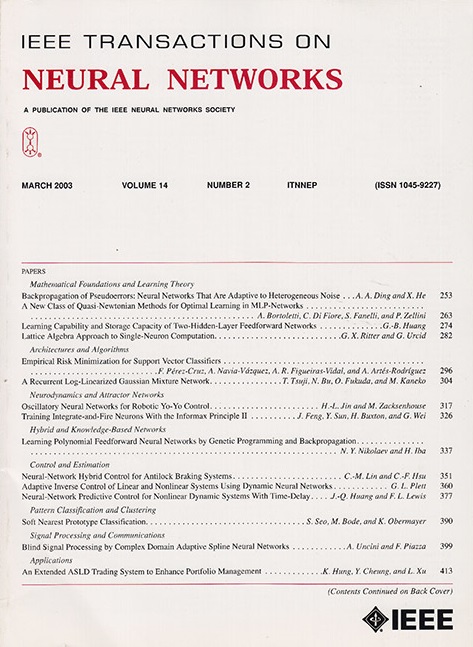
The focus of IEEE Transactions on Neural Networks and Learning Systems is to present scholarly articles discussing the theory, design, and applications of neural networks as well as other learning systems. The journal primarily highlights technical and scientific research in this domain.




 京公网安备 11010802042870号
京ICP备2023020795号-1
京公网安备 11010802042870号
京ICP备2023020795号-1

 分享
分享
 求助内容:
求助内容: 应助结果提醒方式:
 扫码关注我们
