Yohei Haketa , Maho Kawami , Wataru Ota , Tohru Sato , Hiromitsu Maeda
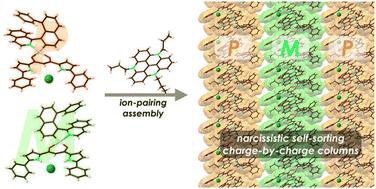
{"title":"Ion-pairing assemblies of anion-responsive helical PtII complexes†","authors":"Yohei Haketa , Maho Kawami , Wataru Ota , Tohru Sato , Hiromitsu Maeda","doi":"10.1039/d4qo01697a","DOIUrl":null,"url":null,"abstract":"<div><div>Naphthylisoquinoline-appended dipyrrolyldiketone Pt<sup>II</sup> complexes as helical π-electronic systems were synthesized. The Pt<sup>II</sup> complexes, showing chiroptical properties in solution, exhibited anion-binding behaviour, resulting in the formation of anion complexes as pseudo π-electronic anions. In combination with the π-electronic cation, the receptor–anion complexes formed charge-by-charge ion-pairing assemblies, with the narcissistic self-sorting columnar structures comprising either of the enantiomers, in the crystal state.</div></div>","PeriodicalId":94379,"journal":{"name":"Organic chemistry frontiers : an international journal of organic chemistry","volume":"11 23","pages":"Pages 6651-6659"},"PeriodicalIF":0.0000,"publicationDate":"2024-10-21","publicationTypes":"Journal Article","fieldsOfStudy":null,"isOpenAccess":false,"openAccessPdf":"","citationCount":"0","resultStr":null,"platform":"Semanticscholar","paperid":null,"PeriodicalName":"Organic chemistry frontiers : an international journal of organic chemistry","FirstCategoryId":"1085","ListUrlMain":"https://www.sciencedirect.com/org/science/article/pii/S2052412924006909","RegionNum":0,"RegionCategory":null,"ArticlePicture":[],"TitleCN":null,"AbstractTextCN":null,"PMCID":null,"EPubDate":"2024/10/2 0:00:00","PubModel":"Epub","JCR":"","JCRName":"","Score":null,"Total":0}
引用次数: 0
Abstract
Naphthylisoquinoline-appended dipyrrolyldiketone PtII complexes as helical π-electronic systems were synthesized. The PtII complexes, showing chiroptical properties in solution, exhibited anion-binding behaviour, resulting in the formation of anion complexes as pseudo π-electronic anions. In combination with the π-electronic cation, the receptor–anion complexes formed charge-by-charge ion-pairing assemblies, with the narcissistic self-sorting columnar structures comprising either of the enantiomers, in the crystal state.



 京公网安备 11010802042870号
京ICP备2023020795号-1
京公网安备 11010802042870号
京ICP备2023020795号-1

 分享
分享

 求助内容:
求助内容: 应助结果提醒方式:
 扫码关注我们
