Douglas P. M. Saraiva, Bruno Ferreira, Leonardo M. A. Ribeiro, Thiago R. L. C. Paixão and Mauro Bertotti
{"title":"Cost-effective quantification of uric acid using niobium oxide and graphene oxide-modified pencil-drawn electrodes on PVC substrates†","authors":"Douglas P. M. Saraiva, Bruno Ferreira, Leonardo M. A. Ribeiro, Thiago R. L. C. Paixão and Mauro Bertotti","doi":"10.1039/D4AY01345J","DOIUrl":null,"url":null,"abstract":"<p >This study introduces a cost-effective approach for quantifying uric acid (UA), the main antioxidant species in human physiology and implicated in inflammatory regulation. Using a PVC substrate and pencil drawing technique, electrodes were fabricated and modified with niobium oxide and graphene oxide <em>via</em> a straightforward “drop casting” method. The nanostructures of the substrate, electrode, and modified electrode were evaluated using SEM images. The synergistic effect between these materials significantly facilitated the uric acid oxidation process with a 400 mV peak potential shift and 45% current increase. The evaluation of the electrode's response to common blood and urine components showed minimal deviation. Among the components tested—ascorbic acid, glucose, nitrate, nitrite, cysteine, urea, creatinine, and ammonium ion—only the ammonium ion exhibited a 10% interference at concentrations commonly found in urine. The sensors showed a good detection limit of 8.7 μmol L<small><sup>−1</sup></small>, with a wide linear range from 8.7 to 2000 μmol L<small><sup>−1</sup></small> with a correlation factor of 0.9993 for five different sensors. The reproducibility and repeatability of the produced sensors were estimated by the RSD at 4% and 1%, respectively. Synthetic urine samples spiked exhibited reliable analysis, with recovery values within a 5% error margin. This work presents a practical, simple, and affordable sensor platform for rapid and accurate UA quantification.</p>","PeriodicalId":64,"journal":{"name":"Analytical Methods","volume":" 43","pages":" 7407-7412"},"PeriodicalIF":2.6000,"publicationDate":"2024-09-30","publicationTypes":"Journal Article","fieldsOfStudy":null,"isOpenAccess":false,"openAccessPdf":"","citationCount":"0","resultStr":null,"platform":"Semanticscholar","paperid":null,"PeriodicalName":"Analytical Methods","FirstCategoryId":"92","ListUrlMain":"https://pubs.rsc.org/en/content/articlelanding/2024/ay/d4ay01345j","RegionNum":3,"RegionCategory":"化学","ArticlePicture":[],"TitleCN":null,"AbstractTextCN":null,"PMCID":null,"EPubDate":"","PubModel":"","JCR":"Q2","JCRName":"CHEMISTRY, ANALYTICAL","Score":null,"Total":0}
引用次数: 0
Abstract
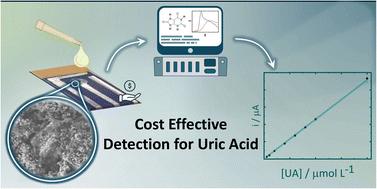
This study introduces a cost-effective approach for quantifying uric acid (UA), the main antioxidant species in human physiology and implicated in inflammatory regulation. Using a PVC substrate and pencil drawing technique, electrodes were fabricated and modified with niobium oxide and graphene oxide via a straightforward “drop casting” method. The nanostructures of the substrate, electrode, and modified electrode were evaluated using SEM images. The synergistic effect between these materials significantly facilitated the uric acid oxidation process with a 400 mV peak potential shift and 45% current increase. The evaluation of the electrode's response to common blood and urine components showed minimal deviation. Among the components tested—ascorbic acid, glucose, nitrate, nitrite, cysteine, urea, creatinine, and ammonium ion—only the ammonium ion exhibited a 10% interference at concentrations commonly found in urine. The sensors showed a good detection limit of 8.7 μmol L−1, with a wide linear range from 8.7 to 2000 μmol L−1 with a correlation factor of 0.9993 for five different sensors. The reproducibility and repeatability of the produced sensors were estimated by the RSD at 4% and 1%, respectively. Synthetic urine samples spiked exhibited reliable analysis, with recovery values within a 5% error margin. This work presents a practical, simple, and affordable sensor platform for rapid and accurate UA quantification.



 京公网安备 11010802042870号
京ICP备2023020795号-1
京公网安备 11010802042870号
京ICP备2023020795号-1

 分享
分享
 求助内容:
求助内容: 应助结果提醒方式:
 扫码关注我们
