{"title":"Optimizing Transfection Efficiency of Spermine Polar Head Cholesterol-Based Cationic Lipids with Amino Acid Linker","authors":"Chopaka Thongbamrer, Nawapol Kunkeaw, Wang Nguitragool, Wanlapa Roobsoong, Jetsumon Sattabongkot, Praneet Opanasopit, Boon-ek Yingyongnarongkul","doi":"10.1002/cbic.202400490","DOIUrl":null,"url":null,"abstract":"<p>In this work, a series of spermine polar head cholesterol-based cationic lipids with various amino acid spacers were synthesized and evaluated as non-viral gene delivery systems. The physicochemical properties of the resulting lipoplexes, formed from these lipids and DOPE, were assessed, including zeta-potential, DNA binding and DNA protection from serum. Transfection efficiency and cytotoxicity were examined under serum-free and 10–40 % serum-containing conditions. The results showed that the physicochemical properties of cationic lipids, both with and without amino acid spacers, were not significantly different. Cationic liposomes composed of lipid <b>Sper-Ahx-Chol</b>, which has a 6-aminohexanoic acid spacer, and DOPE exhibited greater transfection efficiency in HeLa cells compared to Lipofectamine3000, both in the absence and presence of 10–40 % serum. Additionally, lipid <b>Sper-His-Chol</b> with a histidine spacer and <b>Sper-Ahx-Chol</b> showed higher efficiency than Lipofectamine3000 against HEK293T under 40 % serum conditions. These results suggest that the incorporation of amino acids into the cationic lipids can significantly enhance their DNA delivery efficiency. Specifically, certain amino acid modifications improved transfection efficiency while maintaining low cytotoxicity. Our findings highlight the potential of amino acid-tailored cationic lipids as promising vectors for enhanced DNA delivery.</p>","PeriodicalId":140,"journal":{"name":"ChemBioChem","volume":"25 23","pages":""},"PeriodicalIF":2.8000,"publicationDate":"2024-10-01","publicationTypes":"Journal Article","fieldsOfStudy":null,"isOpenAccess":false,"openAccessPdf":"","citationCount":"0","resultStr":null,"platform":"Semanticscholar","paperid":null,"PeriodicalName":"ChemBioChem","FirstCategoryId":"99","ListUrlMain":"https://chemistry-europe.onlinelibrary.wiley.com/doi/10.1002/cbic.202400490","RegionNum":4,"RegionCategory":"生物学","ArticlePicture":[],"TitleCN":null,"AbstractTextCN":null,"PMCID":null,"EPubDate":"","PubModel":"","JCR":"Q3","JCRName":"BIOCHEMISTRY & MOLECULAR BIOLOGY","Score":null,"Total":0}
引用次数: 0
Abstract
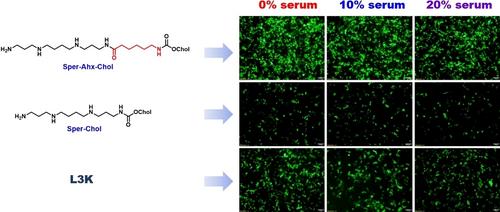
In this work, a series of spermine polar head cholesterol-based cationic lipids with various amino acid spacers were synthesized and evaluated as non-viral gene delivery systems. The physicochemical properties of the resulting lipoplexes, formed from these lipids and DOPE, were assessed, including zeta-potential, DNA binding and DNA protection from serum. Transfection efficiency and cytotoxicity were examined under serum-free and 10–40 % serum-containing conditions. The results showed that the physicochemical properties of cationic lipids, both with and without amino acid spacers, were not significantly different. Cationic liposomes composed of lipid Sper-Ahx-Chol, which has a 6-aminohexanoic acid spacer, and DOPE exhibited greater transfection efficiency in HeLa cells compared to Lipofectamine3000, both in the absence and presence of 10–40 % serum. Additionally, lipid Sper-His-Chol with a histidine spacer and Sper-Ahx-Chol showed higher efficiency than Lipofectamine3000 against HEK293T under 40 % serum conditions. These results suggest that the incorporation of amino acids into the cationic lipids can significantly enhance their DNA delivery efficiency. Specifically, certain amino acid modifications improved transfection efficiency while maintaining low cytotoxicity. Our findings highlight the potential of amino acid-tailored cationic lipids as promising vectors for enhanced DNA delivery.
期刊介绍:
ChemBioChem (Impact Factor 2018: 2.641) publishes important breakthroughs across all areas at the interface of chemistry and biology, including the fields of chemical biology, bioorganic chemistry, bioinorganic chemistry, synthetic biology, biocatalysis, bionanotechnology, and biomaterials. It is published on behalf of Chemistry Europe, an association of 16 European chemical societies, and supported by the Asian Chemical Editorial Society (ACES).




 京公网安备 11010802042870号
京ICP备2023020795号-1
京公网安备 11010802042870号
京ICP备2023020795号-1

 分享
分享
 求助内容:
求助内容: 应助结果提醒方式:
 扫码关注我们
