Major Lower Limb Amputation for Chronic Limb-Threatening Ischemia Is Associated with Poor Long-Term Survival: 4-Year Follow-Up of a Single-Center Experience.
{"title":"Major Lower Limb Amputation for Chronic Limb-Threatening Ischemia Is Associated with Poor Long-Term Survival: 4-Year Follow-Up of a Single-Center Experience.","authors":"Thushan Gooneratne, Rezni Cassim, Mandika Wijeyaratne","doi":"10.3400/avd.oa.23-00078","DOIUrl":null,"url":null,"abstract":"<p><p><b>Objective:</b> Despite advances in medicine, 30% of patients with chronic limb-threatening ischemia (CLTI) require major lower limb amputation (MLLA). The long-term outcome of this cohort is poorly described. <b>Methods:</b> In all, 154 patients undergoing MLLA for CLTI during 2018-2020 were analyzed for short-term and long-term outcomes and prosthesis use. <b>Results:</b> In total, 106 below-knee amputations and 48 above-knee amputations were followed up for a mean duration of 50 months (37-78). The mean age of the cohort was 63 years. The majority were male (60%) with multiple comorbidities, including diabetes (83.8%), hypertension (49.4%), ischemic heart disease (20%), and smoking (32.5%). An equal proportion underwent MLLA as primary (45%) or secondary (55%). 30-day mortality was 6%. The mean length of in-hospital stay was 18 days (3-56). Overall survival rates at 1st, 2nd, and 4th year were 73%, 64%, and 35%, respectively. On a multivariate regression analysis, a higher level of amputation had a significant impact on mortality (p = 0.015). 54% of amputees had a prosthetic limb. However, the primary use of prosthesis was for cosmesis, with only 12% mobile independently. <b>Conclusions:</b> MLLA for CLTI is associated with poor early and long-term survival. Prosthesis use and mobility are extremely poor in the Sri Lankan context.</p>","PeriodicalId":7995,"journal":{"name":"Annals of vascular diseases","volume":"17 3","pages":"234-240"},"PeriodicalIF":0.6000,"publicationDate":"2024-09-25","publicationTypes":"Journal Article","fieldsOfStudy":null,"isOpenAccess":false,"openAccessPdf":"https://www.ncbi.nlm.nih.gov/pmc/articles/PMC11444831/pdf/","citationCount":"0","resultStr":null,"platform":"Semanticscholar","paperid":null,"PeriodicalName":"Annals of vascular diseases","FirstCategoryId":"1085","ListUrlMain":"https://doi.org/10.3400/avd.oa.23-00078","RegionNum":0,"RegionCategory":null,"ArticlePicture":[],"TitleCN":null,"AbstractTextCN":null,"PMCID":null,"EPubDate":"2024/7/6 0:00:00","PubModel":"Epub","JCR":"Q4","JCRName":"PERIPHERAL VASCULAR DISEASE","Score":null,"Total":0}
引用次数: 0
Abstract
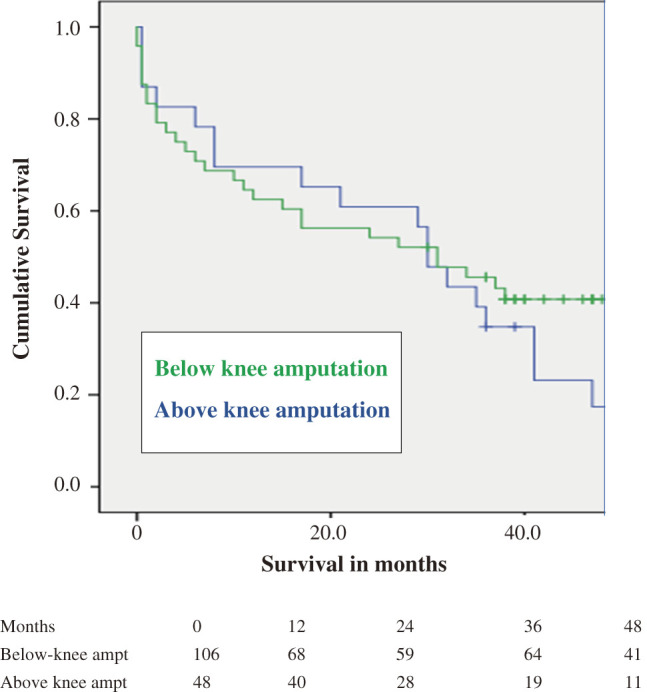
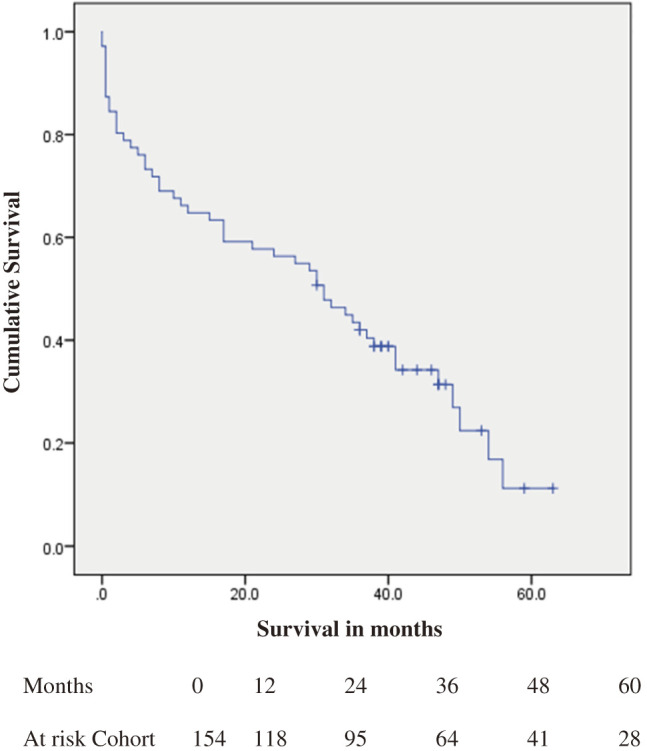
Objective: Despite advances in medicine, 30% of patients with chronic limb-threatening ischemia (CLTI) require major lower limb amputation (MLLA). The long-term outcome of this cohort is poorly described. Methods: In all, 154 patients undergoing MLLA for CLTI during 2018-2020 were analyzed for short-term and long-term outcomes and prosthesis use. Results: In total, 106 below-knee amputations and 48 above-knee amputations were followed up for a mean duration of 50 months (37-78). The mean age of the cohort was 63 years. The majority were male (60%) with multiple comorbidities, including diabetes (83.8%), hypertension (49.4%), ischemic heart disease (20%), and smoking (32.5%). An equal proportion underwent MLLA as primary (45%) or secondary (55%). 30-day mortality was 6%. The mean length of in-hospital stay was 18 days (3-56). Overall survival rates at 1st, 2nd, and 4th year were 73%, 64%, and 35%, respectively. On a multivariate regression analysis, a higher level of amputation had a significant impact on mortality (p = 0.015). 54% of amputees had a prosthetic limb. However, the primary use of prosthesis was for cosmesis, with only 12% mobile independently. Conclusions: MLLA for CLTI is associated with poor early and long-term survival. Prosthesis use and mobility are extremely poor in the Sri Lankan context.





 京公网安备 11010802042870号
京ICP备2023020795号-1
京公网安备 11010802042870号
京ICP备2023020795号-1

 分享
分享
 求助内容:
求助内容: 应助结果提醒方式:
 扫码关注我们
