Kishan R. Ramsodit, Ruben Zwiers, Miki Dalmau-Pastor, Vincent Gouttebarge, Mario Maas, Gino M. M. J. Kerkhoffs
{"title":"Medial sleeve fractures in elite-athletes: A heterogeneous group, anatomical and case-based considerations","authors":"Kishan R. Ramsodit, Ruben Zwiers, Miki Dalmau-Pastor, Vincent Gouttebarge, Mario Maas, Gino M. M. J. Kerkhoffs","doi":"10.1002/ksa.12489","DOIUrl":null,"url":null,"abstract":"<div>\n \n \n <section>\n \n <h3> Purpose</h3>\n \n <p>The purpose of this study is to provide a detailed description of the anatomy and radiology of the medial sleeve and present an approach in its management among elite athletes.</p>\n </section>\n \n <section>\n \n <h3> Methods</h3>\n \n <p>Five cases of elite athletes who underwent treatment for a medial sleeve injury of which the diagnosis was confirmed through physical examination and additional magnetic resonance imaging scan are described in this study.</p>\n </section>\n \n <section>\n \n <h3> Results</h3>\n \n <p>Two patients presented with isolated medial sleeve injuries, while the other three patients suffered from concomitant ankle injuries. Non-operative treatment consisted of relative rest, soft cast immobilization and mobilization in a walking boot or kinesiotape which was successful in four of the cases with regard to the medial sleeve. One patient underwent surgery due to syndesmotic instability. Another patient presented with combined medial and lateral ankle instability which was treated surgically with an open medial and lateral ligament repair. All patients were able to return to their pre-injury sports and at the time of the last follow-up were still playing in their pre-injury level of competition.</p>\n </section>\n \n <section>\n \n <h3> Conclusion</h3>\n \n <p>Medial sleeve injuries of the ankle in elite athletes should be considered in the differential diagnosis for athletes presenting with medial ankle pain. Inherent knowledge regarding anatomy is essential when guiding the management of these injuries which can be treated successfully with a non-operative approach consisting of relative rest, immobilization, kinesiotape and physical therapy. In case of persistent medial instability or rotational instability, surgical repair is a viable treatment option. Both modalities allow athletes to return to the pre-injury level of competition. However, early diagnosis is crucial to minimize the delay of appropriate treatment and avoid potential residual symptoms.</p>\n </section>\n \n <section>\n \n <h3> Level of Evidence</h3>\n \n <p>Level IV.</p>\n </section>\n </div>","PeriodicalId":17880,"journal":{"name":"Knee Surgery, Sports Traumatology, Arthroscopy","volume":"32 12","pages":"3121-3128"},"PeriodicalIF":5.0000,"publicationDate":"2024-10-03","publicationTypes":"Journal Article","fieldsOfStudy":null,"isOpenAccess":false,"openAccessPdf":"https://onlinelibrary.wiley.com/doi/epdf/10.1002/ksa.12489","citationCount":"0","resultStr":null,"platform":"Semanticscholar","paperid":null,"PeriodicalName":"Knee Surgery, Sports Traumatology, Arthroscopy","FirstCategoryId":"3","ListUrlMain":"https://esskajournals.onlinelibrary.wiley.com/doi/10.1002/ksa.12489","RegionNum":2,"RegionCategory":"医学","ArticlePicture":[],"TitleCN":null,"AbstractTextCN":null,"PMCID":null,"EPubDate":"","PubModel":"","JCR":"Q1","JCRName":"ORTHOPEDICS","Score":null,"Total":0}
引用次数: 0
Abstract
Purpose
The purpose of this study is to provide a detailed description of the anatomy and radiology of the medial sleeve and present an approach in its management among elite athletes.
Methods
Five cases of elite athletes who underwent treatment for a medial sleeve injury of which the diagnosis was confirmed through physical examination and additional magnetic resonance imaging scan are described in this study.
Results
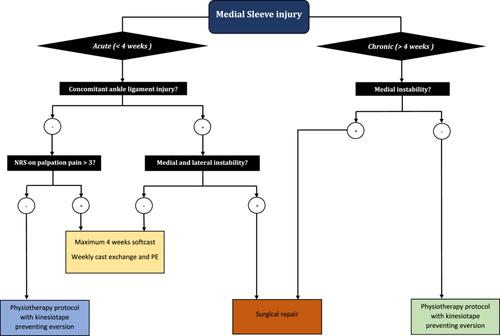
Two patients presented with isolated medial sleeve injuries, while the other three patients suffered from concomitant ankle injuries. Non-operative treatment consisted of relative rest, soft cast immobilization and mobilization in a walking boot or kinesiotape which was successful in four of the cases with regard to the medial sleeve. One patient underwent surgery due to syndesmotic instability. Another patient presented with combined medial and lateral ankle instability which was treated surgically with an open medial and lateral ligament repair. All patients were able to return to their pre-injury sports and at the time of the last follow-up were still playing in their pre-injury level of competition.
Conclusion
Medial sleeve injuries of the ankle in elite athletes should be considered in the differential diagnosis for athletes presenting with medial ankle pain. Inherent knowledge regarding anatomy is essential when guiding the management of these injuries which can be treated successfully with a non-operative approach consisting of relative rest, immobilization, kinesiotape and physical therapy. In case of persistent medial instability or rotational instability, surgical repair is a viable treatment option. Both modalities allow athletes to return to the pre-injury level of competition. However, early diagnosis is crucial to minimize the delay of appropriate treatment and avoid potential residual symptoms.
期刊介绍:
Few other areas of orthopedic surgery and traumatology have undergone such a dramatic evolution in the last 10 years as knee surgery, arthroscopy and sports traumatology. Ranked among the top 33% of journals in both Orthopedics and Sports Sciences, the goal of this European journal is to publish papers about innovative knee surgery, sports trauma surgery and arthroscopy. Each issue features a series of peer-reviewed articles that deal with diagnosis and management and with basic research. Each issue also contains at least one review article about an important clinical problem. Case presentations or short notes about technical innovations are also accepted for publication.
The articles cover all aspects of knee surgery and all types of sports trauma; in addition, epidemiology, diagnosis, treatment and prevention, and all types of arthroscopy (not only the knee but also the shoulder, elbow, wrist, hip, ankle, etc.) are addressed. Articles on new diagnostic techniques such as MRI and ultrasound and high-quality articles about the biomechanics of joints, muscles and tendons are included. Although this is largely a clinical journal, it is also open to basic research with clinical relevance.
Because the journal is supported by a distinguished European Editorial Board, assisted by an international Advisory Board, you can be assured that the journal maintains the highest standards.
Official Clinical Journal of the European Society of Sports Traumatology, Knee Surgery and Arthroscopy (ESSKA).