Itthipon Moonnee, Muhammad Sohail Ahmad, Yusuke Inomata, Worapon Kiatkittipong and Tetsuya Kida
{"title":"Graphene oxide-based materials as proton-conducting membranes for electrochemical applications","authors":"Itthipon Moonnee, Muhammad Sohail Ahmad, Yusuke Inomata, Worapon Kiatkittipong and Tetsuya Kida","doi":"10.1039/D4NR02992E","DOIUrl":null,"url":null,"abstract":"<p >The rapid advancements of graphene oxide (GO)-based membranes necessitate the understanding of their properties and application potential. Generally, proton (H<small><sup>+</sup></small>)-conducting membranes, including GO-based ones, are crucial components in various energy-relevant devices, significantly determining the transport process, selectivity, and overall efficiency of these devices. Particularly, GO-based membranes exhibit great potential in electrochemical applications owing to their remarkable conductivity and ease of undergoing further modifications. This review is aimed at highlighting recent functionalization strategies for GO with diverse substrates. It is also aimed at emphasizing how these modifications can enhance the electrochemical performances of GO-based membranes. Notably, key aspects, such as the enhanced H<small><sup>+</sup></small>-transfer kinetics, improved conductivity, functionalities, and optimization, of these membranes for specific applications are discussed. Additionally, the existing challenges and future directions for the field of functionalized GO are addressed to achieve precise control of the functionalities of these membranes as well as advance next-generation electrochemical devices.</p>","PeriodicalId":92,"journal":{"name":"Nanoscale","volume":" 45","pages":" 20791-20810"},"PeriodicalIF":5.1000,"publicationDate":"2024-10-03","publicationTypes":"Journal Article","fieldsOfStudy":null,"isOpenAccess":false,"openAccessPdf":"","citationCount":"0","resultStr":null,"platform":"Semanticscholar","paperid":null,"PeriodicalName":"Nanoscale","FirstCategoryId":"88","ListUrlMain":"https://pubs.rsc.org/en/content/articlelanding/2024/nr/d4nr02992e","RegionNum":3,"RegionCategory":"材料科学","ArticlePicture":[],"TitleCN":null,"AbstractTextCN":null,"PMCID":null,"EPubDate":"","PubModel":"","JCR":"Q1","JCRName":"CHEMISTRY, MULTIDISCIPLINARY","Score":null,"Total":0}
引用次数: 0
Abstract
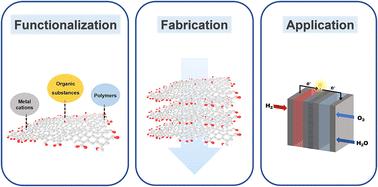
The rapid advancements of graphene oxide (GO)-based membranes necessitate the understanding of their properties and application potential. Generally, proton (H+)-conducting membranes, including GO-based ones, are crucial components in various energy-relevant devices, significantly determining the transport process, selectivity, and overall efficiency of these devices. Particularly, GO-based membranes exhibit great potential in electrochemical applications owing to their remarkable conductivity and ease of undergoing further modifications. This review is aimed at highlighting recent functionalization strategies for GO with diverse substrates. It is also aimed at emphasizing how these modifications can enhance the electrochemical performances of GO-based membranes. Notably, key aspects, such as the enhanced H+-transfer kinetics, improved conductivity, functionalities, and optimization, of these membranes for specific applications are discussed. Additionally, the existing challenges and future directions for the field of functionalized GO are addressed to achieve precise control of the functionalities of these membranes as well as advance next-generation electrochemical devices.
膜是质子交换膜燃料电池中的重要元素,影响着传输现象、耐用性和整体性能。由于新型膜(如石墨烯基膜)的快速发展,全面了解这些新材料的特性至关重要。基于石墨烯的膜,尤其是氧化石墨烯(GO),因其卓越的导电性和进一步改性的潜力,为电化学应用提供了一种前景广阔的替代材料。本综述探讨了用各种基底对 GO 进行功能化的最新策略,强调了引入的功能性及其电化学性能的影响。讨论了这些改性对 GO 电化学性能的影响,重点介绍了这些改性如何增强质子传递动力学、提高电导率以及为目标应用提供特定功能。最后,还讨论了功能化 GO 领域当前面临的挑战和未来的发展方向,重点是实现对功能性更精确的控制,以推动下一代电化学设备的发展。
期刊介绍:
Nanoscale is a high-impact international journal, publishing high-quality research across nanoscience and nanotechnology. Nanoscale publishes a full mix of research articles on experimental and theoretical work, including reviews, communications, and full papers.Highly interdisciplinary, this journal appeals to scientists, researchers and professionals interested in nanoscience and nanotechnology, quantum materials and quantum technology, including the areas of physics, chemistry, biology, medicine, materials, energy/environment, information technology, detection science, healthcare and drug discovery, and electronics.



 京公网安备 11010802042870号
京ICP备2023020795号-1
京公网安备 11010802042870号
京ICP备2023020795号-1

 分享
分享
 求助内容:
求助内容: 应助结果提醒方式:
 扫码关注我们
