Yaling Qin, Min Liu, Hanchao Teng, Na Chen, Chenchen Wu, Chengyu Jiang, Zhuoxin Xue, Hualong Zhu, Jiayi Gui, Xiang Liu, Yuchuan Xiao and Hai Hu
{"title":"Tunable hybridized plasmons–phonons in a graphene/mica-nanofilm heterostructure†","authors":"Yaling Qin, Min Liu, Hanchao Teng, Na Chen, Chenchen Wu, Chengyu Jiang, Zhuoxin Xue, Hualong Zhu, Jiayi Gui, Xiang Liu, Yuchuan Xiao and Hai Hu","doi":"10.1039/D4NR00942H","DOIUrl":null,"url":null,"abstract":"<p >Graphene plasmons exhibit significant potential across diverse fields, including optoelectronics, metamaterials, and biosensing. However, the exposure of all surface atoms in graphene makes it susceptible to surrounding interference, including losses stemming from charged impurity scattering, the dielectric environment, and the substrate roughness. Thus, designing a dielectric environment with a long lifetime and tunability is essential. In this study, we created a van der Waals (vdW) heterostructure with graphene nanoribbons and mica nano-films. Through Fourier-transform infrared spectroscopy, we identified hybrid modes resulting from the interaction between graphene plasmons and mica phonons. By doping and manipulating the structure of graphene, we achieved control over the phonon–plasmon ratio, thereby influencing the characteristics of these modes. Phonon-dominated modes exhibited stable resonant frequencies, whereas plasmon-dominated modes demonstrated continuous tuning from 1140 to 1360 cm<small><sup>−1</sup></small> in resonance frequency, accompanied by an increase in extinction intensity from 0.1% to 1.2%. Multiple phonon couplings limited frequency modulation, yielding stable resonances unaffected by the gate voltage. Mica substrates offer atomic level flatness, long phonon lifetimes, and dielectric functionality, enabling hybrid modes with high confinement, extended lifetimes (up to 1.9 picoseconds), and a broad frequency range (from 750 cm<small><sup>−1</sup></small> to 1450 cm<small><sup>−1</sup></small>). These properties make our graphene and mica heterostructure promising for applications in chemical sensing and integrated photonic devices.</p>","PeriodicalId":92,"journal":{"name":"Nanoscale","volume":" 44","pages":" 20522-20531"},"PeriodicalIF":5.1000,"publicationDate":"2024-10-03","publicationTypes":"Journal Article","fieldsOfStudy":null,"isOpenAccess":false,"openAccessPdf":"","citationCount":"0","resultStr":null,"platform":"Semanticscholar","paperid":null,"PeriodicalName":"Nanoscale","FirstCategoryId":"88","ListUrlMain":"https://pubs.rsc.org/en/content/articlelanding/2024/nr/d4nr00942h","RegionNum":3,"RegionCategory":"材料科学","ArticlePicture":[],"TitleCN":null,"AbstractTextCN":null,"PMCID":null,"EPubDate":"","PubModel":"","JCR":"Q1","JCRName":"CHEMISTRY, MULTIDISCIPLINARY","Score":null,"Total":0}
引用次数: 0
Abstract
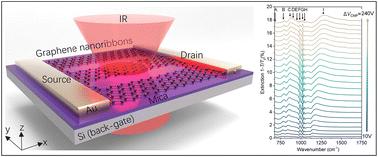
Graphene plasmons exhibit significant potential across diverse fields, including optoelectronics, metamaterials, and biosensing. However, the exposure of all surface atoms in graphene makes it susceptible to surrounding interference, including losses stemming from charged impurity scattering, the dielectric environment, and the substrate roughness. Thus, designing a dielectric environment with a long lifetime and tunability is essential. In this study, we created a van der Waals (vdW) heterostructure with graphene nanoribbons and mica nano-films. Through Fourier-transform infrared spectroscopy, we identified hybrid modes resulting from the interaction between graphene plasmons and mica phonons. By doping and manipulating the structure of graphene, we achieved control over the phonon–plasmon ratio, thereby influencing the characteristics of these modes. Phonon-dominated modes exhibited stable resonant frequencies, whereas plasmon-dominated modes demonstrated continuous tuning from 1140 to 1360 cm−1 in resonance frequency, accompanied by an increase in extinction intensity from 0.1% to 1.2%. Multiple phonon couplings limited frequency modulation, yielding stable resonances unaffected by the gate voltage. Mica substrates offer atomic level flatness, long phonon lifetimes, and dielectric functionality, enabling hybrid modes with high confinement, extended lifetimes (up to 1.9 picoseconds), and a broad frequency range (from 750 cm−1 to 1450 cm−1). These properties make our graphene and mica heterostructure promising for applications in chemical sensing and integrated photonic devices.
期刊介绍:
Nanoscale is a high-impact international journal, publishing high-quality research across nanoscience and nanotechnology. Nanoscale publishes a full mix of research articles on experimental and theoretical work, including reviews, communications, and full papers.Highly interdisciplinary, this journal appeals to scientists, researchers and professionals interested in nanoscience and nanotechnology, quantum materials and quantum technology, including the areas of physics, chemistry, biology, medicine, materials, energy/environment, information technology, detection science, healthcare and drug discovery, and electronics.



 京公网安备 11010802042870号
京ICP备2023020795号-1
京公网安备 11010802042870号
京ICP备2023020795号-1

 分享
分享
 求助内容:
求助内容: 应助结果提醒方式:
 扫码关注我们
