M. Wąsińska-Kałwa, A. Omran, L. Mach, L. Scipioni, J. Bouma, X. Li, S. Radetzki, Y. Mostinski, M. Schippers, T. Gazzi, C. van der Horst, B. Brennecke, A. Hanske, Y. Kolomeets, W. Guba, D. Sykes, J. P. von Kries, J. Broichhagen, T. Hua, D. Veprintsev, L. H. Heitman, S. Oddi, M. Maccarrone, U. Grether and M. Nazare
{"title":"Visualization of membrane localization and the functional state of CB2R pools using matched agonist and inverse agonist probe pairs†","authors":"M. Wąsińska-Kałwa, A. Omran, L. Mach, L. Scipioni, J. Bouma, X. Li, S. Radetzki, Y. Mostinski, M. Schippers, T. Gazzi, C. van der Horst, B. Brennecke, A. Hanske, Y. Kolomeets, W. Guba, D. Sykes, J. P. von Kries, J. Broichhagen, T. Hua, D. Veprintsev, L. H. Heitman, S. Oddi, M. Maccarrone, U. Grether and M. Nazare","doi":"10.1039/D4SC00402G","DOIUrl":null,"url":null,"abstract":"<p >The diversity of physiological roles of the endocannabinoid system has turned it into an attractive yet elusive therapeutic target. However, chemical probes with various functionalities could pave the way for a better understanding of the endocannabinoid system at the cellular level. Notably, inverse agonists of CB<small><sub>2</sub></small>R – a key receptor of the endocannabinoid system – lagged behind despite the evidence regarding the therapeutic potential of its antagonism. Herein, we report a matched fluorescent probe pair based on a common chemotype to address and visualize both the active and inactive states of CB<small><sub>2</sub></small>R, selectively. Alongside extensive cross-validation by flow cytometry, time-lapse confocal microscopy, and super-resolution microscopy, we successfully visualize the intracellular localization of CB<small><sub>2</sub></small>R pools in live cells. The synthetic simplicity, together with the high CB<small><sub>2</sub></small>R-selectivity and specificity of our probes, turns them into valuable tools in chemical biology and drug development that can benefit the clinical translatability of CB<small><sub>2</sub></small>R-based drugs.</p>","PeriodicalId":9909,"journal":{"name":"Chemical Science","volume":" 44","pages":" 18443-18454"},"PeriodicalIF":7.4000,"publicationDate":"2024-10-03","publicationTypes":"Journal Article","fieldsOfStudy":null,"isOpenAccess":false,"openAccessPdf":"https://pubs.rsc.org/en/content/articlepdf/2024/sc/d4sc00402g?page=search","citationCount":"0","resultStr":null,"platform":"Semanticscholar","paperid":null,"PeriodicalName":"Chemical Science","FirstCategoryId":"92","ListUrlMain":"https://pubs.rsc.org/en/content/articlelanding/2024/sc/d4sc00402g","RegionNum":1,"RegionCategory":"化学","ArticlePicture":[],"TitleCN":null,"AbstractTextCN":null,"PMCID":null,"EPubDate":"","PubModel":"","JCR":"Q1","JCRName":"CHEMISTRY, MULTIDISCIPLINARY","Score":null,"Total":0}
引用次数: 0
Abstract
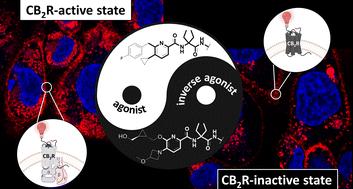
The diversity of physiological roles of the endocannabinoid system has turned it into an attractive yet elusive therapeutic target. However, chemical probes with various functionalities could pave the way for a better understanding of the endocannabinoid system at the cellular level. Notably, inverse agonists of CB2R – a key receptor of the endocannabinoid system – lagged behind despite the evidence regarding the therapeutic potential of its antagonism. Herein, we report a matched fluorescent probe pair based on a common chemotype to address and visualize both the active and inactive states of CB2R, selectively. Alongside extensive cross-validation by flow cytometry, time-lapse confocal microscopy, and super-resolution microscopy, we successfully visualize the intracellular localization of CB2R pools in live cells. The synthetic simplicity, together with the high CB2R-selectivity and specificity of our probes, turns them into valuable tools in chemical biology and drug development that can benefit the clinical translatability of CB2R-based drugs.
期刊介绍:
Chemical Science is a journal that encompasses various disciplines within the chemical sciences. Its scope includes publishing ground-breaking research with significant implications for its respective field, as well as appealing to a wider audience in related areas. To be considered for publication, articles must showcase innovative and original advances in their field of study and be presented in a manner that is understandable to scientists from diverse backgrounds. However, the journal generally does not publish highly specialized research.




 京公网安备 11010802042870号
京ICP备2023020795号-1
京公网安备 11010802042870号
京ICP备2023020795号-1

 分享
分享
 求助内容:
求助内容: 应助结果提醒方式:
 扫码关注我们
