William J. Thompson, Buddhima K. P. Maldeni Kankanamalage, Grace C. Thaggard, Dr. Kyoung Chul Park, Dr. Corey R. Martin, Prof. Dr. Jia Niu, Prof. Dr. Jeffery A. Byers, Prof. Dr. Natalia B. Shustova
{"title":"Catalytically Active Site Mapping Realized through Energy Transfer Modeling","authors":"William J. Thompson, Buddhima K. P. Maldeni Kankanamalage, Grace C. Thaggard, Dr. Kyoung Chul Park, Dr. Corey R. Martin, Prof. Dr. Jia Niu, Prof. Dr. Jeffery A. Byers, Prof. Dr. Natalia B. Shustova","doi":"10.1002/anie.202416695","DOIUrl":null,"url":null,"abstract":"<p>The demands of a sustainable chemical industry are a driving force for the development of heterogeneous catalytic platforms exhibiting facile catalyst recovery, recycling, and resilience to diverse reaction conditions. Homogeneous-to-heterogeneous catalyst transitions can be realized through the integration of efficient homogeneous catalysts within porous matrices. Herein, we offer a versatile approach to understanding how guest distribution and evolution impact the catalytic performance of heterogeneous host–guest catalytic platforms by implementing the resonance energy transfer (RET) concept using fluorescent model systems mimicking the steric constraints of targeted catalysts. Using the RET-based methodology, we mapped condition-dependent guest (re)distribution within a porous support on the example of modular matrices such as metal–organic frameworks (MOFs). Furthermore, we correlate RET results performed on the model systems with the catalytic performance of two MOF-encapsulated catalysts used to promote CO<sub>2</sub> hydrogenation and ring-closing metathesis. Guests are incorporated using aperture-opening encapsulation, and catalyst redistribution is not observed under practical reaction conditions, showcasing a pathway to advance catalyst recyclability in the case of host–guest platforms. These studies represent the first generalizable approach for mapping the guest distribution in heterogeneous host–guest catalytic systems, providing a foundation for predicting and tailoring the performance of catalysts integrated into various porous supports.</p>","PeriodicalId":125,"journal":{"name":"Angewandte Chemie International Edition","volume":"64 4","pages":""},"PeriodicalIF":16.9000,"publicationDate":"2024-10-04","publicationTypes":"Journal Article","fieldsOfStudy":null,"isOpenAccess":false,"openAccessPdf":"","citationCount":"0","resultStr":null,"platform":"Semanticscholar","paperid":null,"PeriodicalName":"Angewandte Chemie International Edition","FirstCategoryId":"92","ListUrlMain":"https://onlinelibrary.wiley.com/doi/10.1002/anie.202416695","RegionNum":1,"RegionCategory":"化学","ArticlePicture":[],"TitleCN":null,"AbstractTextCN":null,"PMCID":null,"EPubDate":"","PubModel":"","JCR":"Q1","JCRName":"CHEMISTRY, MULTIDISCIPLINARY","Score":null,"Total":0}
引用次数: 0
Abstract
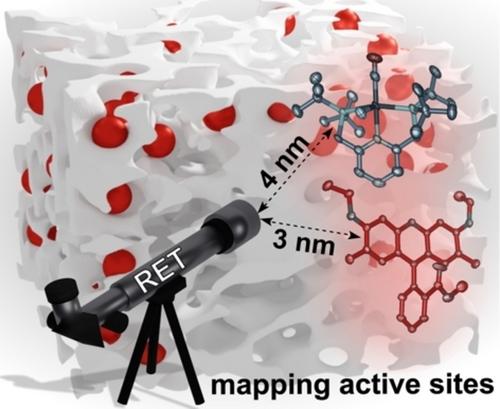
The demands of a sustainable chemical industry are a driving force for the development of heterogeneous catalytic platforms exhibiting facile catalyst recovery, recycling, and resilience to diverse reaction conditions. Homogeneous-to-heterogeneous catalyst transitions can be realized through the integration of efficient homogeneous catalysts within porous matrices. Herein, we offer a versatile approach to understanding how guest distribution and evolution impact the catalytic performance of heterogeneous host–guest catalytic platforms by implementing the resonance energy transfer (RET) concept using fluorescent model systems mimicking the steric constraints of targeted catalysts. Using the RET-based methodology, we mapped condition-dependent guest (re)distribution within a porous support on the example of modular matrices such as metal–organic frameworks (MOFs). Furthermore, we correlate RET results performed on the model systems with the catalytic performance of two MOF-encapsulated catalysts used to promote CO2 hydrogenation and ring-closing metathesis. Guests are incorporated using aperture-opening encapsulation, and catalyst redistribution is not observed under practical reaction conditions, showcasing a pathway to advance catalyst recyclability in the case of host–guest platforms. These studies represent the first generalizable approach for mapping the guest distribution in heterogeneous host–guest catalytic systems, providing a foundation for predicting and tailoring the performance of catalysts integrated into various porous supports.
可持续化学工业的需求是开发异相催化平台的驱动力,这种平台可以方便地回收、循环利用催化剂,并能适应不同的反应条件。通过在多孔基质中整合高效均相催化剂,可以实现催化剂从均相到异相的转变。在此,我们利用荧光模型系统模拟目标催化剂的立体限制,通过实施共振能量转移(RET)概念,提供了一种多用途方法来了解客体分布和演化如何影响异相宿主-客体催化平台的催化性能。利用基于 RET 的方法,我们以金属有机框架 (MOF) 等模块化基质为例,绘制了多孔载体内随条件变化的客体(再)分布图。此外,我们还将对模型系统进行的 RET 结果与用于促进二氧化碳加氢和闭环偏析的两种 MOF 封装催化剂的催化性能进行了关联。客体是通过开孔封装掺入的,在实际反应条件下没有观察到催化剂的再分布,这展示了在宿主-客体平台中提高催化剂可回收性的途径。这些研究首次提出了绘制异质主-客体催化体系中客体分布图的通用方法,为预测和调整集成到各种多孔载体中的催化剂的性能奠定了基础。
期刊介绍:
Angewandte Chemie, a journal of the German Chemical Society (GDCh), maintains a leading position among scholarly journals in general chemistry with an impressive Impact Factor of 16.6 (2022 Journal Citation Reports, Clarivate, 2023). Published weekly in a reader-friendly format, it features new articles almost every day. Established in 1887, Angewandte Chemie is a prominent chemistry journal, offering a dynamic blend of Review-type articles, Highlights, Communications, and Research Articles on a weekly basis, making it unique in the field.



 京公网安备 11010802042870号
京ICP备2023020795号-1
京公网安备 11010802042870号
京ICP备2023020795号-1

 分享
分享
 求助内容:
求助内容: 应助结果提醒方式:
 扫码关注我们
