Ruthenium atoms anchored on oxygen-modified molybdenum disulfide with strong interfacial coupling as efficient and stable catalysts for lithium–oxygen batteries
Xuecheng Cao , Minghui Cui , Kaiqi Fang , Liting Yan , Hongyu Gong , Yu Zhang , Xiangjun Zheng , Ruizhi Yang
{"title":"Ruthenium atoms anchored on oxygen-modified molybdenum disulfide with strong interfacial coupling as efficient and stable catalysts for lithium–oxygen batteries","authors":"Xuecheng Cao , Minghui Cui , Kaiqi Fang , Liting Yan , Hongyu Gong , Yu Zhang , Xiangjun Zheng , Ruizhi Yang","doi":"10.1016/j.jcis.2024.09.226","DOIUrl":null,"url":null,"abstract":"<div><div>Rechargeable non-aqueous lithium-oxygen batteries (LOBs) have garnered increasing attention owing to their high theoretical energy density. However, their slow cathodic kinetics hinder efficient battery reactions. Nanoscale catalysts can effectively enhance electrocatalytic activity and atomic utilization efficiency. However, the agglomeration of nanoscale catalysts (such as cluster and single atoms) during continuous discharge/charge cycles leads to decreased electrochemical performance and poor cyclic stability. Herein, the ruthenium (Ru) atomic sites anchored on an O-doped molybdenum disulfide (O-MoS<sub>2</sub>) catalyst (designated as Ru/O-MoS<sub>2</sub>) was fabricated using a facile impregnation and calcination method. Strong Ru-O coupling between Ru atoms and the O-MoS<sub>2</sub> substrate optimizes the localized electronic structure, resulting in improved electrochemical performance and enhanced resistance to Ostwald ripening. When employed as a cathode catalyst for LOBs, Ru/O-MoS<sub>2</sub> catalyst exhibits a high reversible specific capacity (18700.5 (±59.8) mAh g<sup>−1</sup>), good rate capability, and enhanced long-term stability (115 cycles, 1200 h). This study encourages facile and efficient strategies for the development of effective and stable electrocatalysts for use in LOBs.</div></div>","PeriodicalId":351,"journal":{"name":"Journal of Colloid and Interface Science","volume":"679 ","pages":"Pages 234-242"},"PeriodicalIF":9.7000,"publicationDate":"2025-02-01","publicationTypes":"Journal Article","fieldsOfStudy":null,"isOpenAccess":false,"openAccessPdf":"","citationCount":"0","resultStr":null,"platform":"Semanticscholar","paperid":null,"PeriodicalName":"Journal of Colloid and Interface Science","FirstCategoryId":"92","ListUrlMain":"https://www.sciencedirect.com/science/article/pii/S0021979724022914","RegionNum":1,"RegionCategory":"化学","ArticlePicture":[],"TitleCN":null,"AbstractTextCN":null,"PMCID":null,"EPubDate":"2024/9/28 0:00:00","PubModel":"Epub","JCR":"Q1","JCRName":"CHEMISTRY, PHYSICAL","Score":null,"Total":0}
引用次数: 0
Abstract
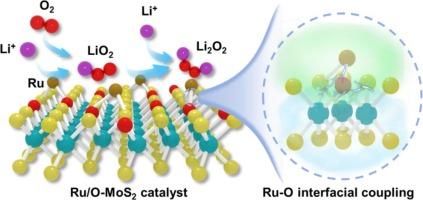
Rechargeable non-aqueous lithium-oxygen batteries (LOBs) have garnered increasing attention owing to their high theoretical energy density. However, their slow cathodic kinetics hinder efficient battery reactions. Nanoscale catalysts can effectively enhance electrocatalytic activity and atomic utilization efficiency. However, the agglomeration of nanoscale catalysts (such as cluster and single atoms) during continuous discharge/charge cycles leads to decreased electrochemical performance and poor cyclic stability. Herein, the ruthenium (Ru) atomic sites anchored on an O-doped molybdenum disulfide (O-MoS2) catalyst (designated as Ru/O-MoS2) was fabricated using a facile impregnation and calcination method. Strong Ru-O coupling between Ru atoms and the O-MoS2 substrate optimizes the localized electronic structure, resulting in improved electrochemical performance and enhanced resistance to Ostwald ripening. When employed as a cathode catalyst for LOBs, Ru/O-MoS2 catalyst exhibits a high reversible specific capacity (18700.5 (±59.8) mAh g−1), good rate capability, and enhanced long-term stability (115 cycles, 1200 h). This study encourages facile and efficient strategies for the development of effective and stable electrocatalysts for use in LOBs.
期刊介绍:
The Journal of Colloid and Interface Science publishes original research findings on the fundamental principles of colloid and interface science, as well as innovative applications in various fields. The criteria for publication include impact, quality, novelty, and originality.
Emphasis:
The journal emphasizes fundamental scientific innovation within the following categories:
A.Colloidal Materials and Nanomaterials
B.Soft Colloidal and Self-Assembly Systems
C.Adsorption, Catalysis, and Electrochemistry
D.Interfacial Processes, Capillarity, and Wetting
E.Biomaterials and Nanomedicine
F.Energy Conversion and Storage, and Environmental Technologies




 京公网安备 11010802042870号
京ICP备2023020795号-1
京公网安备 11010802042870号
京ICP备2023020795号-1

 分享
分享
 求助内容:
求助内容: 应助结果提醒方式:
 扫码关注我们
