Analyzing the dynamics of complicated and uncomplicated appendicitis during the COVID-19 pandemic in Seoul, Korea: a multifaceted time series approach.
{"title":"Analyzing the dynamics of complicated and uncomplicated appendicitis during the COVID-19 pandemic in Seoul, Korea: a multifaceted time series approach.","authors":"Kiook Baek, Chulyong Park","doi":"10.4178/epih.e2024081","DOIUrl":null,"url":null,"abstract":"<p><strong>Objectives: </strong>This study investigated the impact of the coronavirus disease 2019 (COVID-19) pandemic and associated control strategies on the incidence of appendicitis in Seoul, using data from 2018 to 2020 from Korea's National Health Insurance.</p><p><strong>Methods: </strong>We analyzed records of total, complicated, and uncomplicated appendicitis cases, as well as the ratio of complicated to uncomplicated appendicitis, using natural spline and piecewise regression models to identify trends and breakpoints. Bayesian structural time-series (BSTS) models were used to evaluate the causal impact of social distancing on appendicitis incidences.</p><p><strong>Results: </strong>The spline regression analysis indicated decreasing trends in both total and uncomplicated appendicitis cases. Conversely, the incidence of complicated appendicitis and the ratio of complicated to uncomplicated cases increased. Breakpoints for a decline in uncomplicated appendicitis and a rise in the ratio occurred at 31 weeks in 2020 (95% confidence interval [CI], 23.2 to 38.8) and at 33.9 weeks (95% CI, 28.3 to 39.6), respectively. The BSTS model demonstrated a 7.8% reduction in total appendicitis cases (95% credible interval [CrI], -12.1 to -3.3). It also showed a 17.4% decrease in uncomplicated cases (95% CrI, -22.2 to -12.3) and increases of 12.8% (95% CrI, 4.9 to 22.0) in complicated cases and 39.0% (95% CrI, 27.0 to 53.3) in the ratio of complicated to uncomplicated appendicitis.</p><p><strong>Conclusions: </strong>The COVID-19 pandemic resulted in a decrease in both total and uncomplicated appendicitis cases, while the number of complicated cases increased. Reduced medical visits likely accounted for these changes. Strategies are needed to manage changes in disease pathophysiology resulting from altered healthcare utilization during health crises.</p>","PeriodicalId":48543,"journal":{"name":"Epidemiology and Health","volume":" ","pages":"e2024081"},"PeriodicalIF":2.2000,"publicationDate":"2024-01-01","publicationTypes":"Journal Article","fieldsOfStudy":null,"isOpenAccess":false,"openAccessPdf":"https://www.ncbi.nlm.nih.gov/pmc/articles/PMC11832239/pdf/","citationCount":"0","resultStr":null,"platform":"Semanticscholar","paperid":null,"PeriodicalName":"Epidemiology and Health","FirstCategoryId":"3","ListUrlMain":"https://doi.org/10.4178/epih.e2024081","RegionNum":4,"RegionCategory":"医学","ArticlePicture":[],"TitleCN":null,"AbstractTextCN":null,"PMCID":null,"EPubDate":"2024/10/1 0:00:00","PubModel":"Epub","JCR":"Q2","JCRName":"PUBLIC, ENVIRONMENTAL & OCCUPATIONAL HEALTH","Score":null,"Total":0}
引用次数: 0
Abstract
Objectives: This study investigated the impact of the coronavirus disease 2019 (COVID-19) pandemic and associated control strategies on the incidence of appendicitis in Seoul, using data from 2018 to 2020 from Korea's National Health Insurance.
Methods: We analyzed records of total, complicated, and uncomplicated appendicitis cases, as well as the ratio of complicated to uncomplicated appendicitis, using natural spline and piecewise regression models to identify trends and breakpoints. Bayesian structural time-series (BSTS) models were used to evaluate the causal impact of social distancing on appendicitis incidences.
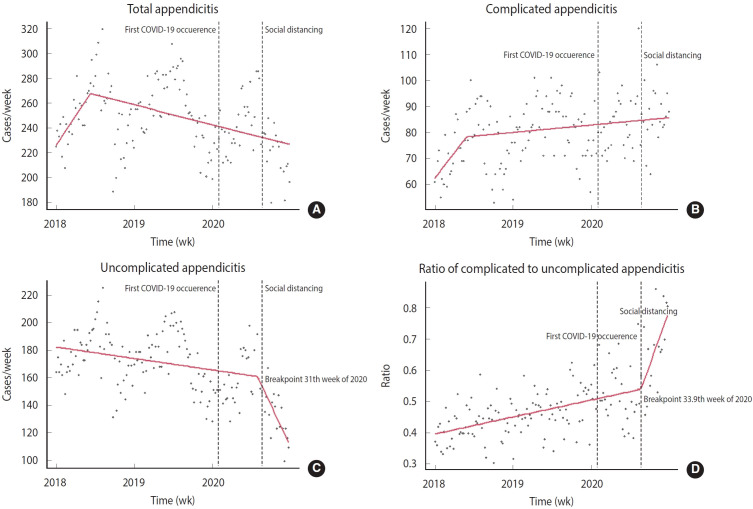
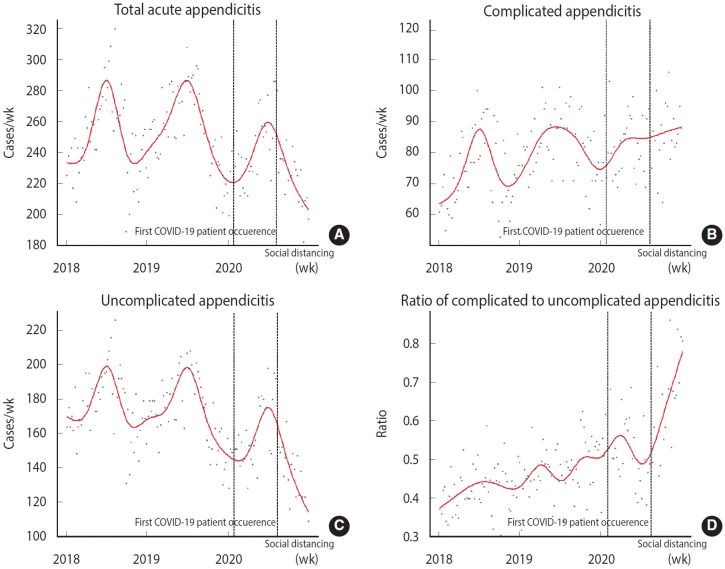
Results: The spline regression analysis indicated decreasing trends in both total and uncomplicated appendicitis cases. Conversely, the incidence of complicated appendicitis and the ratio of complicated to uncomplicated cases increased. Breakpoints for a decline in uncomplicated appendicitis and a rise in the ratio occurred at 31 weeks in 2020 (95% confidence interval [CI], 23.2 to 38.8) and at 33.9 weeks (95% CI, 28.3 to 39.6), respectively. The BSTS model demonstrated a 7.8% reduction in total appendicitis cases (95% credible interval [CrI], -12.1 to -3.3). It also showed a 17.4% decrease in uncomplicated cases (95% CrI, -22.2 to -12.3) and increases of 12.8% (95% CrI, 4.9 to 22.0) in complicated cases and 39.0% (95% CrI, 27.0 to 53.3) in the ratio of complicated to uncomplicated appendicitis.
Conclusions: The COVID-19 pandemic resulted in a decrease in both total and uncomplicated appendicitis cases, while the number of complicated cases increased. Reduced medical visits likely accounted for these changes. Strategies are needed to manage changes in disease pathophysiology resulting from altered healthcare utilization during health crises.
期刊介绍:
Epidemiology and Health (epiH) is an electronic journal publishing papers in all areas of epidemiology and public health. It is indexed on PubMed Central and the scope is wide-ranging: including descriptive, analytical and molecular epidemiology; primary preventive measures; screening approaches and secondary prevention; clinical epidemiology; and all aspects of communicable and non-communicable diseases prevention. The epiH publishes original research, and also welcomes review articles and meta-analyses, cohort profiles and data profiles, epidemic and case investigations, descriptions and applications of new methods, and discussions of research theory or public health policy. We give special consideration to papers from developing countries.



 京公网安备 11010802042870号
京ICP备2023020795号-1
京公网安备 11010802042870号
京ICP备2023020795号-1

 分享
分享
 求助内容:
求助内容: 应助结果提醒方式:
 扫码关注我们
