Haisheng Wei, Jing Li, Xiaorui Yan, Tiantian Liu, Kairui Li, Dan Feng and Yujing Ren
{"title":"A long-range synergistic effect between Ptn clusters and Zn1 single atoms for efficient selective hydrogenations†","authors":"Haisheng Wei, Jing Li, Xiaorui Yan, Tiantian Liu, Kairui Li, Dan Feng and Yujing Ren","doi":"10.1039/D4QI02027H","DOIUrl":null,"url":null,"abstract":"<p >Supported platinum group metal (PGM) catalysts are extensively utilized in catalytic hydrogenations. However, the adsorption energies on single PGM surfaces present the inherent scaling properties, which often lead to increased hydrogenation activity at the expense of selectivity. To address this challenge, we developed a space-separated strategy by confining few-atom Pt<small><sub><em>n</em></sub></small> clusters in Zn<small><sub>1</sub></small>-N<small><sub>3</sub></small> sites decorated with microporous carbon material (Pt<small><sub><em>n</em></sub></small>@Zn<small><sub>1</sub></small>-N–C) to break the scaling relationship in selective hydrogenations. In detail, Pt<small><sub><em>n</em></sub></small> clusters are more favorable for H<small><sub>2</sub></small> activation, while the Zn<small><sub>1</sub></small>-N<small><sub>3</sub></small> single-atom sites can preferentially adsorb functional groups with electron-rich oxygen atoms. Benefiting from this long-range synergistic effect, the Pt<small><sub><em>n</em></sub></small>@Zn<small><sub>1</sub></small>-N–C catalyst displays superior catalytic performance in the selective hydrogenation of nitroarenes (>99% selectivity at ∼100% conversion, and sulfur compound-resistant hydrogenations) and excellent stability in the reverse water gas shift reaction (>99% selectivity over 40 hours at 600 °C). Our findings provide a confinement approach for further improving catalytic performance in selective hydrogenations.</p>","PeriodicalId":79,"journal":{"name":"Inorganic Chemistry Frontiers","volume":" 22","pages":" 7822-7830"},"PeriodicalIF":6.4000,"publicationDate":"2024-10-04","publicationTypes":"Journal Article","fieldsOfStudy":null,"isOpenAccess":false,"openAccessPdf":"","citationCount":"0","resultStr":null,"platform":"Semanticscholar","paperid":null,"PeriodicalName":"Inorganic Chemistry Frontiers","FirstCategoryId":"92","ListUrlMain":"https://pubs.rsc.org/en/content/articlelanding/2024/qi/d4qi02027h","RegionNum":1,"RegionCategory":"化学","ArticlePicture":[],"TitleCN":null,"AbstractTextCN":null,"PMCID":null,"EPubDate":"","PubModel":"","JCR":"Q1","JCRName":"CHEMISTRY, INORGANIC & NUCLEAR","Score":null,"Total":0}
引用次数: 0
Abstract
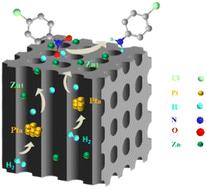
Supported platinum group metal (PGM) catalysts are extensively utilized in catalytic hydrogenations. However, the adsorption energies on single PGM surfaces present the inherent scaling properties, which often lead to increased hydrogenation activity at the expense of selectivity. To address this challenge, we developed a space-separated strategy by confining few-atom Ptn clusters in Zn1-N3 sites decorated with microporous carbon material (Ptn@Zn1-N–C) to break the scaling relationship in selective hydrogenations. In detail, Ptn clusters are more favorable for H2 activation, while the Zn1-N3 single-atom sites can preferentially adsorb functional groups with electron-rich oxygen atoms. Benefiting from this long-range synergistic effect, the Ptn@Zn1-N–C catalyst displays superior catalytic performance in the selective hydrogenation of nitroarenes (>99% selectivity at ∼100% conversion, and sulfur compound-resistant hydrogenations) and excellent stability in the reverse water gas shift reaction (>99% selectivity over 40 hours at 600 °C). Our findings provide a confinement approach for further improving catalytic performance in selective hydrogenations.



 京公网安备 11010802042870号
京ICP备2023020795号-1
京公网安备 11010802042870号
京ICP备2023020795号-1

 分享
分享
 求助内容:
求助内容: 应助结果提醒方式:
 扫码关注我们
