Junkang Ge, Jun Zhao, Lei Li, Zhihao Li, Hui Wang, Xiaodong Zhang and Yi Xie
{"title":"Boosting exciton dissociation in anion and cation co-doped polymeric semiconductor for selective oxidation reaction†","authors":"Junkang Ge, Jun Zhao, Lei Li, Zhihao Li, Hui Wang, Xiaodong Zhang and Yi Xie","doi":"10.1039/D4SC04201H","DOIUrl":null,"url":null,"abstract":"<p >The inherently low dielectric properties and weak shielding effect of polymeric semiconductors cause excitons to dominate their photoexcitation process, which greatly restricts the photocatalytic performances mediated by charge carriers. Here, an anion and cation co-doping strategy was proposed to weaken the binding energy of excitons by forming distinct positive and negative charge regions, where the charge asymmetry produced an external potential to drive exciton dissociation. Using polymeric carbon nitride as a typical model framework, we show that the incorporation of anions (Cl<small><sup>−</sup></small>, Br<small><sup>−</sup></small>, I<small><sup>−</sup></small>) and cations (Na<small><sup>+</sup></small>, K<small><sup>+</sup></small>) could create a significant spatial separation of electrons and holes, thereby promoting exciton dissociation. Specifically, K<small><sup>+</sup></small> and Cl<small><sup>−</sup></small> co-doped polymeric carbon nitride could effectively promote the dissociation of excitons into hot carriers, contributing to the outstanding efficiency in hot-electron-involved photocatalytic processes, such as the generation of superoxide radicals (O<small><sub>2</sub></small>˙<small><sup>−</sup></small>) and the oxidation of phenylboric acid under visible light. This work presents a practical approach for promoting excitons dissociation through the introduction of charge asymmetry.</p>","PeriodicalId":9909,"journal":{"name":"Chemical Science","volume":" 44","pages":" 18543-18548"},"PeriodicalIF":7.4000,"publicationDate":"2024-10-04","publicationTypes":"Journal Article","fieldsOfStudy":null,"isOpenAccess":false,"openAccessPdf":"https://pubs.rsc.org/en/content/articlepdf/2024/sc/d4sc04201h?page=search","citationCount":"0","resultStr":null,"platform":"Semanticscholar","paperid":null,"PeriodicalName":"Chemical Science","FirstCategoryId":"92","ListUrlMain":"https://pubs.rsc.org/en/content/articlelanding/2024/sc/d4sc04201h","RegionNum":1,"RegionCategory":"化学","ArticlePicture":[],"TitleCN":null,"AbstractTextCN":null,"PMCID":null,"EPubDate":"","PubModel":"","JCR":"Q1","JCRName":"CHEMISTRY, MULTIDISCIPLINARY","Score":null,"Total":0}
引用次数: 0
Abstract
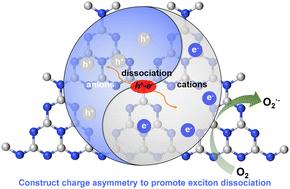
The inherently low dielectric properties and weak shielding effect of polymeric semiconductors cause excitons to dominate their photoexcitation process, which greatly restricts the photocatalytic performances mediated by charge carriers. Here, an anion and cation co-doping strategy was proposed to weaken the binding energy of excitons by forming distinct positive and negative charge regions, where the charge asymmetry produced an external potential to drive exciton dissociation. Using polymeric carbon nitride as a typical model framework, we show that the incorporation of anions (Cl−, Br−, I−) and cations (Na+, K+) could create a significant spatial separation of electrons and holes, thereby promoting exciton dissociation. Specifically, K+ and Cl− co-doped polymeric carbon nitride could effectively promote the dissociation of excitons into hot carriers, contributing to the outstanding efficiency in hot-electron-involved photocatalytic processes, such as the generation of superoxide radicals (O2˙−) and the oxidation of phenylboric acid under visible light. This work presents a practical approach for promoting excitons dissociation through the introduction of charge asymmetry.
期刊介绍:
Chemical Science is a journal that encompasses various disciplines within the chemical sciences. Its scope includes publishing ground-breaking research with significant implications for its respective field, as well as appealing to a wider audience in related areas. To be considered for publication, articles must showcase innovative and original advances in their field of study and be presented in a manner that is understandable to scientists from diverse backgrounds. However, the journal generally does not publish highly specialized research.




 京公网安备 11010802042870号
京ICP备2023020795号-1
京公网安备 11010802042870号
京ICP备2023020795号-1

 分享
分享
 求助内容:
求助内容: 应助结果提醒方式:
 扫码关注我们
