Yao-Yao Jiang , Shuai-Ting Yan , Shan-Zhuo Zhang , Meng Wang , Wei-Ming Diao , Jun Li , Xiao-Min Fang , Hang Yin
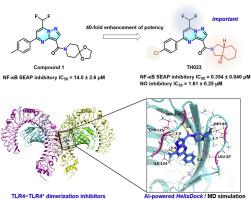
{"title":"Discovery of pyrazolo[1,5-a]pyrimidine derivatives targeting TLR4−TLR4∗ homodimerization via AI-powered next-generation screening","authors":"Yao-Yao Jiang , Shuai-Ting Yan , Shan-Zhuo Zhang , Meng Wang , Wei-Ming Diao , Jun Li , Xiao-Min Fang , Hang Yin","doi":"10.1016/j.ejmech.2024.116945","DOIUrl":null,"url":null,"abstract":"<div><div>TLR4 signaling is instrumental in orchestrating multiple aspects of innate immunity. Developing small molecule inhibitors targeting the TLR4 pathway holds potential therapeutic promise for TLR4-related disorders. Herein, an artificial intelligence (AI)-powered next-generation screening approach, employing <em>HelixVS</em> and <em>HelixDock</em>, was utilized to focus on the TLR4−TLR4∗ (a second copy of TLR4) homodimerization surface, leading to the identification of a potent pyrazolo[1,5-<em>a</em>]pyrimidine derivative, designated as compound <strong>1</strong>. An extensive structure−activity relationship (SAR) exploration culminated in the discovery of the lead compound <strong>TH023</strong>, which effectively blocked the LPS-stimulated NF-κB activation and nitric oxide overproduction in HEK-Blue hTLR4 and RAW264.7 cells, with IC<sub>50</sub> values of 0.354 and 1.61 μM, respectively. Molecular dynamic (MD) simulations indicated that <strong>TH023</strong> stabilized TLR4−MD-2 and disrupted its association with TLR4∗. Moreover, <strong>TH023</strong> alleviated the lung injury and decreased pro-inflammatory cytokine levels in LPS-induced septic mice. These findings not only illuminated the strategic advantage of <em>HelixDock</em> in advancing the frontiers of AI-driven drug discovery, but also provided valuable structural insights for the rational design of TLR4−TLR4∗ protein−protein interaction (PPI) inhibitors based on the pyrazolo[1,5-<em>a</em>]pyrimidine scaffold. Overall, this study validated a new strategy for TLR4 signaling regulation by targeting its dimerization, thereby underscoring the therapeutic promise of <strong>TH023</strong> in treating TLR4-mediated inflammatory diseases.</div></div>","PeriodicalId":314,"journal":{"name":"European Journal of Medicinal Chemistry","volume":"280 ","pages":"Article 116945"},"PeriodicalIF":5.9000,"publicationDate":"2024-12-15","publicationTypes":"Journal Article","fieldsOfStudy":null,"isOpenAccess":false,"openAccessPdf":"","citationCount":"0","resultStr":null,"platform":"Semanticscholar","paperid":null,"PeriodicalName":"European Journal of Medicinal Chemistry","FirstCategoryId":"3","ListUrlMain":"https://www.sciencedirect.com/science/article/pii/S0223523424008262","RegionNum":2,"RegionCategory":"医学","ArticlePicture":[],"TitleCN":null,"AbstractTextCN":null,"PMCID":null,"EPubDate":"2024/10/6 0:00:00","PubModel":"Epub","JCR":"Q1","JCRName":"CHEMISTRY, MEDICINAL","Score":null,"Total":0}
引用次数: 0
Abstract
TLR4 signaling is instrumental in orchestrating multiple aspects of innate immunity. Developing small molecule inhibitors targeting the TLR4 pathway holds potential therapeutic promise for TLR4-related disorders. Herein, an artificial intelligence (AI)-powered next-generation screening approach, employing HelixVS and HelixDock, was utilized to focus on the TLR4−TLR4∗ (a second copy of TLR4) homodimerization surface, leading to the identification of a potent pyrazolo[1,5-a]pyrimidine derivative, designated as compound 1. An extensive structure−activity relationship (SAR) exploration culminated in the discovery of the lead compound TH023, which effectively blocked the LPS-stimulated NF-κB activation and nitric oxide overproduction in HEK-Blue hTLR4 and RAW264.7 cells, with IC50 values of 0.354 and 1.61 μM, respectively. Molecular dynamic (MD) simulations indicated that TH023 stabilized TLR4−MD-2 and disrupted its association with TLR4∗. Moreover, TH023 alleviated the lung injury and decreased pro-inflammatory cytokine levels in LPS-induced septic mice. These findings not only illuminated the strategic advantage of HelixDock in advancing the frontiers of AI-driven drug discovery, but also provided valuable structural insights for the rational design of TLR4−TLR4∗ protein−protein interaction (PPI) inhibitors based on the pyrazolo[1,5-a]pyrimidine scaffold. Overall, this study validated a new strategy for TLR4 signaling regulation by targeting its dimerization, thereby underscoring the therapeutic promise of TH023 in treating TLR4-mediated inflammatory diseases.
期刊介绍:
The European Journal of Medicinal Chemistry is a global journal that publishes studies on all aspects of medicinal chemistry. It provides a medium for publication of original papers and also welcomes critical review papers.
A typical paper would report on the organic synthesis, characterization and pharmacological evaluation of compounds. Other topics of interest are drug design, QSAR, molecular modeling, drug-receptor interactions, molecular aspects of drug metabolism, prodrug synthesis and drug targeting. The journal expects manuscripts to present the rational for a study, provide insight into the design of compounds or understanding of mechanism, or clarify the targets.




 京公网安备 11010802042870号
京ICP备2023020795号-1
京公网安备 11010802042870号
京ICP备2023020795号-1

 分享
分享
 求助内容:
求助内容: 应助结果提醒方式:
 扫码关注我们
