{"title":"Antiepileptic drugs, folate one-carbon metabolism, genetics, and epigenetics: Congenital, developmental, and neuropsychological risks and antiepileptic action","authors":"Edward H. Reynolds","doi":"10.1111/epi.18120","DOIUrl":null,"url":null,"abstract":"<p>Folate and one-carbon metabolism are fundamental to fetal, embryo, and child development and to brain health at all ages.<span><sup>1, 2</sup></span></p><p>The term folate refers to several naturally occurring reduced folate forms that function as cofactors in the transfer and utilization of one-carbon groups. The folate cycle is a mechanism for the synthesis of methyl groups by the progressive reduction of a carbon unit derived from serine (Figure 1). The methyl groups then enter the methylation cycle by addition to homocysteine to form methionine in a reaction catalyzed by the enzyme methionine synthase, which requires vitamin B12 as a cofactor (Figure 1). Folate and vitamin B12 work in symmetry, and their relationship is crucial to the function of both the folate and methylation cycles in which methyl groups are ultimately transferred to S-adenosyl methionine (SAM), the methyl donor in numerous transmethylation reactions, including the methylation of DNA, RNA, and neurotransmitters. At the same time, the folate cycle is required for the synthesis of purines and thymidine, nucleotides important for DNA and RNA synthesis (Figure 1). Thus the folate and methylation cycles are essential for both the synthesis and regulation of expression of DNA and RNA and therefore to genetics and epigenetics.</p><p>It is well established that deficiency or inborn errors of either folate or vitamin B12 may lead to a wide range of overlapping neuropsychiatric and developmental disorders, with or without hematological manifestations.<span><sup>1, 2</sup></span> The importance of folate one-carbon metabolism to the nervous system was reinforced in the 1980s and 1990s with the discovery that periconceptual folic acid can reduce the incidence of neural tube defects (NTDs), especially in women with folate deficiency, leading to the widespread recommendation for women planning pregnancies to take prophylactic folic acid before and in the early stages of pregnancy.<span><sup>3</sup></span> As most pregnancies are unplanned and as folate deficiency is common in many countries, especially in disadvantaged populations, approximately 80 countries have since introduced fortification of wheat, grain, maize, or rice with folic acid, resulting in reductions in the incidence of NTDs of 20%–60%.<span><sup>4, 5</sup></span></p><p>Most antiepileptic drugs (AEDs) interfere with folate one-carbon metabolism in different ways. In the 1960s and 1970s, my colleagues and I found that the frontline drugs phenobarbitone, primidone, and phenytoin caused a reduction in serum, red cell, and cerebrospinal fluid folate levels in a high proportion of patients with epilepsy by uncertain mechanisms.<span><sup>6</sup></span> Treatment with folic acid for 1–3 years improved the mental state, mainly alertness, motivation, mood, and sociability, in many patients and exacerbated the epilepsy in a few.<span><sup>7</sup></span> Experimental studies by several groups confirmed that folate derivatives were convulsant, especially if the highly efficient blood–brain barrier (BBB) mechanism for the transport of methylfolate into the brain is bypassed.<span><sup>8-10</sup></span> I therefore proposed that (1) AED-induced folate deficiency may contribute to some cognitive, mood, and psychiatric complications of epilepsy; and (2) the antiepileptic action of the drugs may be related in part to their antifolate action.<span><sup>6, 7</sup></span></p><p>At that time, almost nothing was known about the role of folate in the nervous system except that it was harmful if administered inappropriately to patients with pernicious anemia or vitamin B12 deficiency.<span><sup>11</sup></span> In the 1970s and 1980s, two new AEDs with very different chemical structures, namely, carbamazepine and sodium valproate, were marketed, and both drugs exhibited mild lowering of blood folate levels.<span><sup>12, 13</sup></span> Interest however waned in 1990, when Wellcome Laboratories marketed lamotrigine as a novel AED with little or no antifolate activity. Interestingly, the development of lamotrigine was based on the antifolate–antiepileptic hypothesis. Wellcome Laboratories already had two antifolate drugs in their portfolio: (1) pyrimethamine, a potent inhibitor of mammalian dihydrofolate reductase (DHFR), utilized as an antimalarial agent, which Wellcome reported was a potent AED; and (2) a related pyrimidine, trimethoprim, which was a weaker DHFR inhibitor and weaker AED. At the same time, they confirmed experimentally that folates, including folinic acid, were convulsant. By manipulating the structure of pyrimethamine, Wellcome reported that the resulting lamotrigine retained the antiepileptic potency of the former but was now a weaker DHFR inhibitor.<span><sup>14</sup></span></p><p>Also in the 1990s, a new measure of disturbed one-carbon and methylation metabolism became available, namely, plasma homocysteine. Since then, numerous studies of adults and children with epilepsy have confirmed that phenobarbitone, phenytoin, carbamazepine, and valproate are significantly associated with a rise in plasma homocysteine.<span><sup>15-17</sup></span> More recently, the same has been reported for levetiracetam, oxcarbazepine, and topiramate.<span><sup>18</sup></span> The rise in plasma homocysteine is invariably correlated with a fall in serum folate, and both are reversible by treatment with folic acid, which may also improve mood.<span><sup>19</sup></span> Genetic polymorphisms of folate and homocysteine, especially the C677T variant of methylene tetrahydrofolate (<i>MTHFR</i>), increases the vulnerability to the above AED-induced disturbances in one-carbon metabolism.<span><sup>15, 20</sup></span></p><p>With increasing evidence and concern about the congenital and developmental risks associated with valproate, this drug has received the most recent research attention. We now know that valproate can impact folate one-carbon and methylation metabolism in multiple ways.<span><sup>21</sup></span> It reduces the transport of methylfolate across the BBB<span><sup>22</sup></span> and the placenta,<span><sup>23</sup></span> perhaps by targeting folate receptors FOLR1 and FRalpha. It may also interfere with both glutamate formyl transferase, the enzyme mediating the formation of formyl tetrahydrofolate (folinic acid), and methionine adenosyl transferase, the enzyme responsible for the synthesis of SAM.<span><sup>17, 24, 25</sup></span></p><p>In the light of the above role of folate one-carbon metabolism in neural development and of the impact of valproate on the folate and methylation cycles, it is certain that the latter mechanisms contribute at least in part to the congenital and developmental risks associated with valproate and probably other AEDs. A particular recent concern has been the experimental evidence and clinical suspicion that congenital risks can be transmitted to subsequent untreated generations by both young women and men exposed to valproate.<span><sup>26</sup></span> This may perhaps be related to the induction of specific regions of DNA hypomethylation, which has been observed especially with both valproate and lamotrigine.<span><sup>27, 28</sup></span> Likewise, the regeneration response of injured spinal neurons to treatment with reduced folates correlated closely with global and gene-specific DNA methylation and was transmissible to four or more untreated generations of rodents.<span><sup>29, 30</sup></span></p><p>Clinical studies in patients with epilepsy have lagged considerably behind the above experimental observations, but a few provide supportive evidence. In a multicenter observational study, periconceptual folic acid exposure was associated with a higher intelligence quotient (IQ) in the offspring at 6 years of follow-up compared with no folic acid exposure for each of the four AEDs studied, including valproate. For all 311 children studied, periconceptual folic acid was associated with an average 5-point higher IQ.<span><sup>31</sup></span> In the Norwegian mother and child cohort, periconceptual folic acid was associated with a fourfold reduction in the risks of delayed language skills at 18 months of follow-up following exposure to many different AEDs.<span><sup>32</sup></span> There are also claims that periconceptual folic acid reduces the risk of autistic traits in children of AED-treated mothers and also of mothers without epilepsy or exposure to AEDs.<span><sup>21</sup></span> It is highly unlikely that the recommended periconceptual daily dose of 400 μg of folic acid will provide adequate protection in the presence of AEDs, and a dose of at least 1 mg, possibly up to 5 mg, has been recommended, pending further studies.<span><sup>21, 32</sup></span></p><p>Research in this clinically important field has been painfully slow, perhaps in part because AED research is dominated by the pharmaceutical industry and there is no financial incentive. For all the above reasons, there is a need for a major research investment. Why do so many of our frontline AEDs interfere with folate one-carbon metabolism and by what mechanisms? How does this interference with the folate and methylation cycles relate to the congenital and developmental risks associated with valproate and other AEDs, and to mood and cognitive disorders in older patients? How best to mitigate or prevent these risks with appropriate prophylactic treatment? Folic acid is an unnatural synthetic product that must first be reduced by DHFR to enter the folate cycle. It is now understood that the human capacity to reduce folic acid is limited and that large numbers of patients have high circulating levels of unmetabolized folic acid with potential harmful consequences, for example, inhibiting the transport of methyl folate across the BBB.<span><sup>33, 34</sup></span> There is also growing clinical and experimental evidence of harms to the nervous system from excess folic acid, possibly related to hypermethylation of DNA and RNA.<span><sup>35, 36</sup></span> Furthermore, excess folic acid can increase the demand for vitamin B12, leading to a fall in vitamin B12 levels.<span><sup>37</sup></span> There has also been considerable debate about the safe upper tolerable dose of folic acid, but this has centered on the possible exposure of whole populations to potential long-term excess folate by fortification policies.<span><sup>38</sup></span> Short-term periconceptual folate is a separate issue, especially in the presence of AEDs. Bearing in mind (1) that vitamin B12 deficiency is also a risk factor for congenital and developmental harms and that vitamin B12 deficiency in pregnancy is common in some countries<span><sup>39, 40</sup></span> and (2) that the relationship between folate and vitamin B12 is crucial to the function of the folate and methylation cycles, it is probable that a combination of a natural folate, such as folinic acid or methylfolate, and vitamin B12 offers the best prophylactic option.<span><sup>21</sup></span></p><p>Finally, what is the relationship between the antifolate and antiepileptic action of the drugs? We know that antifolate drugs are antiepileptic.<span><sup>14</sup></span> It seems to me to be more than a coincidence that so many AEDs of different structure have antifolate one-carbon effects and that natural folates have excitatory properties.<span><sup>17</sup></span> By what mechanisms are folates excitatory?</p><p>These and other questions deserve urgent attention, as they are fundamental not only to AED action and risks but also to neural development and to brain health, involving the folate and methylation cycles, the synthesis and expression of DNA and RNA, and therefore genetics and epigenetics.</p><p>The author declares no conflicts of interest. I confirm that I have read the Journal's position on issues involved in ethical publication and affirm that this report is consistent with those guidelines.</p>","PeriodicalId":11768,"journal":{"name":"Epilepsia","volume":"65 12","pages":"3469-3473"},"PeriodicalIF":6.6000,"publicationDate":"2024-10-07","publicationTypes":"Journal Article","fieldsOfStudy":null,"isOpenAccess":false,"openAccessPdf":"https://onlinelibrary.wiley.com/doi/epdf/10.1111/epi.18120","citationCount":"0","resultStr":null,"platform":"Semanticscholar","paperid":null,"PeriodicalName":"Epilepsia","FirstCategoryId":"3","ListUrlMain":"https://onlinelibrary.wiley.com/doi/10.1111/epi.18120","RegionNum":1,"RegionCategory":"医学","ArticlePicture":[],"TitleCN":null,"AbstractTextCN":null,"PMCID":null,"EPubDate":"","PubModel":"","JCR":"Q1","JCRName":"CLINICAL NEUROLOGY","Score":null,"Total":0}
引用次数: 0
Abstract
Folate and one-carbon metabolism are fundamental to fetal, embryo, and child development and to brain health at all ages.1, 2
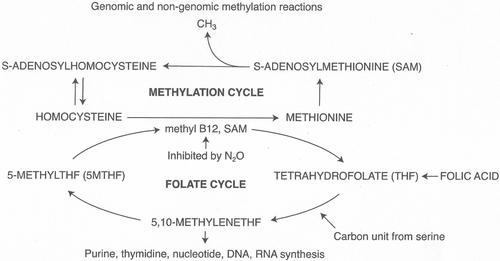
The term folate refers to several naturally occurring reduced folate forms that function as cofactors in the transfer and utilization of one-carbon groups. The folate cycle is a mechanism for the synthesis of methyl groups by the progressive reduction of a carbon unit derived from serine (Figure 1). The methyl groups then enter the methylation cycle by addition to homocysteine to form methionine in a reaction catalyzed by the enzyme methionine synthase, which requires vitamin B12 as a cofactor (Figure 1). Folate and vitamin B12 work in symmetry, and their relationship is crucial to the function of both the folate and methylation cycles in which methyl groups are ultimately transferred to S-adenosyl methionine (SAM), the methyl donor in numerous transmethylation reactions, including the methylation of DNA, RNA, and neurotransmitters. At the same time, the folate cycle is required for the synthesis of purines and thymidine, nucleotides important for DNA and RNA synthesis (Figure 1). Thus the folate and methylation cycles are essential for both the synthesis and regulation of expression of DNA and RNA and therefore to genetics and epigenetics.
It is well established that deficiency or inborn errors of either folate or vitamin B12 may lead to a wide range of overlapping neuropsychiatric and developmental disorders, with or without hematological manifestations.1, 2 The importance of folate one-carbon metabolism to the nervous system was reinforced in the 1980s and 1990s with the discovery that periconceptual folic acid can reduce the incidence of neural tube defects (NTDs), especially in women with folate deficiency, leading to the widespread recommendation for women planning pregnancies to take prophylactic folic acid before and in the early stages of pregnancy.3 As most pregnancies are unplanned and as folate deficiency is common in many countries, especially in disadvantaged populations, approximately 80 countries have since introduced fortification of wheat, grain, maize, or rice with folic acid, resulting in reductions in the incidence of NTDs of 20%–60%.4, 5
Most antiepileptic drugs (AEDs) interfere with folate one-carbon metabolism in different ways. In the 1960s and 1970s, my colleagues and I found that the frontline drugs phenobarbitone, primidone, and phenytoin caused a reduction in serum, red cell, and cerebrospinal fluid folate levels in a high proportion of patients with epilepsy by uncertain mechanisms.6 Treatment with folic acid for 1–3 years improved the mental state, mainly alertness, motivation, mood, and sociability, in many patients and exacerbated the epilepsy in a few.7 Experimental studies by several groups confirmed that folate derivatives were convulsant, especially if the highly efficient blood–brain barrier (BBB) mechanism for the transport of methylfolate into the brain is bypassed.8-10 I therefore proposed that (1) AED-induced folate deficiency may contribute to some cognitive, mood, and psychiatric complications of epilepsy; and (2) the antiepileptic action of the drugs may be related in part to their antifolate action.6, 7
At that time, almost nothing was known about the role of folate in the nervous system except that it was harmful if administered inappropriately to patients with pernicious anemia or vitamin B12 deficiency.11 In the 1970s and 1980s, two new AEDs with very different chemical structures, namely, carbamazepine and sodium valproate, were marketed, and both drugs exhibited mild lowering of blood folate levels.12, 13 Interest however waned in 1990, when Wellcome Laboratories marketed lamotrigine as a novel AED with little or no antifolate activity. Interestingly, the development of lamotrigine was based on the antifolate–antiepileptic hypothesis. Wellcome Laboratories already had two antifolate drugs in their portfolio: (1) pyrimethamine, a potent inhibitor of mammalian dihydrofolate reductase (DHFR), utilized as an antimalarial agent, which Wellcome reported was a potent AED; and (2) a related pyrimidine, trimethoprim, which was a weaker DHFR inhibitor and weaker AED. At the same time, they confirmed experimentally that folates, including folinic acid, were convulsant. By manipulating the structure of pyrimethamine, Wellcome reported that the resulting lamotrigine retained the antiepileptic potency of the former but was now a weaker DHFR inhibitor.14
Also in the 1990s, a new measure of disturbed one-carbon and methylation metabolism became available, namely, plasma homocysteine. Since then, numerous studies of adults and children with epilepsy have confirmed that phenobarbitone, phenytoin, carbamazepine, and valproate are significantly associated with a rise in plasma homocysteine.15-17 More recently, the same has been reported for levetiracetam, oxcarbazepine, and topiramate.18 The rise in plasma homocysteine is invariably correlated with a fall in serum folate, and both are reversible by treatment with folic acid, which may also improve mood.19 Genetic polymorphisms of folate and homocysteine, especially the C677T variant of methylene tetrahydrofolate (MTHFR), increases the vulnerability to the above AED-induced disturbances in one-carbon metabolism.15, 20
With increasing evidence and concern about the congenital and developmental risks associated with valproate, this drug has received the most recent research attention. We now know that valproate can impact folate one-carbon and methylation metabolism in multiple ways.21 It reduces the transport of methylfolate across the BBB22 and the placenta,23 perhaps by targeting folate receptors FOLR1 and FRalpha. It may also interfere with both glutamate formyl transferase, the enzyme mediating the formation of formyl tetrahydrofolate (folinic acid), and methionine adenosyl transferase, the enzyme responsible for the synthesis of SAM.17, 24, 25
In the light of the above role of folate one-carbon metabolism in neural development and of the impact of valproate on the folate and methylation cycles, it is certain that the latter mechanisms contribute at least in part to the congenital and developmental risks associated with valproate and probably other AEDs. A particular recent concern has been the experimental evidence and clinical suspicion that congenital risks can be transmitted to subsequent untreated generations by both young women and men exposed to valproate.26 This may perhaps be related to the induction of specific regions of DNA hypomethylation, which has been observed especially with both valproate and lamotrigine.27, 28 Likewise, the regeneration response of injured spinal neurons to treatment with reduced folates correlated closely with global and gene-specific DNA methylation and was transmissible to four or more untreated generations of rodents.29, 30
Clinical studies in patients with epilepsy have lagged considerably behind the above experimental observations, but a few provide supportive evidence. In a multicenter observational study, periconceptual folic acid exposure was associated with a higher intelligence quotient (IQ) in the offspring at 6 years of follow-up compared with no folic acid exposure for each of the four AEDs studied, including valproate. For all 311 children studied, periconceptual folic acid was associated with an average 5-point higher IQ.31 In the Norwegian mother and child cohort, periconceptual folic acid was associated with a fourfold reduction in the risks of delayed language skills at 18 months of follow-up following exposure to many different AEDs.32 There are also claims that periconceptual folic acid reduces the risk of autistic traits in children of AED-treated mothers and also of mothers without epilepsy or exposure to AEDs.21 It is highly unlikely that the recommended periconceptual daily dose of 400 μg of folic acid will provide adequate protection in the presence of AEDs, and a dose of at least 1 mg, possibly up to 5 mg, has been recommended, pending further studies.21, 32
Research in this clinically important field has been painfully slow, perhaps in part because AED research is dominated by the pharmaceutical industry and there is no financial incentive. For all the above reasons, there is a need for a major research investment. Why do so many of our frontline AEDs interfere with folate one-carbon metabolism and by what mechanisms? How does this interference with the folate and methylation cycles relate to the congenital and developmental risks associated with valproate and other AEDs, and to mood and cognitive disorders in older patients? How best to mitigate or prevent these risks with appropriate prophylactic treatment? Folic acid is an unnatural synthetic product that must first be reduced by DHFR to enter the folate cycle. It is now understood that the human capacity to reduce folic acid is limited and that large numbers of patients have high circulating levels of unmetabolized folic acid with potential harmful consequences, for example, inhibiting the transport of methyl folate across the BBB.33, 34 There is also growing clinical and experimental evidence of harms to the nervous system from excess folic acid, possibly related to hypermethylation of DNA and RNA.35, 36 Furthermore, excess folic acid can increase the demand for vitamin B12, leading to a fall in vitamin B12 levels.37 There has also been considerable debate about the safe upper tolerable dose of folic acid, but this has centered on the possible exposure of whole populations to potential long-term excess folate by fortification policies.38 Short-term periconceptual folate is a separate issue, especially in the presence of AEDs. Bearing in mind (1) that vitamin B12 deficiency is also a risk factor for congenital and developmental harms and that vitamin B12 deficiency in pregnancy is common in some countries39, 40 and (2) that the relationship between folate and vitamin B12 is crucial to the function of the folate and methylation cycles, it is probable that a combination of a natural folate, such as folinic acid or methylfolate, and vitamin B12 offers the best prophylactic option.21
Finally, what is the relationship between the antifolate and antiepileptic action of the drugs? We know that antifolate drugs are antiepileptic.14 It seems to me to be more than a coincidence that so many AEDs of different structure have antifolate one-carbon effects and that natural folates have excitatory properties.17 By what mechanisms are folates excitatory?
These and other questions deserve urgent attention, as they are fundamental not only to AED action and risks but also to neural development and to brain health, involving the folate and methylation cycles, the synthesis and expression of DNA and RNA, and therefore genetics and epigenetics.
The author declares no conflicts of interest. I confirm that I have read the Journal's position on issues involved in ethical publication and affirm that this report is consistent with those guidelines.
期刊介绍:
Epilepsia is the leading, authoritative source for innovative clinical and basic science research for all aspects of epilepsy and seizures. In addition, Epilepsia publishes critical reviews, opinion pieces, and guidelines that foster understanding and aim to improve the diagnosis and treatment of people with seizures and epilepsy.




 京公网安备 11010802042870号
京ICP备2023020795号-1
京公网安备 11010802042870号
京ICP备2023020795号-1

 分享
分享
 求助内容:
求助内容: 应助结果提醒方式:
 扫码关注我们
