Justin T. Tretter MD , Jayanthi N. Koneru MD, FHRS , Diane E. Spicer BS, PA(ASCP) , Kenneth A. Ellenbogen MD, FHRS , Robert H. Anderson MD, PhD , Shlomo Ben-Haim MD
{"title":"A new dimension in cardiac imaging: Three-dimensional exploration of the atrioventricular conduction axis with hierarchical phase-contrast tomography","authors":"Justin T. Tretter MD , Jayanthi N. Koneru MD, FHRS , Diane E. Spicer BS, PA(ASCP) , Kenneth A. Ellenbogen MD, FHRS , Robert H. Anderson MD, PhD , Shlomo Ben-Haim MD","doi":"10.1016/j.hrthm.2024.10.002","DOIUrl":null,"url":null,"abstract":"<div><div>Much of our understanding of the atrioventricular conduction axis has been derived from early 20th-century histologic investigations. These studies, although foundational, are constrained by their 2-dimensional representation of complex 3-dimensional anatomy. The variability in the course of the atrioventricular conduction axis, and its relationship to surrounding cardiac structures, necessitates a more advanced imaging approach. Using hierarchical phase-contrast tomography of an autopsied heart specimen with cellular resolution, this review provides a contemporary understanding of the atrioventricular conduction axis. By correlating these findings with 3-dimensional computed tomographic reconstructions in living patients, we offer clinicians the insights needed accurately to predict the location of the atrioventricular conduction axis. This novel approach overcomes the inherent limitations of 2-dimensional histology, enhancing our ability to understand and visualize the intricate relationships of the conduction axis within the heart.</div></div>","PeriodicalId":12886,"journal":{"name":"Heart rhythm","volume":"21 12","pages":"Pages 2388-2396"},"PeriodicalIF":5.7000,"publicationDate":"2024-10-04","publicationTypes":"Journal Article","fieldsOfStudy":null,"isOpenAccess":false,"openAccessPdf":"","citationCount":"0","resultStr":null,"platform":"Semanticscholar","paperid":null,"PeriodicalName":"Heart rhythm","FirstCategoryId":"3","ListUrlMain":"https://www.sciencedirect.com/science/article/pii/S1547527124033988","RegionNum":2,"RegionCategory":"医学","ArticlePicture":[],"TitleCN":null,"AbstractTextCN":null,"PMCID":null,"EPubDate":"","PubModel":"","JCR":"Q1","JCRName":"CARDIAC & CARDIOVASCULAR SYSTEMS","Score":null,"Total":0}
引用次数: 0
Abstract
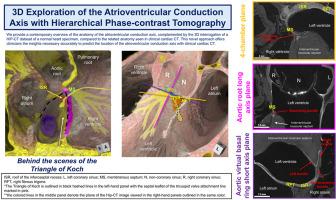
Much of our understanding of the atrioventricular conduction axis has been derived from early 20th-century histologic investigations. These studies, although foundational, are constrained by their 2-dimensional representation of complex 3-dimensional anatomy. The variability in the course of the atrioventricular conduction axis, and its relationship to surrounding cardiac structures, necessitates a more advanced imaging approach. Using hierarchical phase-contrast tomography of an autopsied heart specimen with cellular resolution, this review provides a contemporary understanding of the atrioventricular conduction axis. By correlating these findings with 3-dimensional computed tomographic reconstructions in living patients, we offer clinicians the insights needed accurately to predict the location of the atrioventricular conduction axis. This novel approach overcomes the inherent limitations of 2-dimensional histology, enhancing our ability to understand and visualize the intricate relationships of the conduction axis within the heart.
期刊介绍:
HeartRhythm, the official Journal of the Heart Rhythm Society and the Cardiac Electrophysiology Society, is a unique journal for fundamental discovery and clinical applicability.
HeartRhythm integrates the entire cardiac electrophysiology (EP) community from basic and clinical academic researchers, private practitioners, engineers, allied professionals, industry, and trainees, all of whom are vital and interdependent members of our EP community.
The Heart Rhythm Society is the international leader in science, education, and advocacy for cardiac arrhythmia professionals and patients, and the primary information resource on heart rhythm disorders. Its mission is to improve the care of patients by promoting research, education, and optimal health care policies and standards.



 京公网安备 11010802042870号
京ICP备2023020795号-1
京公网安备 11010802042870号
京ICP备2023020795号-1

 分享
分享
 求助内容:
求助内容: 应助结果提醒方式:
 扫码关注我们
