{"title":"Hypoxia-Induced Inflammation in In Vitro Model of Human Blood-Brain Barrier: Modulatory Effects of the Olfactory Ensheathing Cell-Conditioned Medium.","authors":"Aleksandra Agafonova, Alessia Cosentino, Nicolò Musso, Chiara Prinzi, Cristina Russo, Rosalia Pellitteri, Carmelina Daniela Anfuso, Gabriella Lupo","doi":"10.1007/s12035-024-04517-6","DOIUrl":null,"url":null,"abstract":"<p><p>Hypoxia compromises the integrity of the blood-brain barrier (BBB) and increases its permeability, thereby inducing inflammation. Olfactory ensheathing cells (OECs) garnered considerable interest due to their neuroregenerative and anti-inflammatory properties. Here, we aimed to investigate the potential modulatory effects of OEC-conditioned medium (OEC-CM) on the response of human brain microvascular endothelial cells (HBMECs), constituting the BBB, when exposed to hypoxia. HBMECs were utilized to establish the in vitro BBB model. OECs were isolated from mouse olfactory bulbs, and OEC-CM was collected after 48 h of culture. The effect of OEC-CM treatment on the HBMEC viability was evaluated under both normoxic and hypoxic conditions at 6 h, 24 h, and 30 h. Western blot and immunostaining techniques were employed to assess NF-κB/phospho-NF-κB expression. HIF-1α, VEGF-A, and cPLA<sub>2</sub> mRNA expression levels were quantified using digital PCR. ELISA assays were performed to measure PGE2, VEGF-A, IL-8 secretion, and cPLA<sub>2</sub> specific activity. The in vitro formation of HBMEC capillary-like structures was examined using a three-dimensional matrix system. OEC-CM attenuated pro-inflammatory responses and mitigated the HIF-1α/VEGFA signaling pathway activation in HBMECs under hypoxic condition. Hypoxia-induced damage of the BBB can be mitigated by novel therapeutic strategies harnessing OEC potential.</p>","PeriodicalId":18762,"journal":{"name":"Molecular Neurobiology","volume":" ","pages":"4008-4022"},"PeriodicalIF":4.3000,"publicationDate":"2025-04-01","publicationTypes":"Journal Article","fieldsOfStudy":null,"isOpenAccess":false,"openAccessPdf":"https://www.ncbi.nlm.nih.gov/pmc/articles/PMC11880059/pdf/","citationCount":"0","resultStr":null,"platform":"Semanticscholar","paperid":null,"PeriodicalName":"Molecular Neurobiology","FirstCategoryId":"3","ListUrlMain":"https://doi.org/10.1007/s12035-024-04517-6","RegionNum":2,"RegionCategory":"医学","ArticlePicture":[],"TitleCN":null,"AbstractTextCN":null,"PMCID":null,"EPubDate":"2024/10/7 0:00:00","PubModel":"Epub","JCR":"Q1","JCRName":"NEUROSCIENCES","Score":null,"Total":0}
引用次数: 0
Abstract
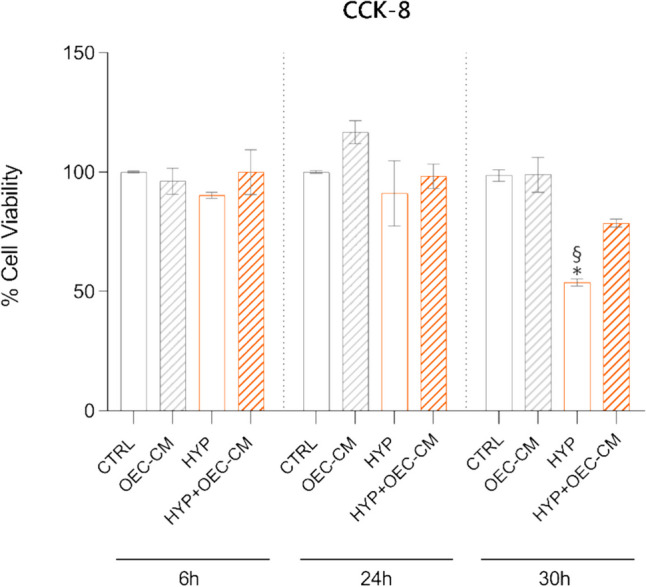
Hypoxia compromises the integrity of the blood-brain barrier (BBB) and increases its permeability, thereby inducing inflammation. Olfactory ensheathing cells (OECs) garnered considerable interest due to their neuroregenerative and anti-inflammatory properties. Here, we aimed to investigate the potential modulatory effects of OEC-conditioned medium (OEC-CM) on the response of human brain microvascular endothelial cells (HBMECs), constituting the BBB, when exposed to hypoxia. HBMECs were utilized to establish the in vitro BBB model. OECs were isolated from mouse olfactory bulbs, and OEC-CM was collected after 48 h of culture. The effect of OEC-CM treatment on the HBMEC viability was evaluated under both normoxic and hypoxic conditions at 6 h, 24 h, and 30 h. Western blot and immunostaining techniques were employed to assess NF-κB/phospho-NF-κB expression. HIF-1α, VEGF-A, and cPLA2 mRNA expression levels were quantified using digital PCR. ELISA assays were performed to measure PGE2, VEGF-A, IL-8 secretion, and cPLA2 specific activity. The in vitro formation of HBMEC capillary-like structures was examined using a three-dimensional matrix system. OEC-CM attenuated pro-inflammatory responses and mitigated the HIF-1α/VEGFA signaling pathway activation in HBMECs under hypoxic condition. Hypoxia-induced damage of the BBB can be mitigated by novel therapeutic strategies harnessing OEC potential.
期刊介绍:
Molecular Neurobiology is an exciting journal for neuroscientists needing to stay in close touch with progress at the forefront of molecular brain research today. It is an especially important periodical for graduate students and "postdocs," specifically designed to synthesize and critically assess research trends for all neuroscientists hoping to stay active at the cutting edge of this dramatically developing area. This journal has proven to be crucial in departmental libraries, serving as essential reading for every committed neuroscientist who is striving to keep abreast of all rapid developments in a forefront field. Most recent significant advances in experimental and clinical neuroscience have been occurring at the molecular level. Until now, there has been no journal devoted to looking closely at this fragmented literature in a critical, coherent fashion. Each submission is thoroughly analyzed by scientists and clinicians internationally renowned for their special competence in the areas treated.






 京公网安备 11010802042870号
京ICP备2023020795号-1
京公网安备 11010802042870号
京ICP备2023020795号-1

 分享
分享
 求助内容:
求助内容: 应助结果提醒方式:
 扫码关注我们
