Xiao-Yan He, Wen-Yan Tan, Li-Li Guo, Ying-Ying Ji, Fu-Jun Jia, Shi-Bin Wang
{"title":"Mental Health Literacy Among Urban and Rural Residents of Guangdong Province, China.","authors":"Xiao-Yan He, Wen-Yan Tan, Li-Li Guo, Ying-Ying Ji, Fu-Jun Jia, Shi-Bin Wang","doi":"10.2147/RMHP.S479868","DOIUrl":null,"url":null,"abstract":"<p><strong>Purpose: </strong>The study aims to understanding the mental health literacy level of urban and rural residents in Guangdong Province, the first major province in China, and its influencing factors is crucial.</p><p><strong>Methods: </strong>A multi-stage stratified equal-volume random sampling method was adopted in October-December 2022 to select permanent residents aged 18 years and above in Guangdong Province for the questionnaire survey, which consisted of a general demographic information questionnaire and a national mental health literacy questionnaire. Rao-Scott <i>χ²</i>-test with correction based on sampling design, independent samples <i>t</i>-test and binary multivariate logistic regression analysis were performed.</p><p><strong>Results: </strong>A total of 51744 individuals completed the questionnaire, including 31822 urban residents and 19200 rural residents. The rate of achievement of mental health literacy was 13.6% among urban residents, which was significantly higher compared to the rate of 8.6% among rural residents. Logistic regression analysis showed that female, higher education, being mental worker, being a retiree, having a higher monthly household income, maintaining a regular diet, and using electronic products for 2-6 hours per day were protective factors for mental health literacy attainment in urban residents, while having chronic diseases, being a smoker and having a history of drinking were identified as risk factors in urban residents. Among in rural residents, married, younger, higher education, being mental worker and using electronic products for 2-6 hours per day, maintaining a regular diet, and engaging in regular exercise were protective factors for achieving mental health literacy, while previous smoking was a risk factor.</p><p><strong>Conclusion: </strong>The study revealed a low level of mental health literacy among urban and rural residents of Guangdong Province, with a significant disparity between the two areas. These findings highlight the need for continuing efforts to increase the dissemination of mental health knowledge in rural communities and improve levels of mental health literacy.</p>","PeriodicalId":56009,"journal":{"name":"Risk Management and Healthcare Policy","volume":"17 ","pages":"2305-2318"},"PeriodicalIF":2.0000,"publicationDate":"2024-09-30","publicationTypes":"Journal Article","fieldsOfStudy":null,"isOpenAccess":false,"openAccessPdf":"https://www.ncbi.nlm.nih.gov/pmc/articles/PMC11451470/pdf/","citationCount":"0","resultStr":null,"platform":"Semanticscholar","paperid":null,"PeriodicalName":"Risk Management and Healthcare Policy","FirstCategoryId":"3","ListUrlMain":"https://doi.org/10.2147/RMHP.S479868","RegionNum":4,"RegionCategory":"医学","ArticlePicture":[],"TitleCN":null,"AbstractTextCN":null,"PMCID":null,"EPubDate":"2024/1/1 0:00:00","PubModel":"eCollection","JCR":"Q2","JCRName":"HEALTH CARE SCIENCES & SERVICES","Score":null,"Total":0}
引用次数: 0
Abstract
Purpose: The study aims to understanding the mental health literacy level of urban and rural residents in Guangdong Province, the first major province in China, and its influencing factors is crucial.
Methods: A multi-stage stratified equal-volume random sampling method was adopted in October-December 2022 to select permanent residents aged 18 years and above in Guangdong Province for the questionnaire survey, which consisted of a general demographic information questionnaire and a national mental health literacy questionnaire. Rao-Scott χ²-test with correction based on sampling design, independent samples t-test and binary multivariate logistic regression analysis were performed.
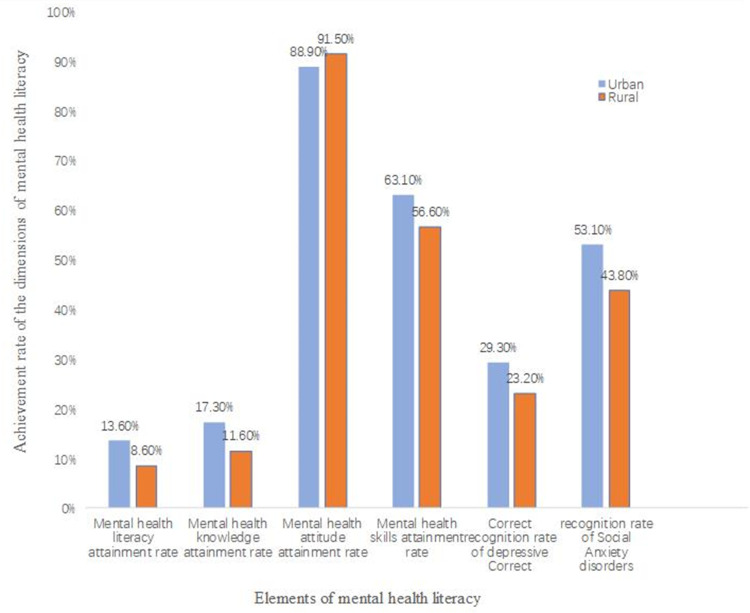
Results: A total of 51744 individuals completed the questionnaire, including 31822 urban residents and 19200 rural residents. The rate of achievement of mental health literacy was 13.6% among urban residents, which was significantly higher compared to the rate of 8.6% among rural residents. Logistic regression analysis showed that female, higher education, being mental worker, being a retiree, having a higher monthly household income, maintaining a regular diet, and using electronic products for 2-6 hours per day were protective factors for mental health literacy attainment in urban residents, while having chronic diseases, being a smoker and having a history of drinking were identified as risk factors in urban residents. Among in rural residents, married, younger, higher education, being mental worker and using electronic products for 2-6 hours per day, maintaining a regular diet, and engaging in regular exercise were protective factors for achieving mental health literacy, while previous smoking was a risk factor.
Conclusion: The study revealed a low level of mental health literacy among urban and rural residents of Guangdong Province, with a significant disparity between the two areas. These findings highlight the need for continuing efforts to increase the dissemination of mental health knowledge in rural communities and improve levels of mental health literacy.
期刊介绍:
Risk Management and Healthcare Policy is an international, peer-reviewed, open access journal focusing on all aspects of public health, policy and preventative measures to promote good health and improve morbidity and mortality in the population. Specific topics covered in the journal include:
Public and community health
Policy and law
Preventative and predictive healthcare
Risk and hazard management
Epidemiology, detection and screening
Lifestyle and diet modification
Vaccination and disease transmission/modification programs
Health and safety and occupational health
Healthcare services provision
Health literacy and education
Advertising and promotion of health issues
Health economic evaluations and resource management
Risk Management and Healthcare Policy focuses on human interventional and observational research. The journal welcomes submitted papers covering original research, clinical and epidemiological studies, reviews and evaluations, guidelines, expert opinion and commentary, and extended reports. Case reports will only be considered if they make a valuable and original contribution to the literature. The journal does not accept study protocols, animal-based or cell line-based studies.






 京公网安备 11010802042870号
京ICP备2023020795号-1
京公网安备 11010802042870号
京ICP备2023020795号-1

 分享
分享
 求助内容:
求助内容: 应助结果提醒方式:
 扫码关注我们
