Zhangmeng Liu, Guiting Lin, Yayao Li, Runchao Zhou and Yunzhi Fu
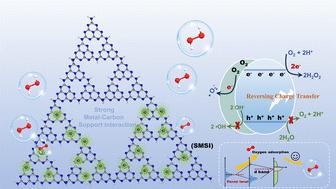
{"title":"Strong metal–support interaction (SMSI) modulates d-orbital centers to promote oxygen reduction reaction†","authors":"Zhangmeng Liu, Guiting Lin, Yayao Li, Runchao Zhou and Yunzhi Fu","doi":"10.1039/D4TA05972G","DOIUrl":null,"url":null,"abstract":"<p >Hydrogen peroxide (H<small><sub>2</sub></small>O<small><sub>2</sub></small>) production through oxygen reduction mediated by semiconductor photocatalysts is a typical reaction for converting solar energy to chemical energy, in which the adsorption and activation of oxygen on the catalyst is the rate-controlling process. To improve the catalytic performance of the catalyst, attention must be paid to the charge transfer effect on molecular orbitals. Hence, carbon–nitrogen support structures have been developed, and Ag clusters can be stably anchored on carbon–nitrogen supports due to the strong metal–support interaction (SMSI). The effect of SMSI and the difference in work function contribute to the antibonding orbitals of active oxygen-accepting Ag atom d-orbital electrons being activated. The experimental results show that the formation of H<small><sub>2</sub></small>O<small><sub>2</sub></small> follows two-electron transfer processes for oxygen reduction. The photoactivity of the system is 6410.7 μmol g<small><sup>−1</sup></small> h<small><sup>−1</sup></small> and the photochemical conversion is 1.06%. These results provide a theoretical basis for further study of the effect of interfacial charge transfer on molecular orbitals.</p>","PeriodicalId":82,"journal":{"name":"Journal of Materials Chemistry A","volume":" 45","pages":" 31153-31162"},"PeriodicalIF":9.5000,"publicationDate":"2024-10-09","publicationTypes":"Journal Article","fieldsOfStudy":null,"isOpenAccess":false,"openAccessPdf":"","citationCount":"0","resultStr":null,"platform":"Semanticscholar","paperid":null,"PeriodicalName":"Journal of Materials Chemistry A","FirstCategoryId":"88","ListUrlMain":"https://pubs.rsc.org/en/content/articlelanding/2024/ta/d4ta05972g","RegionNum":2,"RegionCategory":"材料科学","ArticlePicture":[],"TitleCN":null,"AbstractTextCN":null,"PMCID":null,"EPubDate":"","PubModel":"","JCR":"Q1","JCRName":"CHEMISTRY, PHYSICAL","Score":null,"Total":0}
引用次数: 0
Abstract
Hydrogen peroxide (H2O2) production through oxygen reduction mediated by semiconductor photocatalysts is a typical reaction for converting solar energy to chemical energy, in which the adsorption and activation of oxygen on the catalyst is the rate-controlling process. To improve the catalytic performance of the catalyst, attention must be paid to the charge transfer effect on molecular orbitals. Hence, carbon–nitrogen support structures have been developed, and Ag clusters can be stably anchored on carbon–nitrogen supports due to the strong metal–support interaction (SMSI). The effect of SMSI and the difference in work function contribute to the antibonding orbitals of active oxygen-accepting Ag atom d-orbital electrons being activated. The experimental results show that the formation of H2O2 follows two-electron transfer processes for oxygen reduction. The photoactivity of the system is 6410.7 μmol g−1 h−1 and the photochemical conversion is 1.06%. These results provide a theoretical basis for further study of the effect of interfacial charge transfer on molecular orbitals.
期刊介绍:
The Journal of Materials Chemistry A, B & C covers a wide range of high-quality studies in the field of materials chemistry, with each section focusing on specific applications of the materials studied. Journal of Materials Chemistry A emphasizes applications in energy and sustainability, including topics such as artificial photosynthesis, batteries, and fuel cells. Journal of Materials Chemistry B focuses on applications in biology and medicine, while Journal of Materials Chemistry C covers applications in optical, magnetic, and electronic devices. Example topic areas within the scope of Journal of Materials Chemistry A include catalysis, green/sustainable materials, sensors, and water treatment, among others.




 京公网安备 11010802042870号
京ICP备2023020795号-1
京公网安备 11010802042870号
京ICP备2023020795号-1

 分享
分享
 求助内容:
求助内容: 应助结果提醒方式:
 扫码关注我们
