Yaqian Xin, Shengbo Zhang, Jiafang Liu, Yong Jiang, Yunxia Zhang, Guozhong Wang and Haimin Zhang
{"title":"High-performance electrocatalytic nitrate reduction into ammonia using a chitosan regulated Co nanocatalyst†","authors":"Yaqian Xin, Shengbo Zhang, Jiafang Liu, Yong Jiang, Yunxia Zhang, Guozhong Wang and Haimin Zhang","doi":"10.1039/D4QI02058H","DOIUrl":null,"url":null,"abstract":"<p >The electrocatalytic nitrate reduction reaction (NtrRR) offers an attractive alternative to the Haber–Bosch process for ambient ammonia (NH<small><sub>3</sub></small>) production. Herein, a chitosan regulated Co nanoparticle catalyst (Co-NPs/CC) is designed as an electrocatalyst for achieving highly efficient NtrRR catalysis, and it exhibits a high NH<small><sub>3</sub></small> yield rate of 9181.7 ± 60.9 μg h<small><sup>−1</sup></small> cm<small><sup>−2</sup></small> at −1.2 V (<em>vs.</em> RHE) and a high faradaic efficiency (FE) of 88.7 ± 4.0% at −1.0 V (<em>vs.</em> RHE) in a 0.1 M K<small><sub>2</sub></small>SO<small><sub>4</sub></small> + 0.1 M KNO<small><sub>3</sub></small> electrolyte under ambient conditions. The Co-NPs/CC also exhibited an outstanding performance with a selectivity of 99.5 ± 0.2% for NH<small><sub>3</sub></small> synthesis. The obtained NH<small><sub>4</sub></small><small><sup>+</sup></small> was also qualitatively determined by colorimetric and <small><sup>1</sup></small>H NMR methods. <small><sup>15</sup></small>N isotopic labelling identifies that the N atom of the formed NH<small><sub>3</sub></small> originates from nitrate. Using <em>in situ</em> attenuated total reflection surface-enhanced infrared adsorption spectroscopy (ATR-SEIRAS) and different electrochemical mass spectrometry (DEMS) measurements, the electrocatalytic NtrRR mechanism was verified. This work presents a novel strategy for designing non-noble metal NtrRR electrocatalysts with exposed favorable active sites.</p>","PeriodicalId":79,"journal":{"name":"Inorganic Chemistry Frontiers","volume":" 23","pages":" 8371-8376"},"PeriodicalIF":6.4000,"publicationDate":"2024-10-09","publicationTypes":"Journal Article","fieldsOfStudy":null,"isOpenAccess":false,"openAccessPdf":"","citationCount":"0","resultStr":null,"platform":"Semanticscholar","paperid":null,"PeriodicalName":"Inorganic Chemistry Frontiers","FirstCategoryId":"92","ListUrlMain":"https://pubs.rsc.org/en/content/articlelanding/2024/qi/d4qi02058h","RegionNum":1,"RegionCategory":"化学","ArticlePicture":[],"TitleCN":null,"AbstractTextCN":null,"PMCID":null,"EPubDate":"","PubModel":"","JCR":"Q1","JCRName":"CHEMISTRY, INORGANIC & NUCLEAR","Score":null,"Total":0}
引用次数: 0
Abstract
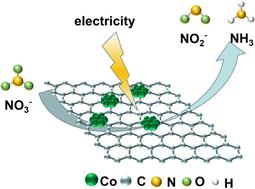
The electrocatalytic nitrate reduction reaction (NtrRR) offers an attractive alternative to the Haber–Bosch process for ambient ammonia (NH3) production. Herein, a chitosan regulated Co nanoparticle catalyst (Co-NPs/CC) is designed as an electrocatalyst for achieving highly efficient NtrRR catalysis, and it exhibits a high NH3 yield rate of 9181.7 ± 60.9 μg h−1 cm−2 at −1.2 V (vs. RHE) and a high faradaic efficiency (FE) of 88.7 ± 4.0% at −1.0 V (vs. RHE) in a 0.1 M K2SO4 + 0.1 M KNO3 electrolyte under ambient conditions. The Co-NPs/CC also exhibited an outstanding performance with a selectivity of 99.5 ± 0.2% for NH3 synthesis. The obtained NH4+ was also qualitatively determined by colorimetric and 1H NMR methods. 15N isotopic labelling identifies that the N atom of the formed NH3 originates from nitrate. Using in situ attenuated total reflection surface-enhanced infrared adsorption spectroscopy (ATR-SEIRAS) and different electrochemical mass spectrometry (DEMS) measurements, the electrocatalytic NtrRR mechanism was verified. This work presents a novel strategy for designing non-noble metal NtrRR electrocatalysts with exposed favorable active sites.



 京公网安备 11010802042870号
京ICP备2023020795号-1
京公网安备 11010802042870号
京ICP备2023020795号-1

 分享
分享
 求助内容:
求助内容: 应助结果提醒方式:
 扫码关注我们
