{"title":"Anion recognition using meta-substituted ureidocalix[4]arene receptors†","authors":"A. Surina , J. Čejka , K. Salvadori , P. Lhoták","doi":"10.1039/d4ob01441c","DOIUrl":null,"url":null,"abstract":"<div><div>Calix[4]arenes bearing urea units at the <em>meta</em> position(s) of the upper rim of the macrocyclic skeleton were prepared by the reaction of the corresponding amines with aryl isocyanates. As shown by the <sup>1</sup>H NMR and UV/vis titration experiments, these systems are capable of effectively complexing selected anions even in a highly competitive environment (such as DMSO-<em>d</em><sub>6</sub>). While the monoureido derivatives showed approximately the same complexation ability irrespective of the substitution (<em>para vs. meta</em> isomers), the bisureas at the upper rim demonstrated interesting differences in complexation. The <em>meta</em>,<em>meta</em> and <em>para</em>,<em>para</em> isomers were shown to prefer 2 : 1 complexes (anion : receptor) regardless of the anion tested, while the analogous <em>meta</em>,<em>para</em> isomer formed 1 : 1 complexes with strongly coordinated anions (<em>e.g.</em> H<sub>2</sub>PO<sub>4</sub><sup>−</sup>) based on synchronous complexation by both ureido groups. This suggests that the regioselective introduction of urea units into the upper rim of calix[4]arene brings with it the possibility of “tuning” the complexation properties depending on the substitution pattern of the functional groups.</div></div>","PeriodicalId":96,"journal":{"name":"Organic & Biomolecular Chemistry","volume":"22 43","pages":"Pages 8669-8678"},"PeriodicalIF":2.7000,"publicationDate":"2024-10-02","publicationTypes":"Journal Article","fieldsOfStudy":null,"isOpenAccess":false,"openAccessPdf":"https://pubs.rsc.org/en/content/articlepdf/2024/ob/d4ob01441c?page=search","citationCount":"0","resultStr":null,"platform":"Semanticscholar","paperid":null,"PeriodicalName":"Organic & Biomolecular Chemistry","FirstCategoryId":"92","ListUrlMain":"https://www.sciencedirect.com/org/science/article/pii/S1477052024008784","RegionNum":3,"RegionCategory":"化学","ArticlePicture":[],"TitleCN":null,"AbstractTextCN":null,"PMCID":null,"EPubDate":"","PubModel":"","JCR":"Q1","JCRName":"CHEMISTRY, ORGANIC","Score":null,"Total":0}
引用次数: 0
Abstract
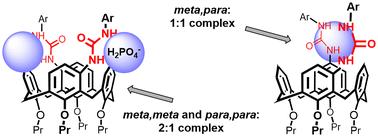
Calix[4]arenes bearing urea units at the meta position(s) of the upper rim of the macrocyclic skeleton were prepared by the reaction of the corresponding amines with aryl isocyanates. As shown by the 1H NMR and UV/vis titration experiments, these systems are capable of effectively complexing selected anions even in a highly competitive environment (such as DMSO-d6). While the monoureido derivatives showed approximately the same complexation ability irrespective of the substitution (para vs. meta isomers), the bisureas at the upper rim demonstrated interesting differences in complexation. The meta,meta and para,para isomers were shown to prefer 2 : 1 complexes (anion : receptor) regardless of the anion tested, while the analogous meta,para isomer formed 1 : 1 complexes with strongly coordinated anions (e.g. H2PO4−) based on synchronous complexation by both ureido groups. This suggests that the regioselective introduction of urea units into the upper rim of calix[4]arene brings with it the possibility of “tuning” the complexation properties depending on the substitution pattern of the functional groups.
期刊介绍:
Organic & Biomolecular Chemistry is an international journal using integrated research in chemistry-organic chemistry. Founded in 2003 by the Royal Society of Chemistry, the journal is published in Semimonthly issues and has been indexed by SCIE, a leading international database. The journal focuses on the key research and cutting-edge progress in the field of chemistry-organic chemistry, publishes and reports the research results in this field in a timely manner, and is committed to becoming a window and platform for rapid academic exchanges among peers in this field. The journal's impact factor in 2023 is 2.9, and its CiteScore is 5.5.



 京公网安备 11010802042870号
京ICP备2023020795号-1
京公网安备 11010802042870号
京ICP备2023020795号-1

 分享
分享
 求助内容:
求助内容: 应助结果提醒方式:
 扫码关注我们
