Naveed Ali, Megan Othus, Eduardo Rodríguez-Arbolí, Corentin Orvain, Filippo Milano, Brenda M Sandmaier, Chris Davis, Ryan S Basom, Frederick R Appelbaum, Roland B Walter
{"title":"Measurable residual disease as predictor of post-day +100 relapses after allografting in adult AML.","authors":"Naveed Ali, Megan Othus, Eduardo Rodríguez-Arbolí, Corentin Orvain, Filippo Milano, Brenda M Sandmaier, Chris Davis, Ryan S Basom, Frederick R Appelbaum, Roland B Walter","doi":"10.1182/bloodadvances.2024013214","DOIUrl":null,"url":null,"abstract":"<p><strong>Abstract: </strong>Measurable residual disease (MRD) by multiparametric flow cytometry (MFC) before allogeneic hematopoietic cell transplantation (HCT) identifies patients at high risk of acute myeloid leukemia (AML) relapse, often occurring early after allografting. To examine the role of MFC MRD testing to predict later relapses, we examined 935 adults with AML or myelodysplastic neoplasm/AML transplanted in first or second morphologic remission who underwent bone marrow restaging studies between day 70 and 100 after HCT and were alive and without relapse by day +100. Of 935 adults, 136 (15%) had MRD before HCT, whereas only 11 (1%) had MRD at day +70 to +100. In day +100 landmark analyses, pre-HCT and day +70 to +100 MFC MRD were both associated with relapse (both P < .001), relapse-free survival (RFS; both P < .001) overall survival (OS; both P < .001), and, for post-HCT MRD, nonrelapse mortality (P = .001) after multivariable adjustment. Importantly, although 126/136 patients (92%) with MRD before HCT tested negative for MRD at day +70 to +100, their outcomes were inferior to those without MRD before HCT and at day +70 to +100, with 3-year relapse risk of 40% vs 15% (P < .001), 3-year RFS of 50% vs 72% (P < .001), and 3-year OS of 56% vs 76% (P < .001), whereas 3-year nonrelapse mortality estimates were similar (P = .53). Thus, despite high MRD conversion rates, outcomes MRD positive/MRD negative (MRDneg) patients are inferior to those of MRDneg/MRDneg patients, suggesting all patients with pre-HCT MRD should be considered for preemptive therapies after allografting.</p>","PeriodicalId":9228,"journal":{"name":"Blood advances","volume":" ","pages":"558-570"},"PeriodicalIF":7.1000,"publicationDate":"2025-02-11","publicationTypes":"Journal Article","fieldsOfStudy":null,"isOpenAccess":false,"openAccessPdf":"https://www.ncbi.nlm.nih.gov/pmc/articles/PMC11821400/pdf/","citationCount":"0","resultStr":null,"platform":"Semanticscholar","paperid":null,"PeriodicalName":"Blood advances","FirstCategoryId":"3","ListUrlMain":"https://doi.org/10.1182/bloodadvances.2024013214","RegionNum":1,"RegionCategory":"医学","ArticlePicture":[],"TitleCN":null,"AbstractTextCN":null,"PMCID":null,"EPubDate":"","PubModel":"","JCR":"Q1","JCRName":"HEMATOLOGY","Score":null,"Total":0}
引用次数: 0
Abstract
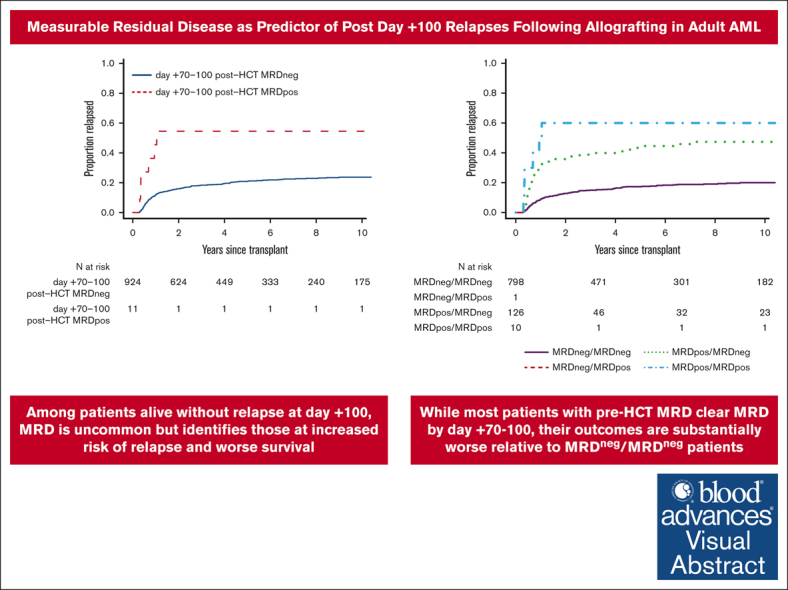
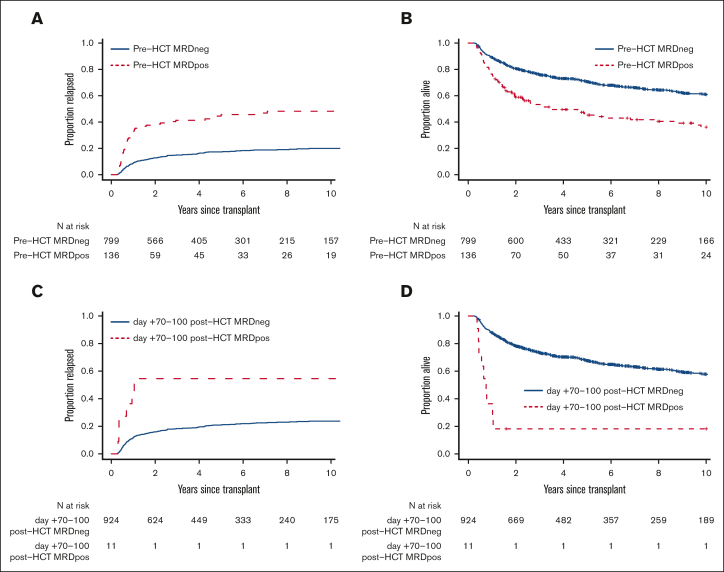
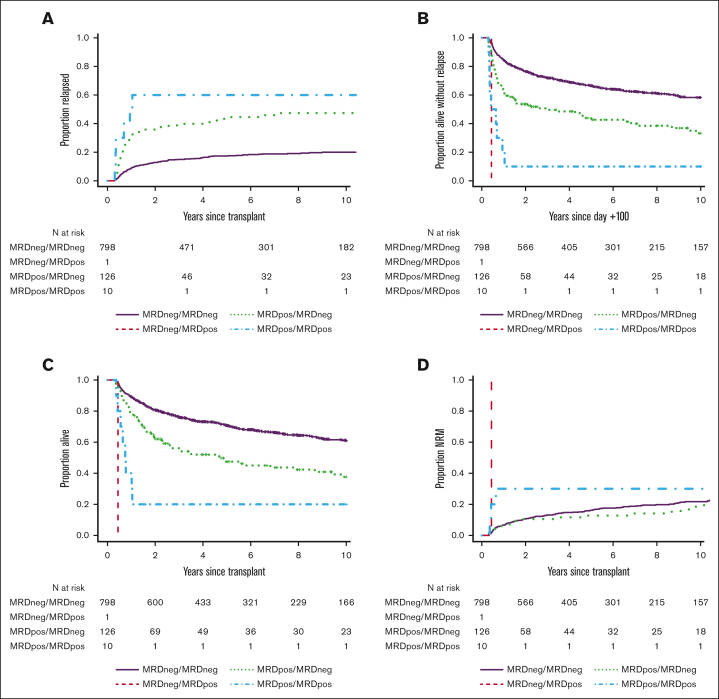
Abstract: Measurable residual disease (MRD) by multiparametric flow cytometry (MFC) before allogeneic hematopoietic cell transplantation (HCT) identifies patients at high risk of acute myeloid leukemia (AML) relapse, often occurring early after allografting. To examine the role of MFC MRD testing to predict later relapses, we examined 935 adults with AML or myelodysplastic neoplasm/AML transplanted in first or second morphologic remission who underwent bone marrow restaging studies between day 70 and 100 after HCT and were alive and without relapse by day +100. Of 935 adults, 136 (15%) had MRD before HCT, whereas only 11 (1%) had MRD at day +70 to +100. In day +100 landmark analyses, pre-HCT and day +70 to +100 MFC MRD were both associated with relapse (both P < .001), relapse-free survival (RFS; both P < .001) overall survival (OS; both P < .001), and, for post-HCT MRD, nonrelapse mortality (P = .001) after multivariable adjustment. Importantly, although 126/136 patients (92%) with MRD before HCT tested negative for MRD at day +70 to +100, their outcomes were inferior to those without MRD before HCT and at day +70 to +100, with 3-year relapse risk of 40% vs 15% (P < .001), 3-year RFS of 50% vs 72% (P < .001), and 3-year OS of 56% vs 76% (P < .001), whereas 3-year nonrelapse mortality estimates were similar (P = .53). Thus, despite high MRD conversion rates, outcomes MRD positive/MRD negative (MRDneg) patients are inferior to those of MRDneg/MRDneg patients, suggesting all patients with pre-HCT MRD should be considered for preemptive therapies after allografting.
期刊介绍:
Blood Advances, a semimonthly medical journal published by the American Society of Hematology, marks the first addition to the Blood family in 70 years. This peer-reviewed, online-only, open-access journal was launched under the leadership of founding editor-in-chief Robert Negrin, MD, from Stanford University Medical Center in Stanford, CA, with its inaugural issue released on November 29, 2016.
Blood Advances serves as an international platform for original articles detailing basic laboratory, translational, and clinical investigations in hematology. The journal comprehensively covers all aspects of hematology, including disorders of leukocytes (both benign and malignant), erythrocytes, platelets, hemostatic mechanisms, vascular biology, immunology, and hematologic oncology. Each article undergoes a rigorous peer-review process, with selection based on the originality of the findings, the high quality of the work presented, and the clarity of the presentation.



 京公网安备 11010802042870号
京ICP备2023020795号-1
京公网安备 11010802042870号
京ICP备2023020795号-1

 分享
分享
 求助内容:
求助内容: 应助结果提醒方式:
 扫码关注我们
