{"title":"Fish That Fish for Fish—A Peculiar Location of “Fishing Motoneurons” in the Striated Frogfish Antennarius striatus","authors":"Hanako Hagio, Hirotaka Nishino, Kenta Miyake, Nene Sato, Kei Sawada, Tomoya Nakayama, Naoyuki Yamamoto","doi":"10.1002/cne.25674","DOIUrl":null,"url":null,"abstract":"<p>In lophiform teleosts, the first dorsal fin has evolved as a specialized structure called the “illicium” equipped with the esca, which is a modified skin flap used to attract small fish for predation. The motor control system of the illicium, however, remained unknown. The present study investigated the innervation of muscles for the illicium and morphology of motoneurons innervating them in the striated frogfish <i>Antennarius striatus</i>. We found that the dorsal ramus of occipital nerve innervates the muscles. Motoneurons for the illicium are present in the dorsolateral zone of ventral horn at the medullo-spinal boundary level, forming a cluster somewhat distinct from other motoneurons of the ventral horn. Motoneurons for the second to fourth dorsal fins and pectoral fin were located in the ventrolateral and ventromedial zones of ventral horn, respectively, whereas those of the dorsal trunk muscle in the dorsomedial zone of ventral horn. Motoneurons for the first dorsal spine of white-spotted pygmy filefish were also investigated for species comparison and were found to locate in the ventrolateral zone of ventral horn, similarly to the motoneurons for the second to fourth dorsal fins of the frogfish. These results suggest that motoneurons for the illicium have become segregated from other motoneurons to be situated in an unusual dorsal position for a motoneuron pool of a dorsal fin, in concert with the evolution of specialized “fishing behavior” performed by the illicium.</p>","PeriodicalId":15552,"journal":{"name":"Journal of Comparative Neurology","volume":"532 10","pages":""},"PeriodicalIF":2.1000,"publicationDate":"2024-10-08","publicationTypes":"Journal Article","fieldsOfStudy":null,"isOpenAccess":false,"openAccessPdf":"https://onlinelibrary.wiley.com/doi/epdf/10.1002/cne.25674","citationCount":"0","resultStr":null,"platform":"Semanticscholar","paperid":null,"PeriodicalName":"Journal of Comparative Neurology","FirstCategoryId":"3","ListUrlMain":"https://onlinelibrary.wiley.com/doi/10.1002/cne.25674","RegionNum":4,"RegionCategory":"医学","ArticlePicture":[],"TitleCN":null,"AbstractTextCN":null,"PMCID":null,"EPubDate":"","PubModel":"","JCR":"Q3","JCRName":"NEUROSCIENCES","Score":null,"Total":0}
引用次数: 0
Abstract
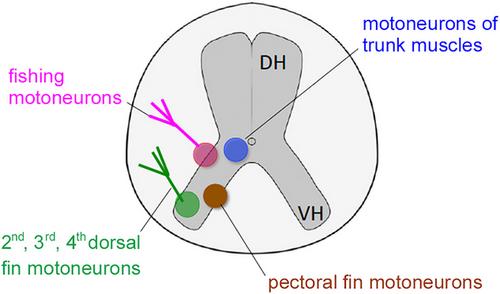
In lophiform teleosts, the first dorsal fin has evolved as a specialized structure called the “illicium” equipped with the esca, which is a modified skin flap used to attract small fish for predation. The motor control system of the illicium, however, remained unknown. The present study investigated the innervation of muscles for the illicium and morphology of motoneurons innervating them in the striated frogfish Antennarius striatus. We found that the dorsal ramus of occipital nerve innervates the muscles. Motoneurons for the illicium are present in the dorsolateral zone of ventral horn at the medullo-spinal boundary level, forming a cluster somewhat distinct from other motoneurons of the ventral horn. Motoneurons for the second to fourth dorsal fins and pectoral fin were located in the ventrolateral and ventromedial zones of ventral horn, respectively, whereas those of the dorsal trunk muscle in the dorsomedial zone of ventral horn. Motoneurons for the first dorsal spine of white-spotted pygmy filefish were also investigated for species comparison and were found to locate in the ventrolateral zone of ventral horn, similarly to the motoneurons for the second to fourth dorsal fins of the frogfish. These results suggest that motoneurons for the illicium have become segregated from other motoneurons to be situated in an unusual dorsal position for a motoneuron pool of a dorsal fin, in concert with the evolution of specialized “fishing behavior” performed by the illicium.
期刊介绍:
Established in 1891, JCN is the oldest continually published basic neuroscience journal. Historically, as the name suggests, the journal focused on a comparison among species to uncover the intricacies of how the brain functions. In modern times, this research is called systems neuroscience where animal models are used to mimic core cognitive processes with the ultimate goal of understanding neural circuits and connections that give rise to behavioral patterns and different neural states.
Research published in JCN covers all species from invertebrates to humans, and the reports inform the readers about the function and organization of nervous systems in species with an emphasis on the way that species adaptations inform about the function or organization of the nervous systems, rather than on their evolution per se.
JCN publishes primary research articles and critical commentaries and review-type articles offering expert insight in to cutting edge research in the field of systems neuroscience; a complete list of contribution types is given in the Author Guidelines. For primary research contributions, only full-length investigative reports are desired; the journal does not accept short communications.



 京公网安备 11010802042870号
京ICP备2023020795号-1
京公网安备 11010802042870号
京ICP备2023020795号-1

 分享
分享
 求助内容:
求助内容: 应助结果提醒方式:
 扫码关注我们
