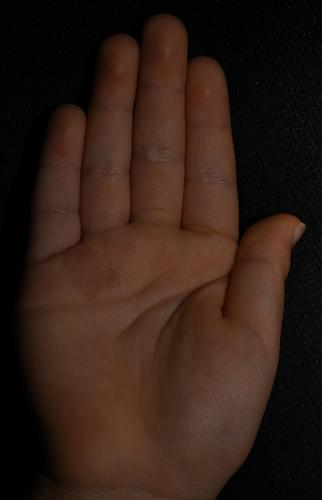
{"title":"Letter to the Editor","authors":"Ms Qian Zhang","doi":"10.1111/jpc.16687","DOIUrl":null,"url":null,"abstract":"<p>A 5-year-old girl presented with a 1-year history of slowly increasing, asymptomatic hyperpigmentation on her right palm. On physical examination, there was solitary black macule with a regular border on the right palm (Fig. 1). There were no scales or signs of inflammation on the surface. A direct microscopic examination (DME) on a potassium hydroxide (10%) mount revealed brown-branched septate hyphae. A fungal culture on Sabouraud agar showed brownish-black wet colonies after 2 weeks. On the dermatological examination, the patient exhibited non-melanocytic pigmentation with a reticular pattern. A diagnosis of tinea nigra palmaris was confirmed. She was treated with topical azoles and keratolytics, and showed a good response with resolution within 2 weeks of therapy.</p><p>Tinea nigra is an uncommon superficial fungal infection caused by <i>Hortaea werneckii</i>. Clinically, it is characterised by asymptomatic, non-scaly, well-defined brown- to black-pigmented macules. There can be a single lesion or a few that merge together. It mostly affects the palms and/or soles unilaterally, sometimes also on the dorsal aspect of the hands, rarely involves the arms, legs, neck and trunk. Most cases occur in tropical and subtropical regions, especially in coastal zones, because the organism is well adapted to extremely high-salt environments.<span><sup>1</sup></span> Occasionally, hyperhidrosis is a predisposing factor in some cases. The differential diagnosis of tinea nigra includes other pigmented lesions such as melanocytic nevus, palmar lichen planus, Addison's disease, melanosis of syphilis, post-inflammatory hyperpigmentation and malignant melanoma.<span><sup>2</sup></span> Often, a biopsy is unnecessary for diagnosis. Dermoscopy reveals a homogeneous non-melanocytic pigment reticulate pattern.<span><sup>3</sup></span> In general, characteristic clinical features, dermoscopy and DME can assist in diagnosis. Topical application of effective anti-fungals and keratolytics can clear the lesions within 2–4 weeks. Sometimes, lesions can be eliminated by scraping and friction while washing the hands.</p><p>The patient's parents consented to the use of her photograph and personal information.</p>","PeriodicalId":16648,"journal":{"name":"Journal of paediatrics and child health","volume":"60 12","pages":"893"},"PeriodicalIF":1.4000,"publicationDate":"2024-10-07","publicationTypes":"Journal Article","fieldsOfStudy":null,"isOpenAccess":false,"openAccessPdf":"https://onlinelibrary.wiley.com/doi/epdf/10.1111/jpc.16687","citationCount":"0","resultStr":null,"platform":"Semanticscholar","paperid":null,"PeriodicalName":"Journal of paediatrics and child health","FirstCategoryId":"3","ListUrlMain":"https://onlinelibrary.wiley.com/doi/10.1111/jpc.16687","RegionNum":4,"RegionCategory":"医学","ArticlePicture":[],"TitleCN":null,"AbstractTextCN":null,"PMCID":null,"EPubDate":"","PubModel":"","JCR":"Q2","JCRName":"PEDIATRICS","Score":null,"Total":0}
引用次数: 0
Abstract
A 5-year-old girl presented with a 1-year history of slowly increasing, asymptomatic hyperpigmentation on her right palm. On physical examination, there was solitary black macule with a regular border on the right palm (Fig. 1). There were no scales or signs of inflammation on the surface. A direct microscopic examination (DME) on a potassium hydroxide (10%) mount revealed brown-branched septate hyphae. A fungal culture on Sabouraud agar showed brownish-black wet colonies after 2 weeks. On the dermatological examination, the patient exhibited non-melanocytic pigmentation with a reticular pattern. A diagnosis of tinea nigra palmaris was confirmed. She was treated with topical azoles and keratolytics, and showed a good response with resolution within 2 weeks of therapy.
Tinea nigra is an uncommon superficial fungal infection caused by Hortaea werneckii. Clinically, it is characterised by asymptomatic, non-scaly, well-defined brown- to black-pigmented macules. There can be a single lesion or a few that merge together. It mostly affects the palms and/or soles unilaterally, sometimes also on the dorsal aspect of the hands, rarely involves the arms, legs, neck and trunk. Most cases occur in tropical and subtropical regions, especially in coastal zones, because the organism is well adapted to extremely high-salt environments.1 Occasionally, hyperhidrosis is a predisposing factor in some cases. The differential diagnosis of tinea nigra includes other pigmented lesions such as melanocytic nevus, palmar lichen planus, Addison's disease, melanosis of syphilis, post-inflammatory hyperpigmentation and malignant melanoma.2 Often, a biopsy is unnecessary for diagnosis. Dermoscopy reveals a homogeneous non-melanocytic pigment reticulate pattern.3 In general, characteristic clinical features, dermoscopy and DME can assist in diagnosis. Topical application of effective anti-fungals and keratolytics can clear the lesions within 2–4 weeks. Sometimes, lesions can be eliminated by scraping and friction while washing the hands.
The patient's parents consented to the use of her photograph and personal information.
期刊介绍:
The Journal of Paediatrics and Child Health publishes original research articles of scientific excellence in paediatrics and child health. Research Articles, Case Reports and Letters to the Editor are published, together with invited Reviews, Annotations, Editorial Comments and manuscripts of educational interest.



 京公网安备 11010802042870号
京ICP备2023020795号-1
京公网安备 11010802042870号
京ICP备2023020795号-1

 分享
分享

 求助内容:
求助内容: 应助结果提醒方式:
 扫码关注我们
