Antonia Giacco, Stefania Iervolino, Federica Cioffi, Teresa Peluso, Giovanna Mercurio, Luca Roberto, Valeria de Rosa, Mariarosaria Cammarota, Silvia Varricchio, Stefania Staibano, Francesca Boscia, Lorella Maria Teresa Canzoniero, Mario De Felice, Concetta Ambrosino, Maria Moreno, Elena Silvestri
{"title":"Brain Abnormalities in Young Single- and Double-Heterozygote Mice for Both Nkx2-1- and Pax8-Null Mutations.","authors":"Antonia Giacco, Stefania Iervolino, Federica Cioffi, Teresa Peluso, Giovanna Mercurio, Luca Roberto, Valeria de Rosa, Mariarosaria Cammarota, Silvia Varricchio, Stefania Staibano, Francesca Boscia, Lorella Maria Teresa Canzoniero, Mario De Felice, Concetta Ambrosino, Maria Moreno, Elena Silvestri","doi":"10.1007/s12035-024-04524-7","DOIUrl":null,"url":null,"abstract":"<p><p>In humans and mice, Nkx2-1 and Pax8 are crucial morphogenic transcription factors defining the early development of the thyroid and specific extrathyroidal tissues. By using 3-month-old single or double heterozygotes for Nkx2-1- and Pax8-null mutations (DHTP) mice, we studied brain abnormalities under different human-like dysthyroidisms, focusing on putative alterations of specific neurotransmitter systems, expression of markers of pre- and post-synaptic function and, given the physio-pathological role mitochondria have in controlling the bioenergetic status of neurons, of mitochondrial dynamics and oxidative balance. Compared to Wt controls, DHTP mice, bearing both systemic and brain hypothyroidism, showed altered expression of synaptic markers, generic and cholinergic (corroborated by immunohistochemistry in caudate, putamen, hippocampus, and basal forebrain) and glutamatergic ones, and reduced expression of key proteins of synaptic plasticity potency and several isoforms of glutamate receptors. The brain of DHTP mice was characterized by lower levels of H<sub>2</sub>O<sub>2</sub> and imbalanced mitochondrial dynamics. Nkx2-1 + / - mice showed dopaminergic neuron-specific alterations, morphologically, more evident in the substantia nigra of DHTP mice. Nkx2-1 + / - mice also showed enhanced mitochondrial biogenesis and oxidative capacity likely as a global response of the brain to Nkx2-1 haploinsufficiency and/or to their elevated T3 circulating levels. Reduced transcription of both tyrosine hydroxylase and dopamine transporter was observed in Pax8 + / - euthyroid mice, suggesting a dopaminergic dysfunction, albeit likely at an early stage, but consistent with the deregulated glucose homeostasis observed in such animals. Overall, new information was obtained on the impact of haploinsufficiency of Pax8 and NKx2-1 on several brain neuroanatomical, molecular, and neurochemical aspects, thus opening the way for future targeting brain dysfunctions in the management of both overt and subclinical thyroid dysfunctions.</p>","PeriodicalId":18762,"journal":{"name":"Molecular Neurobiology","volume":" ","pages":"4023-4041"},"PeriodicalIF":4.3000,"publicationDate":"2025-04-01","publicationTypes":"Journal Article","fieldsOfStudy":null,"isOpenAccess":false,"openAccessPdf":"https://www.ncbi.nlm.nih.gov/pmc/articles/PMC11880048/pdf/","citationCount":"0","resultStr":null,"platform":"Semanticscholar","paperid":null,"PeriodicalName":"Molecular Neurobiology","FirstCategoryId":"3","ListUrlMain":"https://doi.org/10.1007/s12035-024-04524-7","RegionNum":2,"RegionCategory":"医学","ArticlePicture":[],"TitleCN":null,"AbstractTextCN":null,"PMCID":null,"EPubDate":"2024/10/8 0:00:00","PubModel":"Epub","JCR":"Q1","JCRName":"NEUROSCIENCES","Score":null,"Total":0}
引用次数: 0
Abstract
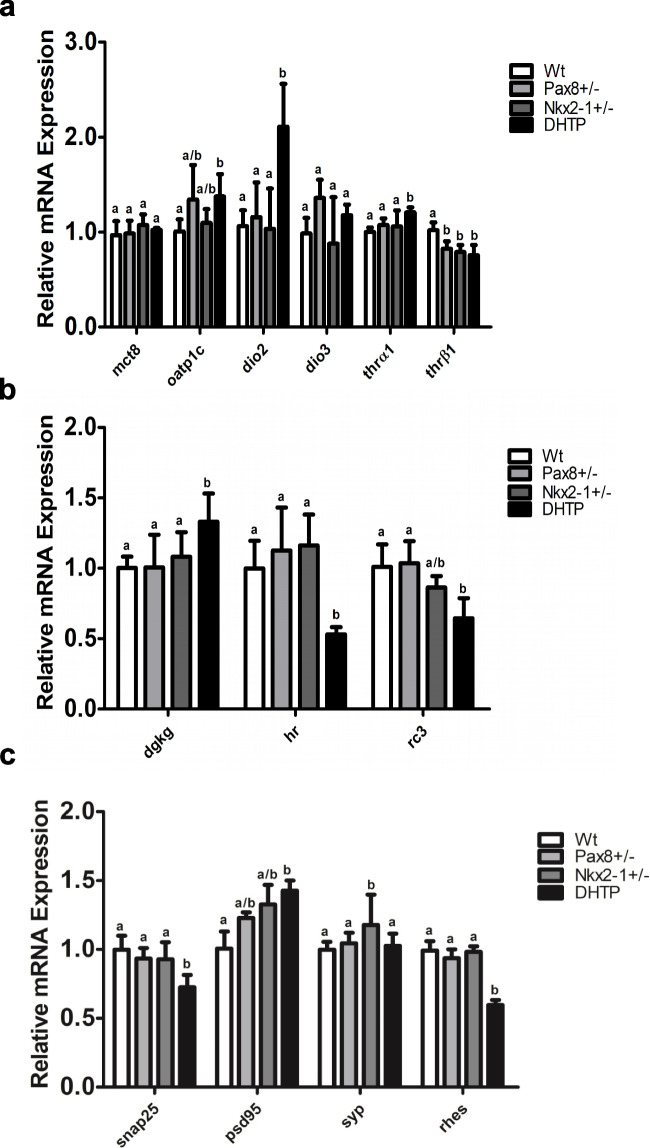
In humans and mice, Nkx2-1 and Pax8 are crucial morphogenic transcription factors defining the early development of the thyroid and specific extrathyroidal tissues. By using 3-month-old single or double heterozygotes for Nkx2-1- and Pax8-null mutations (DHTP) mice, we studied brain abnormalities under different human-like dysthyroidisms, focusing on putative alterations of specific neurotransmitter systems, expression of markers of pre- and post-synaptic function and, given the physio-pathological role mitochondria have in controlling the bioenergetic status of neurons, of mitochondrial dynamics and oxidative balance. Compared to Wt controls, DHTP mice, bearing both systemic and brain hypothyroidism, showed altered expression of synaptic markers, generic and cholinergic (corroborated by immunohistochemistry in caudate, putamen, hippocampus, and basal forebrain) and glutamatergic ones, and reduced expression of key proteins of synaptic plasticity potency and several isoforms of glutamate receptors. The brain of DHTP mice was characterized by lower levels of H2O2 and imbalanced mitochondrial dynamics. Nkx2-1 + / - mice showed dopaminergic neuron-specific alterations, morphologically, more evident in the substantia nigra of DHTP mice. Nkx2-1 + / - mice also showed enhanced mitochondrial biogenesis and oxidative capacity likely as a global response of the brain to Nkx2-1 haploinsufficiency and/or to their elevated T3 circulating levels. Reduced transcription of both tyrosine hydroxylase and dopamine transporter was observed in Pax8 + / - euthyroid mice, suggesting a dopaminergic dysfunction, albeit likely at an early stage, but consistent with the deregulated glucose homeostasis observed in such animals. Overall, new information was obtained on the impact of haploinsufficiency of Pax8 and NKx2-1 on several brain neuroanatomical, molecular, and neurochemical aspects, thus opening the way for future targeting brain dysfunctions in the management of both overt and subclinical thyroid dysfunctions.
期刊介绍:
Molecular Neurobiology is an exciting journal for neuroscientists needing to stay in close touch with progress at the forefront of molecular brain research today. It is an especially important periodical for graduate students and "postdocs," specifically designed to synthesize and critically assess research trends for all neuroscientists hoping to stay active at the cutting edge of this dramatically developing area. This journal has proven to be crucial in departmental libraries, serving as essential reading for every committed neuroscientist who is striving to keep abreast of all rapid developments in a forefront field. Most recent significant advances in experimental and clinical neuroscience have been occurring at the molecular level. Until now, there has been no journal devoted to looking closely at this fragmented literature in a critical, coherent fashion. Each submission is thoroughly analyzed by scientists and clinicians internationally renowned for their special competence in the areas treated.




 京公网安备 11010802042870号
京ICP备2023020795号-1
京公网安备 11010802042870号
京ICP备2023020795号-1

 分享
分享
 求助内容:
求助内容: 应助结果提醒方式:
 扫码关注我们
