Li-Qin Che, Zhen-Zhen Qu, Zhuo-Feng Mao, Qi Qiao, Kai-Ping Zhou, Li-Jing Jia, Wei-Ping Wang
{"title":"Low-frequency rTMS Plays a Neuroprotective role in Pilocarpine-induced Status Epilepticus Rat Models Through the AMPAR GluA1-STIM-Ca<sup>2+</sup> Pathway.","authors":"Li-Qin Che, Zhen-Zhen Qu, Zhuo-Feng Mao, Qi Qiao, Kai-Ping Zhou, Li-Jing Jia, Wei-Ping Wang","doi":"10.1007/s12035-024-04521-w","DOIUrl":null,"url":null,"abstract":"<p><p>Low-frequency repetitive transcranial magnetic stimulation (rTMS) refers to the stimulation of the brain using repetitive magnetic field pulses at a low frequency (≤ 1 Hz) to reduce seizures. Currently, the mechanism is not well understood. Male Sprague-Dawley rats underwent pilocarpine-induced status epilepticus (SE) and were then stimulated with low-frequency rTMS. An epilepsy cell model was then established by incubating rat hippocampal neurons with Mg<sup>2+</sup>-free extracellular fluids. The effects of the low-frequency rTMS on epileptogenesis and hippocampal neuron injury were evaluated using a video electroencephalogram (vEEG) and Nissl staining, and the expression of AMPAR GluA1 and STIM in the hippocampus and hippocampal neurons was assessed using western blot and immunofluorescence. Additionally, the intracellular Ca<sup>2+</sup> concentration and reactive oxygen species (ROS) were measured using flow cytometry. Low-frequency rTMS attenuated spontaneous recurrent seizures in rats with epilepsy, with the SE group exhibiting a higher incidence (100%) and frequency (3.00 ± 0.18 times/day) than the SE + 0.3 (50% incidence, 0.06 ± 0.03 times/day), SE + 0.5 (0.20 ± 0.02 times/day) and SE + 1 Hz (1.02 ± 0.05 times/day) groups. Additionally, rTMS reduced the damage and apoptosis of hippocampal pyramidal neurons, increasing their numbers in the CA1 and CA3 regions. Furthermore, AMPAR GluA1 and STIM expression were upregulated in the hippocampus when using rTMS, reversing the downregulation caused by seizures. Immunofluorescence verified the increased fluorescence intensity of AMPAR GluA1 and STIM. Moreover, rTMS inhibited Ca<sup>2+</sup> overload and ROS in epileptic neuron models. Low-frequency rTMS may exert neuroprotective effects through the AMPAR GluA1-STIM-Ca<sup>2+</sup> pathway.</p>","PeriodicalId":18762,"journal":{"name":"Molecular Neurobiology","volume":" ","pages":"4042-4054"},"PeriodicalIF":4.3000,"publicationDate":"2025-04-01","publicationTypes":"Journal Article","fieldsOfStudy":null,"isOpenAccess":false,"openAccessPdf":"https://www.ncbi.nlm.nih.gov/pmc/articles/PMC11880165/pdf/","citationCount":"0","resultStr":null,"platform":"Semanticscholar","paperid":null,"PeriodicalName":"Molecular Neurobiology","FirstCategoryId":"3","ListUrlMain":"https://doi.org/10.1007/s12035-024-04521-w","RegionNum":2,"RegionCategory":"医学","ArticlePicture":[],"TitleCN":null,"AbstractTextCN":null,"PMCID":null,"EPubDate":"2024/10/9 0:00:00","PubModel":"Epub","JCR":"Q1","JCRName":"NEUROSCIENCES","Score":null,"Total":0}
引用次数: 0
Abstract
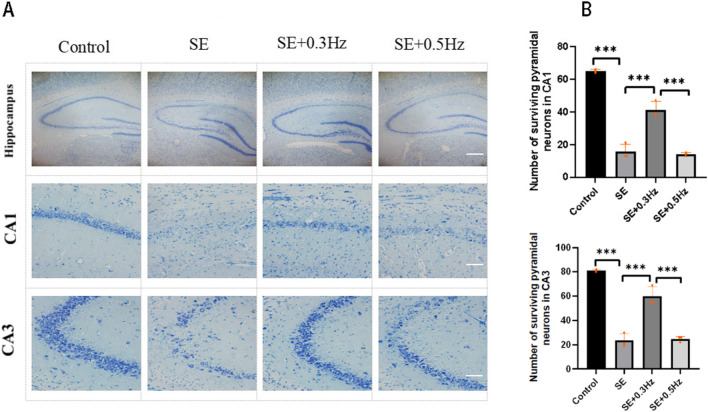
Low-frequency repetitive transcranial magnetic stimulation (rTMS) refers to the stimulation of the brain using repetitive magnetic field pulses at a low frequency (≤ 1 Hz) to reduce seizures. Currently, the mechanism is not well understood. Male Sprague-Dawley rats underwent pilocarpine-induced status epilepticus (SE) and were then stimulated with low-frequency rTMS. An epilepsy cell model was then established by incubating rat hippocampal neurons with Mg2+-free extracellular fluids. The effects of the low-frequency rTMS on epileptogenesis and hippocampal neuron injury were evaluated using a video electroencephalogram (vEEG) and Nissl staining, and the expression of AMPAR GluA1 and STIM in the hippocampus and hippocampal neurons was assessed using western blot and immunofluorescence. Additionally, the intracellular Ca2+ concentration and reactive oxygen species (ROS) were measured using flow cytometry. Low-frequency rTMS attenuated spontaneous recurrent seizures in rats with epilepsy, with the SE group exhibiting a higher incidence (100%) and frequency (3.00 ± 0.18 times/day) than the SE + 0.3 (50% incidence, 0.06 ± 0.03 times/day), SE + 0.5 (0.20 ± 0.02 times/day) and SE + 1 Hz (1.02 ± 0.05 times/day) groups. Additionally, rTMS reduced the damage and apoptosis of hippocampal pyramidal neurons, increasing their numbers in the CA1 and CA3 regions. Furthermore, AMPAR GluA1 and STIM expression were upregulated in the hippocampus when using rTMS, reversing the downregulation caused by seizures. Immunofluorescence verified the increased fluorescence intensity of AMPAR GluA1 and STIM. Moreover, rTMS inhibited Ca2+ overload and ROS in epileptic neuron models. Low-frequency rTMS may exert neuroprotective effects through the AMPAR GluA1-STIM-Ca2+ pathway.
期刊介绍:
Molecular Neurobiology is an exciting journal for neuroscientists needing to stay in close touch with progress at the forefront of molecular brain research today. It is an especially important periodical for graduate students and "postdocs," specifically designed to synthesize and critically assess research trends for all neuroscientists hoping to stay active at the cutting edge of this dramatically developing area. This journal has proven to be crucial in departmental libraries, serving as essential reading for every committed neuroscientist who is striving to keep abreast of all rapid developments in a forefront field. Most recent significant advances in experimental and clinical neuroscience have been occurring at the molecular level. Until now, there has been no journal devoted to looking closely at this fragmented literature in a critical, coherent fashion. Each submission is thoroughly analyzed by scientists and clinicians internationally renowned for their special competence in the areas treated.





 京公网安备 11010802042870号
京ICP备2023020795号-1
京公网安备 11010802042870号
京ICP备2023020795号-1

 分享
分享
 求助内容:
求助内容: 应助结果提醒方式:
 扫码关注我们
