Min Zhang, Xue Zhang, Yongyue Xu, Yanhui Xiang, Bo Zhang, Zhen Xie, Qiong Wu, Chunbo Lou
{"title":"High-resolution and programmable RNA-IN and RNA-OUT genetic circuit in living mammalian cells.","authors":"Min Zhang, Xue Zhang, Yongyue Xu, Yanhui Xiang, Bo Zhang, Zhen Xie, Qiong Wu, Chunbo Lou","doi":"10.1038/s41467-024-52962-7","DOIUrl":null,"url":null,"abstract":"<p><p>RNAs and their encoded proteins intricately regulate diverse cell types and states within the human body. Dysregulated RNA expressions or mutations can lead to various diseased cell states, including tumorigenesis. Detecting and manipulating these endogenous RNAs offers significant promise for restoring healthy cell states and targeting tumors both in research and clinical contexts. This study presents an RNA-IN and RNA-OUT genetic circuit capable dynamically sensing and manipulating any RNA target in a programmable manner. The RNA-IN module employes a programmable CRISPR-associated protease (CASP) complex for RNA detection, while the RNA-OUT module utilizes an engineered protease-responsive dCas9-VPR activator. Additionally, the CASP module can detect point mutations by harnessing an uncovered dual-nucleotide synergistic switching effect within the CASP complex, resulting in the amplification of point-mutation signals from initially undetectable levels (1.5-fold) to a remarkable 94-fold. We successfully showcase the circuit's ability to rewire endogenous RNA-IN signals to activate endogenous progesterone biosynthesis pathway, dynamically monitor adipogenic differentiation of mesenchymal stem cells (MSCs) and the epithelial-to-mesenchmal trans-differentiation, as well as selective killing of tumor cells. The programmable RNA-IN and RNA-OUT circuit exhibits tremendous potential for applications in gene therapy, biosensing and design of synthetic regulatory networks.</p>","PeriodicalId":19066,"journal":{"name":"Nature Communications","volume":"15 1","pages":"8768"},"PeriodicalIF":15.7000,"publicationDate":"2024-10-10","publicationTypes":"Journal Article","fieldsOfStudy":null,"isOpenAccess":false,"openAccessPdf":"https://www.ncbi.nlm.nih.gov/pmc/articles/PMC11464720/pdf/","citationCount":"0","resultStr":null,"platform":"Semanticscholar","paperid":null,"PeriodicalName":"Nature Communications","FirstCategoryId":"103","ListUrlMain":"https://doi.org/10.1038/s41467-024-52962-7","RegionNum":1,"RegionCategory":"综合性期刊","ArticlePicture":[],"TitleCN":null,"AbstractTextCN":null,"PMCID":null,"EPubDate":"","PubModel":"","JCR":"Q1","JCRName":"MULTIDISCIPLINARY SCIENCES","Score":null,"Total":0}
引用次数: 0
Abstract
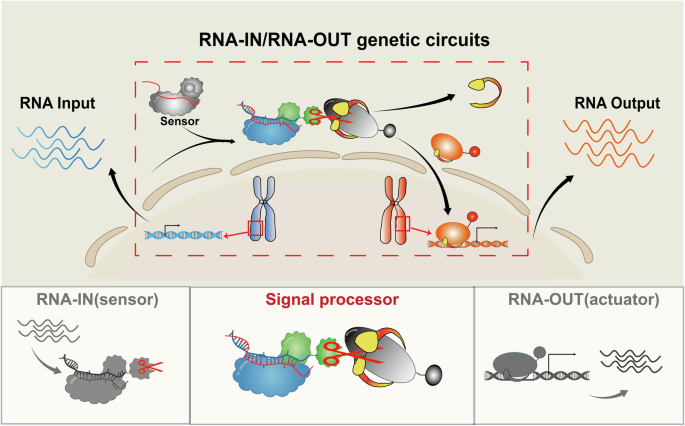
RNAs and their encoded proteins intricately regulate diverse cell types and states within the human body. Dysregulated RNA expressions or mutations can lead to various diseased cell states, including tumorigenesis. Detecting and manipulating these endogenous RNAs offers significant promise for restoring healthy cell states and targeting tumors both in research and clinical contexts. This study presents an RNA-IN and RNA-OUT genetic circuit capable dynamically sensing and manipulating any RNA target in a programmable manner. The RNA-IN module employes a programmable CRISPR-associated protease (CASP) complex for RNA detection, while the RNA-OUT module utilizes an engineered protease-responsive dCas9-VPR activator. Additionally, the CASP module can detect point mutations by harnessing an uncovered dual-nucleotide synergistic switching effect within the CASP complex, resulting in the amplification of point-mutation signals from initially undetectable levels (1.5-fold) to a remarkable 94-fold. We successfully showcase the circuit's ability to rewire endogenous RNA-IN signals to activate endogenous progesterone biosynthesis pathway, dynamically monitor adipogenic differentiation of mesenchymal stem cells (MSCs) and the epithelial-to-mesenchmal trans-differentiation, as well as selective killing of tumor cells. The programmable RNA-IN and RNA-OUT circuit exhibits tremendous potential for applications in gene therapy, biosensing and design of synthetic regulatory networks.
期刊介绍:
Nature Communications, an open-access journal, publishes high-quality research spanning all areas of the natural sciences. Papers featured in the journal showcase significant advances relevant to specialists in each respective field. With a 2-year impact factor of 16.6 (2022) and a median time of 8 days from submission to the first editorial decision, Nature Communications is committed to rapid dissemination of research findings. As a multidisciplinary journal, it welcomes contributions from biological, health, physical, chemical, Earth, social, mathematical, applied, and engineering sciences, aiming to highlight important breakthroughs within each domain.



 京公网安备 11010802042870号
京ICP备2023020795号-1
京公网安备 11010802042870号
京ICP备2023020795号-1

 分享
分享
 求助内容:
求助内容: 应助结果提醒方式:
 扫码关注我们
