Yoo Jung Choi, Sungbin Jang, Hongjun Chang, Youjin Kim, Suji Kim, Ga Yoon Kim, Juho Lee, Janghyuk Moon, Jinsoo Kim and Won-Hee Ryu
{"title":"A black zirconia cathode coating layer enabling facile charge diffusion and surface lattice stabilization for lithium-ion batteries†","authors":"Yoo Jung Choi, Sungbin Jang, Hongjun Chang, Youjin Kim, Suji Kim, Ga Yoon Kim, Juho Lee, Janghyuk Moon, Jinsoo Kim and Won-Hee Ryu","doi":"10.1039/D4TA05179C","DOIUrl":null,"url":null,"abstract":"<p >The conformal surface coating of Ni-rich layered cathode materials is essential for mitigating their interfacial and subsequent structural degradation. The zirconia (ZrO<small><sub>2</sub></small>) coating effectively enhances the surface stability of the cathode owing to its excellent chemical durability; however, the insulating electrical conductivity of ZrO<small><sub>2</sub></small> increases the electrode resistance and triggers efficiency decay. Here, we propose highly conductive oxygen-deficient black ZrO<small><sub>2−<em>x</em></sub></small> as a charge-conductive coating material. The black ZrO<small><sub>2−<em>x</em></sub></small> is uniformly coated onto the Ni-rich LiNi<small><sub>0.8</sub></small>Mn<small><sub>0.1</sub></small>Co<small><sub>0.1</sub></small>O<small><sub>2</sub></small> (NMC) surface <em>via</em> a solvent-free mechanochemical shearing process. Benefiting from the black ZrO<small><sub>2−<em>x</em></sub></small> coating layer, black ZrO<small><sub>2−<em>x</em></sub></small> coated NMC shows improved cycling characteristics and better rate capability than both bare NMC and ZrO<small><sub>2</sub></small> coated NMC. The enhanced electrochemical performance by the conformal coating of black ZrO<small><sub>2−<em>x</em></sub></small> mainly results from enhanced charge transfer, reduced gas evolution, and mitigated microstructural cracking. Density functional theory calculations confirm that the defective structure of black ZrO<small><sub>2−<em>x</em></sub></small> lowers the energy barrier for Li ion transfer, and strong hybridization between Zr in black ZrO<small><sub>2−<em>x</em></sub></small> and O in NMC mitigates oxygen evolution.</p>","PeriodicalId":82,"journal":{"name":"Journal of Materials Chemistry A","volume":" 44","pages":" 30667-30675"},"PeriodicalIF":9.5000,"publicationDate":"2024-10-10","publicationTypes":"Journal Article","fieldsOfStudy":null,"isOpenAccess":false,"openAccessPdf":"","citationCount":"0","resultStr":null,"platform":"Semanticscholar","paperid":null,"PeriodicalName":"Journal of Materials Chemistry A","FirstCategoryId":"88","ListUrlMain":"https://pubs.rsc.org/en/content/articlelanding/2024/ta/d4ta05179c","RegionNum":2,"RegionCategory":"材料科学","ArticlePicture":[],"TitleCN":null,"AbstractTextCN":null,"PMCID":null,"EPubDate":"","PubModel":"","JCR":"Q1","JCRName":"CHEMISTRY, PHYSICAL","Score":null,"Total":0}
引用次数: 0
Abstract
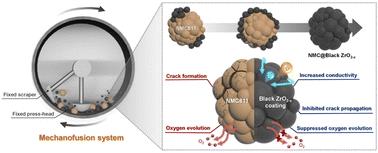
The conformal surface coating of Ni-rich layered cathode materials is essential for mitigating their interfacial and subsequent structural degradation. The zirconia (ZrO2) coating effectively enhances the surface stability of the cathode owing to its excellent chemical durability; however, the insulating electrical conductivity of ZrO2 increases the electrode resistance and triggers efficiency decay. Here, we propose highly conductive oxygen-deficient black ZrO2−x as a charge-conductive coating material. The black ZrO2−x is uniformly coated onto the Ni-rich LiNi0.8Mn0.1Co0.1O2 (NMC) surface via a solvent-free mechanochemical shearing process. Benefiting from the black ZrO2−x coating layer, black ZrO2−x coated NMC shows improved cycling characteristics and better rate capability than both bare NMC and ZrO2 coated NMC. The enhanced electrochemical performance by the conformal coating of black ZrO2−x mainly results from enhanced charge transfer, reduced gas evolution, and mitigated microstructural cracking. Density functional theory calculations confirm that the defective structure of black ZrO2−x lowers the energy barrier for Li ion transfer, and strong hybridization between Zr in black ZrO2−x and O in NMC mitigates oxygen evolution.
期刊介绍:
The Journal of Materials Chemistry A, B & C covers a wide range of high-quality studies in the field of materials chemistry, with each section focusing on specific applications of the materials studied. Journal of Materials Chemistry A emphasizes applications in energy and sustainability, including topics such as artificial photosynthesis, batteries, and fuel cells. Journal of Materials Chemistry B focuses on applications in biology and medicine, while Journal of Materials Chemistry C covers applications in optical, magnetic, and electronic devices. Example topic areas within the scope of Journal of Materials Chemistry A include catalysis, green/sustainable materials, sensors, and water treatment, among others.



 京公网安备 11010802042870号
京ICP备2023020795号-1
京公网安备 11010802042870号
京ICP备2023020795号-1

 分享
分享
 求助内容:
求助内容: 应助结果提醒方式:
 扫码关注我们
