{"title":"Wearable gold decorated direct laser writing graphene for ultra-minor strains","authors":"Elnaz Khakpour and Sadegh Sadeghzadeh","doi":"10.1039/D4CP03085K","DOIUrl":null,"url":null,"abstract":"<p >This paper reports a flexible and wearable piezoresistive strain sensor composed of the LIG/PDMS nanocomposite. LIG was first prepared on commercial Kapton tape by CO<small><sub>2</sub></small> laser scanning. The presence of carbon atoms and their high ratio compared to oxygen atoms were confirmed using XPS, XRD, and Raman tests. FESEM images also showed the presence of multilayer graphene sheets in a porous foam. The strain sensor was fabricated by transferring LIG to a PDMS elastic polymer substrate. This sensor exhibits high sensitivity (GF<small><sub>max.</sub></small> = 78.2), low hysteresis, and a wide working range (strains of 1–100%). It also has a stable and fast dynamic response and provides good reversibility and repeatability. After 10 000 cycles, the signal peak changed only 2%, indicating its long-term durability and stability. The Au-enhanced sensor exhibits more regular response patterns and higher sensitivity (GF<small><sub>max.</sub></small> = 220.3). It showed a very low detection limit of 0.1%. In addition to positive SNR numbers at 0.1% strain, a high gauge factor of 45.8 was obtained, which is very high compared to that of most reported strain sensors and shows Au/LIG/PDMS sensor's great sensitivity at deficient strains. Gold deposition was performed in two ways (gold deposition on PI film and gold deposition on LIG). Au/LIG-based sensors, with their unique characteristics, are well-suited for detecting subtle strains like those found in arterial pulses and blood pressure. This makes them strong contenders for tactile and wearable sensor applications. This LIG-based sensor holds great promise for the future development of wearable technology, such as flexible sensors integrated into clothing or even artificial skin.</p>","PeriodicalId":99,"journal":{"name":"Physical Chemistry Chemical Physics","volume":" 42","pages":" 26871-26885"},"PeriodicalIF":2.9000,"publicationDate":"2024-10-10","publicationTypes":"Journal Article","fieldsOfStudy":null,"isOpenAccess":false,"openAccessPdf":"","citationCount":"0","resultStr":null,"platform":"Semanticscholar","paperid":null,"PeriodicalName":"Physical Chemistry Chemical Physics","FirstCategoryId":"92","ListUrlMain":"https://pubs.rsc.org/en/content/articlelanding/2024/cp/d4cp03085k","RegionNum":3,"RegionCategory":"化学","ArticlePicture":[],"TitleCN":null,"AbstractTextCN":null,"PMCID":null,"EPubDate":"","PubModel":"","JCR":"Q3","JCRName":"CHEMISTRY, PHYSICAL","Score":null,"Total":0}
引用次数: 0
Abstract
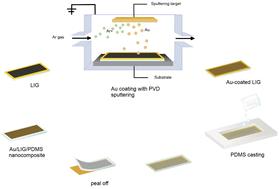
This paper reports a flexible and wearable piezoresistive strain sensor composed of the LIG/PDMS nanocomposite. LIG was first prepared on commercial Kapton tape by CO2 laser scanning. The presence of carbon atoms and their high ratio compared to oxygen atoms were confirmed using XPS, XRD, and Raman tests. FESEM images also showed the presence of multilayer graphene sheets in a porous foam. The strain sensor was fabricated by transferring LIG to a PDMS elastic polymer substrate. This sensor exhibits high sensitivity (GFmax. = 78.2), low hysteresis, and a wide working range (strains of 1–100%). It also has a stable and fast dynamic response and provides good reversibility and repeatability. After 10 000 cycles, the signal peak changed only 2%, indicating its long-term durability and stability. The Au-enhanced sensor exhibits more regular response patterns and higher sensitivity (GFmax. = 220.3). It showed a very low detection limit of 0.1%. In addition to positive SNR numbers at 0.1% strain, a high gauge factor of 45.8 was obtained, which is very high compared to that of most reported strain sensors and shows Au/LIG/PDMS sensor's great sensitivity at deficient strains. Gold deposition was performed in two ways (gold deposition on PI film and gold deposition on LIG). Au/LIG-based sensors, with their unique characteristics, are well-suited for detecting subtle strains like those found in arterial pulses and blood pressure. This makes them strong contenders for tactile and wearable sensor applications. This LIG-based sensor holds great promise for the future development of wearable technology, such as flexible sensors integrated into clothing or even artificial skin.
期刊介绍:
Physical Chemistry Chemical Physics (PCCP) is an international journal co-owned by 19 physical chemistry and physics societies from around the world. This journal publishes original, cutting-edge research in physical chemistry, chemical physics and biophysical chemistry. To be suitable for publication in PCCP, articles must include significant innovation and/or insight into physical chemistry; this is the most important criterion that reviewers and Editors will judge against when evaluating submissions.
The journal has a broad scope and welcomes contributions spanning experiment, theory, computation and data science. Topical coverage includes spectroscopy, dynamics, kinetics, statistical mechanics, thermodynamics, electrochemistry, catalysis, surface science, quantum mechanics, quantum computing and machine learning. Interdisciplinary research areas such as polymers and soft matter, materials, nanoscience, energy, surfaces/interfaces, and biophysical chemistry are welcomed if they demonstrate significant innovation and/or insight into physical chemistry. Joined experimental/theoretical studies are particularly appreciated when complementary and based on up-to-date approaches.




 京公网安备 11010802042870号
京ICP备2023020795号-1
京公网安备 11010802042870号
京ICP备2023020795号-1

 分享
分享
 求助内容:
求助内容: 应助结果提醒方式:
 扫码关注我们
