Xu Yan, Su Fu, Ying Xie, Chunlin Zhang, Xuejian Wu
{"title":"Piezo1-driven mechanotransduction as a key regulator of cartilage degradation in early osteoarthritis.","authors":"Xu Yan, Su Fu, Ying Xie, Chunlin Zhang, Xuejian Wu","doi":"10.17305/bb.2024.11156","DOIUrl":null,"url":null,"abstract":"<p><p>Osteoarthritis (OA) is a prevalent degenerative disease characterized by pain and cartilage damage in its later stages, while early OA is marked by the loss of cartilage's mechanical function. Recent studies suggest that Piezo1, a mechanotransducer, may contribute to cartilage degradation under abnormal physical stress. This study investigates the mechanism by which Piezo1 mediates the loss of cartilage's mechanical properties. Using rat chondrocytes cultured in a 3D in vitro model, we found that fluid flow-induced physical stress activates constitutively expressed Piezo1, leading to increased catabolic activity and apoptosis, which, in turn, disrupts the matrix structure. Ex vivo cartilage experiments further demonstrated that the mechanical stress-induced loss of cartilage's physical properties (approximately 10% reduction in relaxation modulus) is mediated by Piezo1 and depends on cell viability. Notably, Piezo1 agonists alone did not alter the mechanical behavior of cartilage tissue. In vivo, using an OA rat model induced by anterior cruciate ligament transection, we observed cartilage integrity degradation and loss of mechanical properties, which were partially mitigated by Piezo1 inhibition. RNA sequencing revealed significant modulation of the PI3K signaling and matrix regulation pathways. Collectively, this study demonstrates that Piezo1-mediated catabolic activity in chondrocytes is a key driver of the loss of cartilage's mechanical function during the relaxation phase.</p>","PeriodicalId":72398,"journal":{"name":"Biomolecules & biomedicine","volume":" ","pages":"905-913"},"PeriodicalIF":0.0000,"publicationDate":"2025-03-07","publicationTypes":"Journal Article","fieldsOfStudy":null,"isOpenAccess":false,"openAccessPdf":"https://www.ncbi.nlm.nih.gov/pmc/articles/PMC11959384/pdf/","citationCount":"0","resultStr":null,"platform":"Semanticscholar","paperid":null,"PeriodicalName":"Biomolecules & biomedicine","FirstCategoryId":"1085","ListUrlMain":"https://doi.org/10.17305/bb.2024.11156","RegionNum":0,"RegionCategory":null,"ArticlePicture":[],"TitleCN":null,"AbstractTextCN":null,"PMCID":null,"EPubDate":"","PubModel":"","JCR":"0","JCRName":"MEDICINE, RESEARCH & EXPERIMENTAL","Score":null,"Total":0}
引用次数: 0
Abstract
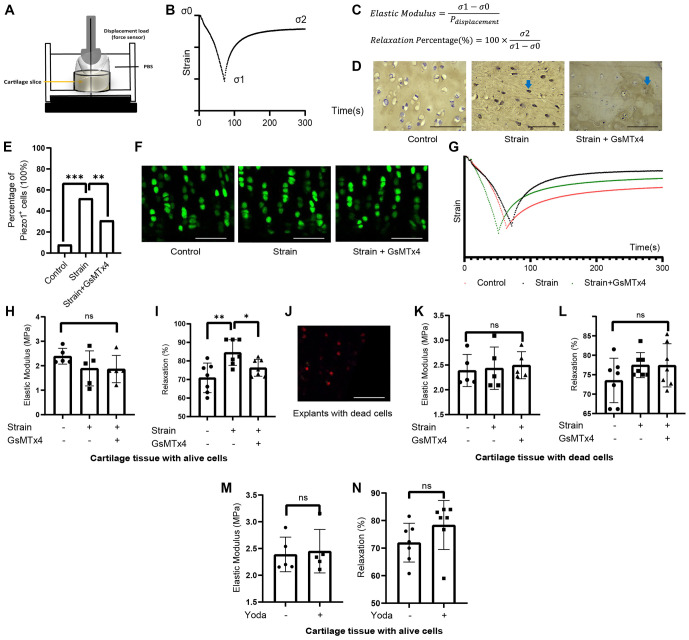
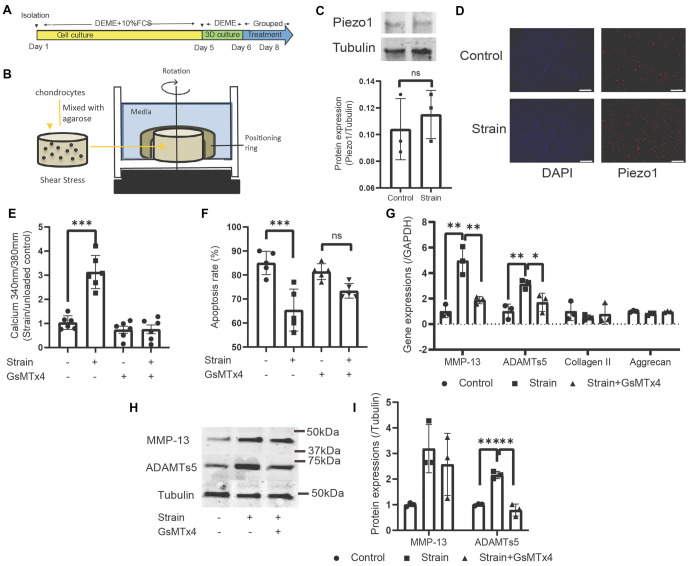
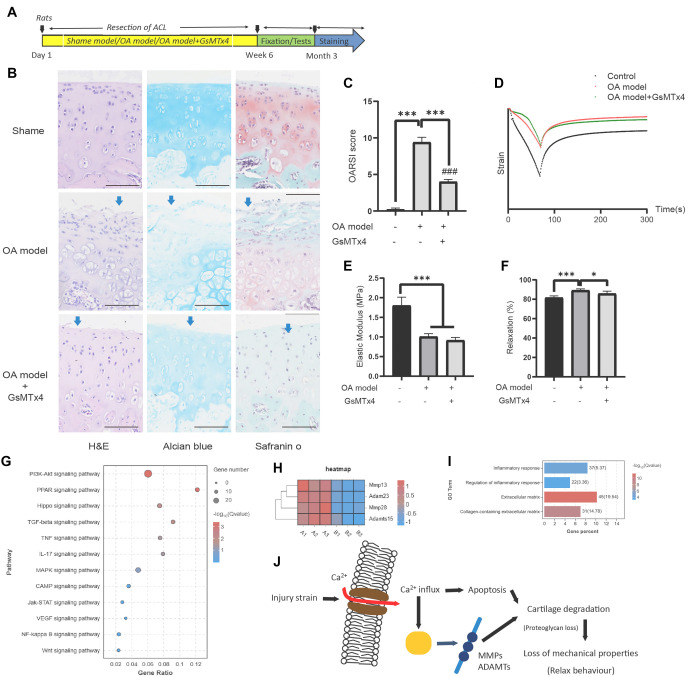
Osteoarthritis (OA) is a prevalent degenerative disease characterized by pain and cartilage damage in its later stages, while early OA is marked by the loss of cartilage's mechanical function. Recent studies suggest that Piezo1, a mechanotransducer, may contribute to cartilage degradation under abnormal physical stress. This study investigates the mechanism by which Piezo1 mediates the loss of cartilage's mechanical properties. Using rat chondrocytes cultured in a 3D in vitro model, we found that fluid flow-induced physical stress activates constitutively expressed Piezo1, leading to increased catabolic activity and apoptosis, which, in turn, disrupts the matrix structure. Ex vivo cartilage experiments further demonstrated that the mechanical stress-induced loss of cartilage's physical properties (approximately 10% reduction in relaxation modulus) is mediated by Piezo1 and depends on cell viability. Notably, Piezo1 agonists alone did not alter the mechanical behavior of cartilage tissue. In vivo, using an OA rat model induced by anterior cruciate ligament transection, we observed cartilage integrity degradation and loss of mechanical properties, which were partially mitigated by Piezo1 inhibition. RNA sequencing revealed significant modulation of the PI3K signaling and matrix regulation pathways. Collectively, this study demonstrates that Piezo1-mediated catabolic activity in chondrocytes is a key driver of the loss of cartilage's mechanical function during the relaxation phase.



 京公网安备 11010802042870号
京ICP备2023020795号-1
京公网安备 11010802042870号
京ICP备2023020795号-1

 分享
分享

 求助内容:
求助内容: 应助结果提醒方式:
 扫码关注我们
