{"title":"Expanding the armamentarium for metabolic dysfunction-associated steatohepatitis","authors":"Sven M Francque, Luisa Vonghia","doi":"10.1016/s2468-1253(24)00306-6","DOIUrl":null,"url":null,"abstract":"The treatment of metabolic dysfunction-associated steatohepatitis (MASH) has proven challenging, with many compounds failing during development for various reasons. However, with the recent accelerated approval of resmetirom by the US Food and Drug Administration for the treatment of individuals with fibrotic MASH,<span><span><sup>1</sup></span></span> there is renewed enthusiasm in the field. MASH pathophysiology is complex, and progressive disease results from an imbalance between the driving metabolic inflammatory mechanisms (many of which are extrahepatic; eg, the dysfunctional adipose tissue) and intrahepatic defence and repair mechanisms.<span><span><sup>2</sup></span></span> Many of the compounds currently considered to be the most promising mainly improve the cardiometabolic environment, subsequently (with or without additional direct intrahepatic effects) improving MASH. Many drugs targeting specific intrahepatic metabolic or fibroinflammatory mechanisms have proven unsuccessful in clinical trials, despite preclinical evidence.<span><span><sup>3</sup></span></span> Resmetirom, a liver-targeted thyroid hormone β receptor agonist, showed that a more isolated liver-directed approach, with little or no effect on the extrahepatic drivers of MASH, is also capable of not only improving MASH but inducing the regression of fibrosis.<span><span><sup>1</sup></span></span>","PeriodicalId":56028,"journal":{"name":"Lancet Gastroenterology & Hepatology","volume":"25 1","pages":""},"PeriodicalIF":38.6000,"publicationDate":"2024-10-11","publicationTypes":"Journal Article","fieldsOfStudy":null,"isOpenAccess":false,"openAccessPdf":"","citationCount":"0","resultStr":null,"platform":"Semanticscholar","paperid":null,"PeriodicalName":"Lancet Gastroenterology & Hepatology","FirstCategoryId":"3","ListUrlMain":"https://doi.org/10.1016/s2468-1253(24)00306-6","RegionNum":1,"RegionCategory":"医学","ArticlePicture":[],"TitleCN":null,"AbstractTextCN":null,"PMCID":null,"EPubDate":"","PubModel":"","JCR":"Q1","JCRName":"GASTROENTEROLOGY & HEPATOLOGY","Score":null,"Total":0}
引用次数: 0
Abstract
The treatment of metabolic dysfunction-associated steatohepatitis (MASH) has proven challenging, with many compounds failing during development for various reasons. However, with the recent accelerated approval of resmetirom by the US Food and Drug Administration for the treatment of individuals with fibrotic MASH,1 there is renewed enthusiasm in the field. MASH pathophysiology is complex, and progressive disease results from an imbalance between the driving metabolic inflammatory mechanisms (many of which are extrahepatic; eg, the dysfunctional adipose tissue) and intrahepatic defence and repair mechanisms.2 Many of the compounds currently considered to be the most promising mainly improve the cardiometabolic environment, subsequently (with or without additional direct intrahepatic effects) improving MASH. Many drugs targeting specific intrahepatic metabolic or fibroinflammatory mechanisms have proven unsuccessful in clinical trials, despite preclinical evidence.3 Resmetirom, a liver-targeted thyroid hormone β receptor agonist, showed that a more isolated liver-directed approach, with little or no effect on the extrahepatic drivers of MASH, is also capable of not only improving MASH but inducing the regression of fibrosis.1
期刊介绍:
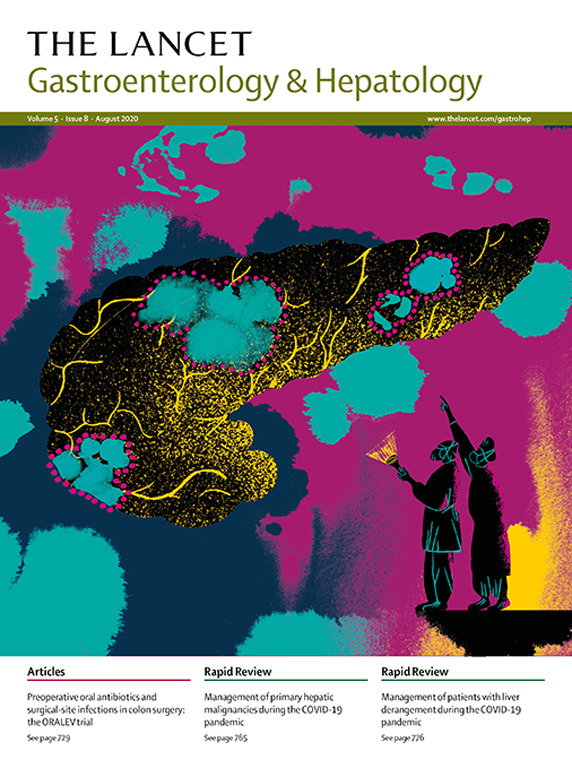
The Lancet Gastroenterology & Hepatology is an authoritative forum for key opinion leaders across medicine, government, and health systems to influence clinical practice, explore global policy, and inform constructive, positive change worldwide.
The Lancet Gastroenterology & Hepatology publishes papers that reflect the rich variety of ongoing clinical research in these fields, especially in the areas of inflammatory bowel diseases, NAFLD and NASH, functional gastrointestinal disorders, digestive cancers, and viral hepatitis.



 京公网安备 11010802042870号
京ICP备2023020795号-1
京公网安备 11010802042870号
京ICP备2023020795号-1

 分享
分享
 求助内容:
求助内容: 应助结果提醒方式:
 扫码关注我们
