Li-Bo Chen, Tong-Hui Wang, Xing-You Lang and Qing Jiang
{"title":"Lewis acid sites and flexible active centers synergistically boost efficient electrochemical ammonia synthesis†","authors":"Li-Bo Chen, Tong-Hui Wang, Xing-You Lang and Qing Jiang","doi":"10.1039/D4TA04884A","DOIUrl":null,"url":null,"abstract":"<p >Much effort has been made to develop efficient electrochemical catalysts for the nitrogen reduction reaction (NRR). However, the activity and selectivity of present catalysts are still limited in their applications. Herein, from the perspective of Lewis acid–base interactions and flexible active centers, positively charged tetrahedron transition metal (TM) clusters were anchored onto boron nitride nanotubes (BNNTs) with B-vacancies to design a series of efficient NRR catalysts, meeting the above requirements. Through Density Functional Theory (DFT) calculations, our results uncover that the Mn<small><sub>4</sub></small>/BNNT (6, 6) system exhibits optimal activity characterized by a low limiting potential of only −0.29 V and high selectivity, as confirmed by the adsorption energy difference between nitrogen molecules and hydrogen proton (−0.73 eV). Owing to the existence of electron-deficient Lewis acid sites, the adsorption and activation of N<small><sub>2</sub></small> are strongly enhanced. Simultaneously, the flexible active center destabilizes the N-containing intermediates and upgrades the hydrogenation reaction process, facilitating the desorption of NH<small><sub>3</sub></small> or its further hydrogenation to NH<small><sub>4</sub></small><small><sup>+</sup></small>. This innovative approach, employing a Lewis acid pair and a flexible active center to design efficient NRR catalysts, holds great promise for NH<small><sub>3</sub></small> synthesis under ambient conditions.</p>","PeriodicalId":82,"journal":{"name":"Journal of Materials Chemistry A","volume":" 44","pages":" 30476-30485"},"PeriodicalIF":9.5000,"publicationDate":"2024-10-11","publicationTypes":"Journal Article","fieldsOfStudy":null,"isOpenAccess":false,"openAccessPdf":"","citationCount":"0","resultStr":null,"platform":"Semanticscholar","paperid":null,"PeriodicalName":"Journal of Materials Chemistry A","FirstCategoryId":"88","ListUrlMain":"https://pubs.rsc.org/en/content/articlelanding/2024/ta/d4ta04884a","RegionNum":2,"RegionCategory":"材料科学","ArticlePicture":[],"TitleCN":null,"AbstractTextCN":null,"PMCID":null,"EPubDate":"","PubModel":"","JCR":"Q1","JCRName":"CHEMISTRY, PHYSICAL","Score":null,"Total":0}
引用次数: 0
Abstract
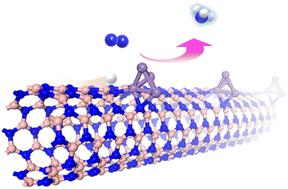
Much effort has been made to develop efficient electrochemical catalysts for the nitrogen reduction reaction (NRR). However, the activity and selectivity of present catalysts are still limited in their applications. Herein, from the perspective of Lewis acid–base interactions and flexible active centers, positively charged tetrahedron transition metal (TM) clusters were anchored onto boron nitride nanotubes (BNNTs) with B-vacancies to design a series of efficient NRR catalysts, meeting the above requirements. Through Density Functional Theory (DFT) calculations, our results uncover that the Mn4/BNNT (6, 6) system exhibits optimal activity characterized by a low limiting potential of only −0.29 V and high selectivity, as confirmed by the adsorption energy difference between nitrogen molecules and hydrogen proton (−0.73 eV). Owing to the existence of electron-deficient Lewis acid sites, the adsorption and activation of N2 are strongly enhanced. Simultaneously, the flexible active center destabilizes the N-containing intermediates and upgrades the hydrogenation reaction process, facilitating the desorption of NH3 or its further hydrogenation to NH4+. This innovative approach, employing a Lewis acid pair and a flexible active center to design efficient NRR catalysts, holds great promise for NH3 synthesis under ambient conditions.
期刊介绍:
The Journal of Materials Chemistry A, B & C covers a wide range of high-quality studies in the field of materials chemistry, with each section focusing on specific applications of the materials studied. Journal of Materials Chemistry A emphasizes applications in energy and sustainability, including topics such as artificial photosynthesis, batteries, and fuel cells. Journal of Materials Chemistry B focuses on applications in biology and medicine, while Journal of Materials Chemistry C covers applications in optical, magnetic, and electronic devices. Example topic areas within the scope of Journal of Materials Chemistry A include catalysis, green/sustainable materials, sensors, and water treatment, among others.



 京公网安备 11010802042870号
京ICP备2023020795号-1
京公网安备 11010802042870号
京ICP备2023020795号-1

 分享
分享
 求助内容:
求助内容: 应助结果提醒方式:
 扫码关注我们
