An azo-receptor immobilized mesoporous honeycomb silica framework as a solid-state chromogenic sensor for capturing ultra-trace cadmium ions from environmental/industrial samples†
Anju P. Veedu, Balasurendran Jeyakumar, Akhila Maheswari Mohan, Satheesh Kuppusamy, Pitchaiah K. Chinaraga, Manjula Muthurathinam, C. V. S. Brahmananda Rao, Sivaraman Nagarajan and Prabhakaran Deivasigamani
{"title":"An azo-receptor immobilized mesoporous honeycomb silica framework as a solid-state chromogenic sensor for capturing ultra-trace cadmium ions from environmental/industrial samples†","authors":"Anju P. Veedu, Balasurendran Jeyakumar, Akhila Maheswari Mohan, Satheesh Kuppusamy, Pitchaiah K. Chinaraga, Manjula Muthurathinam, C. V. S. Brahmananda Rao, Sivaraman Nagarajan and Prabhakaran Deivasigamani","doi":"10.1039/D4TA04574B","DOIUrl":null,"url":null,"abstract":"<p >This work focuses on a pollution-free ultra-portable solid-state opto-chemosensor for sensing noxious Cd<small><sup>2+</sup></small> in environmental, industrial and non-industrial samples. An amphiphilic heterocyclic azo-receptor, (<em>E</em>)-4-((4,5-dimethylthiazol-2-yl)diazenyl)-6-hexylbenzene-1,3-diol (DMTHBD), is meticulously interlaced with a mesoporous honeycomb structured silica monolith framework (MHSF). The aqua-compatible optical sensor (DMTHBD@MHSF) offers remarkable structural integrity, surface morphology and porosity. The MHSF and DMTHBD@MHSF materials are characterized using powder X-ray diffraction, X-ray photoelectron spectroscopy, Fourier transform infrared spectroscopy, high-resolution transmission electron microscopy, field-emission scanning electron microscopy, energy dispersive X-ray analysis, selected area electron diffraction, elemental mapping analysis, thermogravimetric/differential thermal analysis, Brunauer–Emmett–Teller (surface area) analysis and Barrett–Joyner–Halenda (pore size distribution) plots. The MHSF shows a uniform distribution of well-packed continuous mesopore channels that expedite the voluminous loading of receptor molecules on the MHSF and the analyte diffusion to the receptor chelating sites. The DMTHBD@MHSF sensor exhibits exclusive selectivity for ultra-trace Cd<small><sup>2+</sup></small>, with brilliant concentration correlative color metamorphosis in ≤50 s, using a minimal sensor dose (3 mg). A distinguishable solid-state hue transition from salmon pink to intense violet is spotted in the concentration range of 1–400 μg L<small><sup>−1</sup></small>, with a linear signal response between 0 and 150 μg L<small><sup>−1</sup></small>, with detection and quantification limits of 0.15 and 0.50 μg L<small><sup>−1</sup></small> of Cd<small><sup>2+</sup></small>, respectively. The renewable sensor demonstrates excellent stability/durability under harsh working conditions, with reliable performance even after prolonged storage. The practical applications of the proposed sensor are authenticated using diverse actual samples, with an average recovery of ≥99.43% for Cd<small><sup>2+</sup></small> and a relative standard deviation of ≤1.65%.</p>","PeriodicalId":82,"journal":{"name":"Journal of Materials Chemistry A","volume":" 44","pages":" 30567-30581"},"PeriodicalIF":9.5000,"publicationDate":"2024-10-11","publicationTypes":"Journal Article","fieldsOfStudy":null,"isOpenAccess":false,"openAccessPdf":"","citationCount":"0","resultStr":null,"platform":"Semanticscholar","paperid":null,"PeriodicalName":"Journal of Materials Chemistry A","FirstCategoryId":"88","ListUrlMain":"https://pubs.rsc.org/en/content/articlelanding/2024/ta/d4ta04574b","RegionNum":2,"RegionCategory":"材料科学","ArticlePicture":[],"TitleCN":null,"AbstractTextCN":null,"PMCID":null,"EPubDate":"","PubModel":"","JCR":"Q1","JCRName":"CHEMISTRY, PHYSICAL","Score":null,"Total":0}
引用次数: 0
Abstract
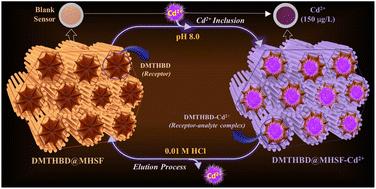
This work focuses on a pollution-free ultra-portable solid-state opto-chemosensor for sensing noxious Cd2+ in environmental, industrial and non-industrial samples. An amphiphilic heterocyclic azo-receptor, (E)-4-((4,5-dimethylthiazol-2-yl)diazenyl)-6-hexylbenzene-1,3-diol (DMTHBD), is meticulously interlaced with a mesoporous honeycomb structured silica monolith framework (MHSF). The aqua-compatible optical sensor (DMTHBD@MHSF) offers remarkable structural integrity, surface morphology and porosity. The MHSF and DMTHBD@MHSF materials are characterized using powder X-ray diffraction, X-ray photoelectron spectroscopy, Fourier transform infrared spectroscopy, high-resolution transmission electron microscopy, field-emission scanning electron microscopy, energy dispersive X-ray analysis, selected area electron diffraction, elemental mapping analysis, thermogravimetric/differential thermal analysis, Brunauer–Emmett–Teller (surface area) analysis and Barrett–Joyner–Halenda (pore size distribution) plots. The MHSF shows a uniform distribution of well-packed continuous mesopore channels that expedite the voluminous loading of receptor molecules on the MHSF and the analyte diffusion to the receptor chelating sites. The DMTHBD@MHSF sensor exhibits exclusive selectivity for ultra-trace Cd2+, with brilliant concentration correlative color metamorphosis in ≤50 s, using a minimal sensor dose (3 mg). A distinguishable solid-state hue transition from salmon pink to intense violet is spotted in the concentration range of 1–400 μg L−1, with a linear signal response between 0 and 150 μg L−1, with detection and quantification limits of 0.15 and 0.50 μg L−1 of Cd2+, respectively. The renewable sensor demonstrates excellent stability/durability under harsh working conditions, with reliable performance even after prolonged storage. The practical applications of the proposed sensor are authenticated using diverse actual samples, with an average recovery of ≥99.43% for Cd2+ and a relative standard deviation of ≤1.65%.
期刊介绍:
The Journal of Materials Chemistry A, B & C covers a wide range of high-quality studies in the field of materials chemistry, with each section focusing on specific applications of the materials studied. Journal of Materials Chemistry A emphasizes applications in energy and sustainability, including topics such as artificial photosynthesis, batteries, and fuel cells. Journal of Materials Chemistry B focuses on applications in biology and medicine, while Journal of Materials Chemistry C covers applications in optical, magnetic, and electronic devices. Example topic areas within the scope of Journal of Materials Chemistry A include catalysis, green/sustainable materials, sensors, and water treatment, among others.




 京公网安备 11010802042870号
京ICP备2023020795号-1
京公网安备 11010802042870号
京ICP备2023020795号-1

 分享
分享
 求助内容:
求助内容: 应助结果提醒方式:
 扫码关注我们
