{"title":"Exploring reaction mechanisms for CO2 reduction on carbides†","authors":"Naveed Ashraf, Atef Iqbal and Younes Abghoui","doi":"10.1039/D4TA05592F","DOIUrl":null,"url":null,"abstract":"<p >The electrocatalytic conversion of carbon dioxide (CO<small><sub>2</sub></small>) into valuable fuels offers immense promise in pursuing sustainable energy solutions. Transition metal carbides (TMCs) with their robustness and intriguing electronic properties have traditionally emerged as captivating contenders in the quest for efficient catalysts for the CO<small><sub>2</sub></small> reduction reaction (CO<small><sub>2</sub></small>RR). The presence of carbon atoms in TMC structures unlocks a unique reaction mechanism for the CO<small><sub>2</sub></small>RR, namely the Mars–van Krevelen (MVK) mechanism, facilitating CO<small><sub>2</sub></small> capture and more efficient conversion to high-value-added chemicals. This work is the first report on the use of TMCs for the CO<small><sub>2</sub></small>RR where comprehensive reaction pathways for different product formations are investigated. This theoretical study delves into the electronic intricacies of TMCs, unraveling their potential to drive the transformative journey toward a greener tomorrow. Here, we analyzed 11 TMCs to explore the reactivity trends toward CO, formic acid, methane, methanediol, and methanol formation. VC is the best candidate explored to produce formic acid at 0 V onset potential. In addition, WC is the best candidate explored to produce methanol at an onset potential of −0.36 V. These results demonstrate that our studied TMCs as electrocatalysts are more promising than previously studied materials (metals and oxides) for application in the CO<small><sub>2</sub></small>RR, and thus require more attention and investigation.</p>","PeriodicalId":82,"journal":{"name":"Journal of Materials Chemistry A","volume":" 44","pages":" 30340-30350"},"PeriodicalIF":9.5000,"publicationDate":"2024-10-11","publicationTypes":"Journal Article","fieldsOfStudy":null,"isOpenAccess":false,"openAccessPdf":"","citationCount":"0","resultStr":null,"platform":"Semanticscholar","paperid":null,"PeriodicalName":"Journal of Materials Chemistry A","FirstCategoryId":"88","ListUrlMain":"https://pubs.rsc.org/en/content/articlelanding/2024/ta/d4ta05592f","RegionNum":2,"RegionCategory":"材料科学","ArticlePicture":[],"TitleCN":null,"AbstractTextCN":null,"PMCID":null,"EPubDate":"","PubModel":"","JCR":"Q1","JCRName":"CHEMISTRY, PHYSICAL","Score":null,"Total":0}
引用次数: 0
Abstract
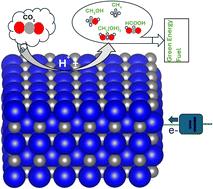
The electrocatalytic conversion of carbon dioxide (CO2) into valuable fuels offers immense promise in pursuing sustainable energy solutions. Transition metal carbides (TMCs) with their robustness and intriguing electronic properties have traditionally emerged as captivating contenders in the quest for efficient catalysts for the CO2 reduction reaction (CO2RR). The presence of carbon atoms in TMC structures unlocks a unique reaction mechanism for the CO2RR, namely the Mars–van Krevelen (MVK) mechanism, facilitating CO2 capture and more efficient conversion to high-value-added chemicals. This work is the first report on the use of TMCs for the CO2RR where comprehensive reaction pathways for different product formations are investigated. This theoretical study delves into the electronic intricacies of TMCs, unraveling their potential to drive the transformative journey toward a greener tomorrow. Here, we analyzed 11 TMCs to explore the reactivity trends toward CO, formic acid, methane, methanediol, and methanol formation. VC is the best candidate explored to produce formic acid at 0 V onset potential. In addition, WC is the best candidate explored to produce methanol at an onset potential of −0.36 V. These results demonstrate that our studied TMCs as electrocatalysts are more promising than previously studied materials (metals and oxides) for application in the CO2RR, and thus require more attention and investigation.
期刊介绍:
The Journal of Materials Chemistry A, B & C covers a wide range of high-quality studies in the field of materials chemistry, with each section focusing on specific applications of the materials studied. Journal of Materials Chemistry A emphasizes applications in energy and sustainability, including topics such as artificial photosynthesis, batteries, and fuel cells. Journal of Materials Chemistry B focuses on applications in biology and medicine, while Journal of Materials Chemistry C covers applications in optical, magnetic, and electronic devices. Example topic areas within the scope of Journal of Materials Chemistry A include catalysis, green/sustainable materials, sensors, and water treatment, among others.




 京公网安备 11010802042870号
京ICP备2023020795号-1
京公网安备 11010802042870号
京ICP备2023020795号-1

 分享
分享
 求助内容:
求助内容: 应助结果提醒方式:
 扫码关注我们
