Xiaoquan Ji, Aimin Zhang, Xuezhang Duan, Quan Wang
{"title":"Stereotactic body radiotherapy versus lenvatinib for hepatocellular carcinoma with portal vein tumor thrombosis: a propensity matching score analysis.","authors":"Xiaoquan Ji, Aimin Zhang, Xuezhang Duan, Quan Wang","doi":"10.1186/s13014-024-02527-1","DOIUrl":null,"url":null,"abstract":"<p><strong>Background and objectives: </strong>The purpose of this study was to investigate the survival benefit of Stereotactic Body Radiotherapy (SBRT) versus lenvatinib as first-line therapy in the treatment of hepatocellular carcinoma (HCC) with portal vein tumor thrombosis (PVTT).</p><p><strong>Materials and methods: </strong>147 HCC patients with PVTT were included in this retrospective study, 70 were treated with SBRT and 77 of were treated with lenvatinib. Propensity score matching (PSM) analysis was employed to balance the differences in baseline characteristics between the two groups. Overall survival (OS), progression-free survival (PFS) and objective response rate (ORR) were compared between the two groups. In addition, the safety of patients in both groups was also evaluated.</p><p><strong>Results: </strong>After PSM, 38 patients were matched in each of the two groups. The median OS was 14.5 (95% CI: 10.1-18.9) and 11.1 (95% CI: 9.3-12.9) months in the SBRT and lenvatinib groups, respectively (P = 0.014). The median PFS was 6.8 (95% CI: 5.1-8.5) and 5.0 (95% CI: 3.0-7.0) months, respectively (P = 0.010). The 1-, 2-years OS rates in the two groups were 65.8% vs. 39.5% and 31.6% vs. 10.5%, respectively. The 6-, 12-months PFS rates in the two groups were 57.9% vs. 44.7% and 28.9% vs. 10.5%, respectively. In addition, the SBRT group had a better ORR than the lenvatinib group (52.6% vs. 23.7%, P = 0.009). Patients with good response to SBRT had better survival. Cox proportional hazard model showed that SBRT was an important prognostic factor for OS and PFS. The incidence of hypertension (34.2% vs. 0%) was higher in the LEN group, however, both treatment modalities were well tolerated in the two groups of patients.</p><p><strong>Conclusion: </strong>In HCC patients with PVTT, SBRT had a better survival benefit than Lenvatinib treatment as first-line therapy.</p>","PeriodicalId":49639,"journal":{"name":"Radiation Oncology","volume":"19 1","pages":"143"},"PeriodicalIF":3.3000,"publicationDate":"2024-10-11","publicationTypes":"Journal Article","fieldsOfStudy":null,"isOpenAccess":false,"openAccessPdf":"https://www.ncbi.nlm.nih.gov/pmc/articles/PMC11468427/pdf/","citationCount":"0","resultStr":null,"platform":"Semanticscholar","paperid":null,"PeriodicalName":"Radiation Oncology","FirstCategoryId":"3","ListUrlMain":"https://doi.org/10.1186/s13014-024-02527-1","RegionNum":2,"RegionCategory":"医学","ArticlePicture":[],"TitleCN":null,"AbstractTextCN":null,"PMCID":null,"EPubDate":"","PubModel":"","JCR":"Q2","JCRName":"ONCOLOGY","Score":null,"Total":0}
引用次数: 0
Abstract
Background and objectives: The purpose of this study was to investigate the survival benefit of Stereotactic Body Radiotherapy (SBRT) versus lenvatinib as first-line therapy in the treatment of hepatocellular carcinoma (HCC) with portal vein tumor thrombosis (PVTT).
Materials and methods: 147 HCC patients with PVTT were included in this retrospective study, 70 were treated with SBRT and 77 of were treated with lenvatinib. Propensity score matching (PSM) analysis was employed to balance the differences in baseline characteristics between the two groups. Overall survival (OS), progression-free survival (PFS) and objective response rate (ORR) were compared between the two groups. In addition, the safety of patients in both groups was also evaluated.
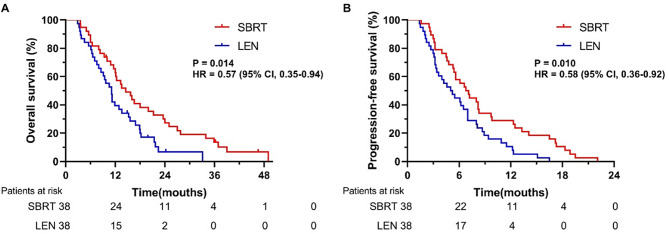
Results: After PSM, 38 patients were matched in each of the two groups. The median OS was 14.5 (95% CI: 10.1-18.9) and 11.1 (95% CI: 9.3-12.9) months in the SBRT and lenvatinib groups, respectively (P = 0.014). The median PFS was 6.8 (95% CI: 5.1-8.5) and 5.0 (95% CI: 3.0-7.0) months, respectively (P = 0.010). The 1-, 2-years OS rates in the two groups were 65.8% vs. 39.5% and 31.6% vs. 10.5%, respectively. The 6-, 12-months PFS rates in the two groups were 57.9% vs. 44.7% and 28.9% vs. 10.5%, respectively. In addition, the SBRT group had a better ORR than the lenvatinib group (52.6% vs. 23.7%, P = 0.009). Patients with good response to SBRT had better survival. Cox proportional hazard model showed that SBRT was an important prognostic factor for OS and PFS. The incidence of hypertension (34.2% vs. 0%) was higher in the LEN group, however, both treatment modalities were well tolerated in the two groups of patients.
Conclusion: In HCC patients with PVTT, SBRT had a better survival benefit than Lenvatinib treatment as first-line therapy.
Radiation OncologyONCOLOGY-RADIOLOGY, NUCLEAR MEDICINE & MEDICAL IMAGING
CiteScore
6.50
自引率
2.80%
发文量
181
审稿时长
3-6 weeks
期刊介绍:
Radiation Oncology encompasses all aspects of research that impacts on the treatment of cancer using radiation. It publishes findings in molecular and cellular radiation biology, radiation physics, radiation technology, and clinical oncology.





 京公网安备 11010802042870号
京ICP备2023020795号-1
京公网安备 11010802042870号
京ICP备2023020795号-1

 分享
分享
 求助内容:
求助内容: 应助结果提醒方式:
 扫码关注我们
