Yaxing Liu, Wenhao Ding, Jiaxin Liu, Guizhe Zhao, Weiyin Li and Yaqing Liu
{"title":"Electrochemical synthesis of wormcast-like Pd-based polycrystalline high entropy aggregates for methanol water co-electrocatalysis†","authors":"Yaxing Liu, Wenhao Ding, Jiaxin Liu, Guizhe Zhao, Weiyin Li and Yaqing Liu","doi":"10.1039/D4TA06304J","DOIUrl":null,"url":null,"abstract":"<p >High entropy compound (HEC) nanostructures have attracted considerable attention for various electrocatalysis reactions due to their unique physicochemical features provided by the adjustable multi-elemental synergy. However, there is a lack of focus on grain boundary engineering in HEC nanomaterials for enhanced electrocatalysis. Herein, wormcast-like PdFeCoNiCu polycrystalline high-entropy nanomaterials (PdFeCoNiCu-pHENs) are synthesized by a facile two-stage potential electrodeposition method. The as-synthesized PdFeCoNiCu-pHENs wormcast-like porous nanostructure enriches grain boundary defects, which exhibit superior electroactivity toward both the hydrogen evolution reaction (HER) and methanol oxidation reaction (MOR), as well as excellent MOR-coupled hydrogen production in alkaline media. Benefiting from the electron synergistic effect of multiple elements and the full distribution of massive grain boundary defects in novel wormcast-like polycrystalline aggregation, PdFeCoNiCu-pHENs exhibited great MOR (a specific activity of 52.5 mA cm<small><sup>−2</sup></small>) and HER (an overpotential of 38.4 mV <em>versus</em> RHE at 10 mA cm<small><sup>−2</sup></small>) electroactivities and efficient MOR-assisted hydrogen generation (the required cell voltage of 1.11 V at 100 mA cm<small><sup>−2</sup></small>) ability. This study offers a new strategy to develop advantageous high-entropy electrocatalysts for efficient energy-saving hydrogen production.</p>","PeriodicalId":82,"journal":{"name":"Journal of Materials Chemistry A","volume":" 44","pages":" 30757-30767"},"PeriodicalIF":9.5000,"publicationDate":"2024-10-12","publicationTypes":"Journal Article","fieldsOfStudy":null,"isOpenAccess":false,"openAccessPdf":"","citationCount":"0","resultStr":null,"platform":"Semanticscholar","paperid":null,"PeriodicalName":"Journal of Materials Chemistry A","FirstCategoryId":"88","ListUrlMain":"https://pubs.rsc.org/en/content/articlelanding/2024/ta/d4ta06304j","RegionNum":2,"RegionCategory":"材料科学","ArticlePicture":[],"TitleCN":null,"AbstractTextCN":null,"PMCID":null,"EPubDate":"","PubModel":"","JCR":"Q1","JCRName":"CHEMISTRY, PHYSICAL","Score":null,"Total":0}
引用次数: 0
Abstract
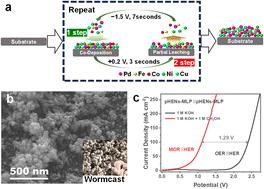
High entropy compound (HEC) nanostructures have attracted considerable attention for various electrocatalysis reactions due to their unique physicochemical features provided by the adjustable multi-elemental synergy. However, there is a lack of focus on grain boundary engineering in HEC nanomaterials for enhanced electrocatalysis. Herein, wormcast-like PdFeCoNiCu polycrystalline high-entropy nanomaterials (PdFeCoNiCu-pHENs) are synthesized by a facile two-stage potential electrodeposition method. The as-synthesized PdFeCoNiCu-pHENs wormcast-like porous nanostructure enriches grain boundary defects, which exhibit superior electroactivity toward both the hydrogen evolution reaction (HER) and methanol oxidation reaction (MOR), as well as excellent MOR-coupled hydrogen production in alkaline media. Benefiting from the electron synergistic effect of multiple elements and the full distribution of massive grain boundary defects in novel wormcast-like polycrystalline aggregation, PdFeCoNiCu-pHENs exhibited great MOR (a specific activity of 52.5 mA cm−2) and HER (an overpotential of 38.4 mV versus RHE at 10 mA cm−2) electroactivities and efficient MOR-assisted hydrogen generation (the required cell voltage of 1.11 V at 100 mA cm−2) ability. This study offers a new strategy to develop advantageous high-entropy electrocatalysts for efficient energy-saving hydrogen production.
期刊介绍:
The Journal of Materials Chemistry A, B & C covers a wide range of high-quality studies in the field of materials chemistry, with each section focusing on specific applications of the materials studied. Journal of Materials Chemistry A emphasizes applications in energy and sustainability, including topics such as artificial photosynthesis, batteries, and fuel cells. Journal of Materials Chemistry B focuses on applications in biology and medicine, while Journal of Materials Chemistry C covers applications in optical, magnetic, and electronic devices. Example topic areas within the scope of Journal of Materials Chemistry A include catalysis, green/sustainable materials, sensors, and water treatment, among others.



 京公网安备 11010802042870号
京ICP备2023020795号-1
京公网安备 11010802042870号
京ICP备2023020795号-1

 分享
分享
 求助内容:
求助内容: 应助结果提醒方式:
 扫码关注我们
