Hydroxyapatite layer evolution on silica-based (45S10P) bioactive glass-ceramic nanoparticles doped with Zn2+ ions: Augmentation of in vitro bioactivity, antibacterial activity and textural modification for bone regeneration
A. Prasad , A. Maha Lakshmi , Sathaiah Murimadugula , P. Venkateswara Rao , Kusum Kumari , Mutlu Özcan , Narayanan Madaboosi , P. Syam Prasad
{"title":"Hydroxyapatite layer evolution on silica-based (45S10P) bioactive glass-ceramic nanoparticles doped with Zn2+ ions: Augmentation of in vitro bioactivity, antibacterial activity and textural modification for bone regeneration","authors":"A. Prasad , A. Maha Lakshmi , Sathaiah Murimadugula , P. Venkateswara Rao , Kusum Kumari , Mutlu Özcan , Narayanan Madaboosi , P. Syam Prasad","doi":"10.1016/j.surfin.2024.105209","DOIUrl":null,"url":null,"abstract":"<div><div>Zinc-incorporated bioactive glasses (BG) and bioactive glass-ceramic (BGC) nanoparticles (BGC-NPs) represent highly adaptable, biodegradable, and bioactive materials in tissue engineering and regenerative medicine. This study delves into the synthesis, characterization and biomedical implications of Zn<sup>2+</sup> ions-doped 45S10P spherical BGC-NPs, employing analytical techniques and in vitro assays. The resulting (Zn<sup>2+</sup>+ 45S10P) BGC-NPs, prepared using a modified Strober's method, exhibited spherical morphology with excellent dispersion, as verified by TEM, FE-SEM, and DLS analyses. XRD, FTIR, and FESEM analysis revealed an augmented hydroxyapatite (HAp) layer formation with increasing zinc content. Zeta potential analysis showcased a shift from negative to positive values after immersion in simulated body fluid (SBF), indicating the bioactive potential of the developed BGC-NPs. Hemocompatibility assays indicated the biocompatibility of all BGC-NPs, demonstrating minimal hemolytic effects with incorporating Zn<sup>2+</sup> ions below a standard threshold (<5 % lysis). Further, the migration assay revealed the potentiality of the BGC-NPs to stimulate the migration of HeLa cells. Cell viability assays employing MG-63 osteoblast-like cells highlighted enhanced cell viability over time, underscoring their non-toxic nature and potential for tissue regeneration. Antibacterial assays displayed significant inhibitory effects against Gram-negative compared to Gram-positive bacteria, underscoring their potential for anti-infection applications. Overall, the results affirm the promising prospects of Zinc incorporation into 45S10P BGC-NPs for bone tissue regeneration applications.</div></div>","PeriodicalId":22081,"journal":{"name":"Surfaces and Interfaces","volume":"54 ","pages":"Article 105209"},"PeriodicalIF":6.3000,"publicationDate":"2024-11-01","publicationTypes":"Journal Article","fieldsOfStudy":null,"isOpenAccess":false,"openAccessPdf":"","citationCount":"0","resultStr":null,"platform":"Semanticscholar","paperid":null,"PeriodicalName":"Surfaces and Interfaces","FirstCategoryId":"88","ListUrlMain":"https://www.sciencedirect.com/science/article/pii/S2468023024013658","RegionNum":2,"RegionCategory":"材料科学","ArticlePicture":[],"TitleCN":null,"AbstractTextCN":null,"PMCID":null,"EPubDate":"2024/10/2 0:00:00","PubModel":"Epub","JCR":"Q2","JCRName":"CHEMISTRY, PHYSICAL","Score":null,"Total":0}
引用次数: 0
Abstract
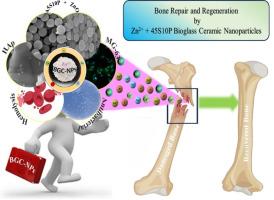
Zinc-incorporated bioactive glasses (BG) and bioactive glass-ceramic (BGC) nanoparticles (BGC-NPs) represent highly adaptable, biodegradable, and bioactive materials in tissue engineering and regenerative medicine. This study delves into the synthesis, characterization and biomedical implications of Zn2+ ions-doped 45S10P spherical BGC-NPs, employing analytical techniques and in vitro assays. The resulting (Zn2++ 45S10P) BGC-NPs, prepared using a modified Strober's method, exhibited spherical morphology with excellent dispersion, as verified by TEM, FE-SEM, and DLS analyses. XRD, FTIR, and FESEM analysis revealed an augmented hydroxyapatite (HAp) layer formation with increasing zinc content. Zeta potential analysis showcased a shift from negative to positive values after immersion in simulated body fluid (SBF), indicating the bioactive potential of the developed BGC-NPs. Hemocompatibility assays indicated the biocompatibility of all BGC-NPs, demonstrating minimal hemolytic effects with incorporating Zn2+ ions below a standard threshold (<5 % lysis). Further, the migration assay revealed the potentiality of the BGC-NPs to stimulate the migration of HeLa cells. Cell viability assays employing MG-63 osteoblast-like cells highlighted enhanced cell viability over time, underscoring their non-toxic nature and potential for tissue regeneration. Antibacterial assays displayed significant inhibitory effects against Gram-negative compared to Gram-positive bacteria, underscoring their potential for anti-infection applications. Overall, the results affirm the promising prospects of Zinc incorporation into 45S10P BGC-NPs for bone tissue regeneration applications.
期刊介绍:
The aim of the journal is to provide a respectful outlet for ''sound science'' papers in all research areas on surfaces and interfaces. We define sound science papers as papers that describe new and well-executed research, but that do not necessarily provide brand new insights or are merely a description of research results.
Surfaces and Interfaces publishes research papers in all fields of surface science which may not always find the right home on first submission to our Elsevier sister journals (Applied Surface, Surface and Coatings Technology, Thin Solid Films)



 京公网安备 11010802042870号
京ICP备2023020795号-1
京公网安备 11010802042870号
京ICP备2023020795号-1

 分享
分享
 求助内容:
求助内容: 应助结果提醒方式:
 扫码关注我们
