Tuning architectural synergy reactivity of nano-tin oxide on high storage reversible capacity retention of ammonium vanadate nanobelt array cathode for lithium-ion battery
{"title":"Tuning architectural synergy reactivity of nano-tin oxide on high storage reversible capacity retention of ammonium vanadate nanobelt array cathode for lithium-ion battery","authors":"Rozita Monsef, Masoud Salavati-Niasari","doi":"10.1016/j.mseb.2024.117743","DOIUrl":null,"url":null,"abstract":"<div><div>Enabling ambient cycling stability of vanadium-based materials is of fundamental importance in the advancement of next generation electrodes for high-performance lithium-ion batteries. Although, extending these host layered nano-architectures illustrate the effective electrochemical activity by regulating the gallery space for fast Li<sup>+</sup> storage, the reported structural integrity in terms of the cycling stability for vanadium-based cathodes is highly challenging. In present study, a series of NH<sub>4</sub>V<sub>4</sub>O<sub>10</sub>-SnO<sub>2</sub> (NHV-SnO<sub>2</sub>) nanocomposite consisting of diverse contents of SnO<sub>2</sub> (x: 5.0, 15.0 and 30.0 wt%) were synthesized through a three-step program based on sonochemical-calcination-hydrothermal treatment and employed as an advanced energetic material for lithium-ion battery cathodes. For the first time, understanding the impact of SnO<sub>2</sub> loading on electrochemical reactions of NHV-based electrodes was regarded as an effective engineering strategy to optimize structural modulation and cell lifetime without distinct capacity fading. Notably, combination of NHV and SnO<sub>2</sub> in optimum proportions not only enhances the specific surface area, but also expand buffer the volume change for lithium-ion intercalation/extraction. By this design, the assembled battery containing 15.0 wt% SnO<sub>2</sub> illustrated stable capacities of 301.77 mAh g<sup>−1</sup> (30 mA g<sup>−1</sup>) and 232.05 mAh g<sup>−1</sup> (240 mA g<sup>−1</sup>) with capacity retention values as high as 97.94 % and 97.03 % for 50 cycles, respectively. Of note, the results described here could show a vital guidance toward designing better composite-based cathode material for energy storage devices.</div></div>","PeriodicalId":18233,"journal":{"name":"Materials Science and Engineering: B","volume":"310 ","pages":"Article 117743"},"PeriodicalIF":4.6000,"publicationDate":"2024-12-01","publicationTypes":"Journal Article","fieldsOfStudy":null,"isOpenAccess":false,"openAccessPdf":"","citationCount":"0","resultStr":null,"platform":"Semanticscholar","paperid":null,"PeriodicalName":"Materials Science and Engineering: B","FirstCategoryId":"88","ListUrlMain":"https://www.sciencedirect.com/science/article/pii/S0921510724005725","RegionNum":3,"RegionCategory":"材料科学","ArticlePicture":[],"TitleCN":null,"AbstractTextCN":null,"PMCID":null,"EPubDate":"2024/10/4 0:00:00","PubModel":"Epub","JCR":"Q2","JCRName":"MATERIALS SCIENCE, MULTIDISCIPLINARY","Score":null,"Total":0}
引用次数: 0
Abstract
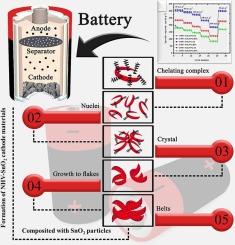
Enabling ambient cycling stability of vanadium-based materials is of fundamental importance in the advancement of next generation electrodes for high-performance lithium-ion batteries. Although, extending these host layered nano-architectures illustrate the effective electrochemical activity by regulating the gallery space for fast Li+ storage, the reported structural integrity in terms of the cycling stability for vanadium-based cathodes is highly challenging. In present study, a series of NH4V4O10-SnO2 (NHV-SnO2) nanocomposite consisting of diverse contents of SnO2 (x: 5.0, 15.0 and 30.0 wt%) were synthesized through a three-step program based on sonochemical-calcination-hydrothermal treatment and employed as an advanced energetic material for lithium-ion battery cathodes. For the first time, understanding the impact of SnO2 loading on electrochemical reactions of NHV-based electrodes was regarded as an effective engineering strategy to optimize structural modulation and cell lifetime without distinct capacity fading. Notably, combination of NHV and SnO2 in optimum proportions not only enhances the specific surface area, but also expand buffer the volume change for lithium-ion intercalation/extraction. By this design, the assembled battery containing 15.0 wt% SnO2 illustrated stable capacities of 301.77 mAh g−1 (30 mA g−1) and 232.05 mAh g−1 (240 mA g−1) with capacity retention values as high as 97.94 % and 97.03 % for 50 cycles, respectively. Of note, the results described here could show a vital guidance toward designing better composite-based cathode material for energy storage devices.
期刊介绍:
The journal provides an international medium for the publication of theoretical and experimental studies and reviews related to the electronic, electrochemical, ionic, magnetic, optical, and biosensing properties of solid state materials in bulk, thin film and particulate forms. Papers dealing with synthesis, processing, characterization, structure, physical properties and computational aspects of nano-crystalline, crystalline, amorphous and glassy forms of ceramics, semiconductors, layered insertion compounds, low-dimensional compounds and systems, fast-ion conductors, polymers and dielectrics are viewed as suitable for publication. Articles focused on nano-structured aspects of these advanced solid-state materials will also be considered suitable.




 京公网安备 11010802042870号
京ICP备2023020795号-1
京公网安备 11010802042870号
京ICP备2023020795号-1

 分享
分享
 求助内容:
求助内容: 应助结果提醒方式:
 扫码关注我们
