Effect of amorphous chrysin loading in hydrophobically modified Pluronic F68 nanomicelles on its anticancer activity, stability and oral bioavailability
Harihar Narayan, Ashok Kumar Jangid, Jiten R. Sharma, Ankita Kishore, Alok Kumar Mahor, Umesh C. S. Yadav, Hitesh Kulhari and Prem Prakash Singh
{"title":"Effect of amorphous chrysin loading in hydrophobically modified Pluronic F68 nanomicelles on its anticancer activity, stability and oral bioavailability","authors":"Harihar Narayan, Ashok Kumar Jangid, Jiten R. Sharma, Ankita Kishore, Alok Kumar Mahor, Umesh C. S. Yadav, Hitesh Kulhari and Prem Prakash Singh","doi":"10.1039/D4PM00074A","DOIUrl":null,"url":null,"abstract":"<p >Designing a potential polymer-based drug delivery carrier is of great significance for enhancing the anticancer effectiveness and oral delivery of hydrophobic phytodrugs. Chrysin (CRY) is a potential anticancer phytomolecule; however, its utilization for further applications is restricted due to its low aqueous solubility and poor bioavailability. Here, a biocompatible polymer, <em>i.e.</em> Pluronic F68 modified with stearic acid (F68–SA) was used for the fabrication of chrysin-loaded nanomicelles (CNMs). The fabricated CNMs comprised particles of 142.7 nm size with a spherical shape, amorphous nature, and a drug encapsulation efficiency of 37.06%. The incorporation of a hydrophobic segment into Pluronic F68 significantly enhanced the sustained drug release profile and stability. The CNMs effectively enhanced the anticancer effect against human lung A549 cancer cells, as confirmed by MTT, AO/EB, and cellular uptake assays. Moreover, the fabricated CNMs demonstrated a higher plasma chrysin concentration–time (<em>C</em><small><sub>max</sub></small>) profile compared to a chrysin suspension. The AUC<small><sub>0–<em>t</em></sub></small> of the CNMs was also 5.6 times higher than that of the CRY suspension. These results indicate that the bioavailability of chrysin was significantly improved due to faster and enhanced absorption after administration as a nanomicelle formulation.</p>","PeriodicalId":101141,"journal":{"name":"RSC Pharmaceutics","volume":" 4","pages":" 716-726"},"PeriodicalIF":0.0000,"publicationDate":"2024-06-26","publicationTypes":"Journal Article","fieldsOfStudy":null,"isOpenAccess":false,"openAccessPdf":"https://pubs.rsc.org/en/content/articlepdf/2024/pm/d4pm00074a?page=search","citationCount":"0","resultStr":null,"platform":"Semanticscholar","paperid":null,"PeriodicalName":"RSC Pharmaceutics","FirstCategoryId":"1085","ListUrlMain":"https://pubs.rsc.org/en/content/articlelanding/2024/pm/d4pm00074a","RegionNum":0,"RegionCategory":null,"ArticlePicture":[],"TitleCN":null,"AbstractTextCN":null,"PMCID":null,"EPubDate":"","PubModel":"","JCR":"","JCRName":"","Score":null,"Total":0}
引用次数: 0
Abstract
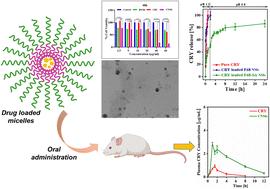
Designing a potential polymer-based drug delivery carrier is of great significance for enhancing the anticancer effectiveness and oral delivery of hydrophobic phytodrugs. Chrysin (CRY) is a potential anticancer phytomolecule; however, its utilization for further applications is restricted due to its low aqueous solubility and poor bioavailability. Here, a biocompatible polymer, i.e. Pluronic F68 modified with stearic acid (F68–SA) was used for the fabrication of chrysin-loaded nanomicelles (CNMs). The fabricated CNMs comprised particles of 142.7 nm size with a spherical shape, amorphous nature, and a drug encapsulation efficiency of 37.06%. The incorporation of a hydrophobic segment into Pluronic F68 significantly enhanced the sustained drug release profile and stability. The CNMs effectively enhanced the anticancer effect against human lung A549 cancer cells, as confirmed by MTT, AO/EB, and cellular uptake assays. Moreover, the fabricated CNMs demonstrated a higher plasma chrysin concentration–time (Cmax) profile compared to a chrysin suspension. The AUC0–t of the CNMs was also 5.6 times higher than that of the CRY suspension. These results indicate that the bioavailability of chrysin was significantly improved due to faster and enhanced absorption after administration as a nanomicelle formulation.



 京公网安备 11010802042870号
京ICP备2023020795号-1
京公网安备 11010802042870号
京ICP备2023020795号-1

 分享
分享

 求助内容:
求助内容: 应助结果提醒方式:
 扫码关注我们
